In the Uplands near Smith's Cove, Billy Gerhardt continues excavating what the team believes to be Shaft Five, built by the Truro Company in 1850. Gary Drayton metal detects the spoils and recovers two heavy iron spikes with rose-head tops that he dates to the 1700s, possibly predating the Money Pit's 1795 discovery. In the War Room, Marty Lagina and Craig Tester report results from the Eagle Canada seismic survey, in which 18,000 dynamite charges placed at six-foot intervals mapped voids and structures beneath Oak Island's eastern drumlin to depths of 300 feet. Jeremy Church identifies what he calls an "obnoxious anomaly" off the southeastern edge of the Cave-In Pit, along with a distinct linear feature running toward the Money Pit at approximately 60 feet deep, consistent with the flood tunnel. A 30-ton long-reach excavator from Delway Enterprises, delivered by Devin Matchett and equipped with a 60-foot boom, allows the team to reach the target depth. At roughly 50 feet, Jack Begley spots water rushing in from the landward side and squirting up from the bottom. The hole rapidly becomes unstable and caves in, forcing the team to backfill.
Craig Tester, Alex Lagina, and historian Charles Barkhouse travel to Saint Mary's University in Halifax, where Dr. Christa Brosseau and colleague Dr. Xiang Yang examine the two iron spikes under a scanning electron microscope capable of 200,000 times magnification. Both contain phosphorus, a signature of phosphoric iron that Brosseau explains is characteristic of pre-1840s manufacture, when older smelting methods could not extract the element from ore. The identical composition of both spikes indicates they came from the same batch. Brosseau adds that phosphorus-rich iron ore is commonly found in Britain and Northern Europe, pointing to a possible area of origin. At the Mug and Anchor pub in Mahone Bay, the team discusses the results and agrees the spikes could represent unrecorded original construction, potentially air shafts or auxiliary access points for flood tunnel builders.
On Lot 17 southwest of the Money Pit, Rick Lagina and Gary Drayton search an area where a hurricane five weeks earlier caused significant coastal erosion. Gary recovers a large chunk of lead that the team considers testing by laser ablation to determine whether it shares an origin with other lead artifacts from the island, including the 700-year-old lead cross from Smith's Cove traced to a Knights Templar region in Southern France.
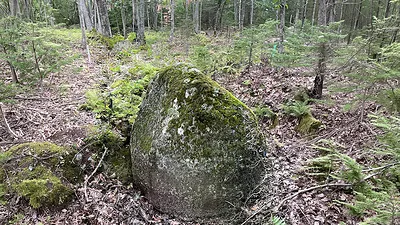
At the Eye of the Swamp, Rick, Marty, Gary, Billy, and fellow landowner Tom Nolan drain the area and begin excavating the mysterious circle of stones with embedded iron discovered earlier in the season, a site that author and researcher Corjan Mol and researcher Chris Morford believe may mark a treasure vault hidden by the Knights Templar based on encoded information in paintings by 17th-century French artist Nicholas Poussin. Blue clay packed onto a large stone at the base of the formation recalls the blue clay layer found at 40 feet in the Money Pit by Daniel McGinnis and his partners in 1804. Several large oak stumps emerge around the Eye, evidence that the area was once dry land, supporting geoscientist Dr. Ian Spooner's findings of significant human activity at the swamp in the late 1600s. Gary detects a large piece of iron attached to one trunk. Most striking are boulders as large as those forming Nolan's Cross, stacked together with smaller angular stone beneath and no clay between layers. Tom, son of the late treasure hunter Fred Nolan, notes his father never saw these stones and would have insisted they remain undisturbed. The team halts excavation and decides to bring in Dr. Spooner to determine whether the boulders were placed by human hands or are glacial erratics.