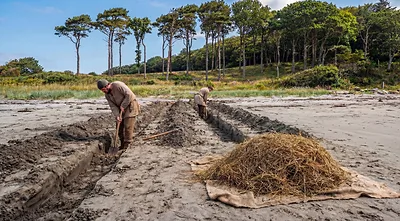
In the War Room, the team reviews carbon dating results from borehole FG-12 in the Money Pit area: a wood sample recovered at 106 feet has been dated to as early as 1626, more than 150 years before the discovery of the original treasure shaft by Daniel McGinnis in 1795. Located just 25 feet from the promising H-8 shaft that previously yielded pottery, parchment, leather bookbinding, and 17th-century human bones, FG-12 now appears to be a strong candidate for a large-scale excavation. Craig Tester agrees to contact Irving Equipment and Vanessa Lucido of ROC Equipment about bringing larger caissons to the site. At Smith's Cove, Craig, Rick Lagina, Jack Begley, and archaeologist Laird Niven examine a wooden structure near the ancient slipway, built without metal fasteners, raising the possibility it predates the known searcher era. Billy Gerhardt clears soil from the front while the team hand-digs around it, but the structure suddenly collapses during the excavation. No stone box drains are found connected to it, leading the team to conclude the flood tunnel evidence more likely lies in the Uplands area.
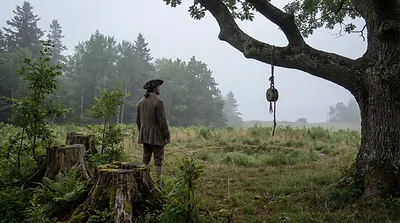
In the Uplands between Smith's Cove and the Money Pit, Marty Lagina, Alex Lagina, Gary Drayton, and Billy Gerhardt begin a new excavation targeting the flood tunnel. About three feet down, Billy hits a large square timber in situ, followed by more placed wood, cross beams, and what appears to be a shaft or tunnel structure. Scott Barlow photographs the find. Gary recovers a square-cut nail that he identifies as handmade, dating to approximately 1800 to 1850, placing the structure in the Truro Company era. The following day, Rick and Laird arrive to inspect the site and note massive notched timbers and logs similar in construction to the U-shaped structure at Smith's Cove, which was dated to 1769. The scale of the woodwork surprises the team, with some of the largest timbers found in the area outside of the U-shaped structure itself.
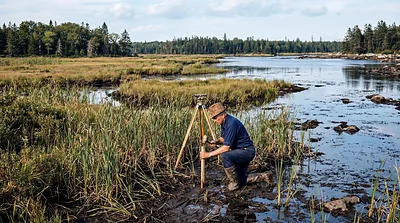
In the swamp, Rick, Gary, Jack, and Billy metal detect along the stone-paved area toward the Eye of the Swamp. From deep in a hole Billy has excavated, they recover a large iron strap or bracket showing the wood grain pattern characteristic of old hand-forged iron. Laird examines the piece and suggests it could be reinforcing strap for a large timber or possibly from a chest. Marty, Alex, and Gary then take the strap, along with two digging tools found the previous week near the Eye of the Swamp, to blacksmithing expert Carmen Legge at the Ross Farm Museum in New Ross, Nova Scotia. Carmen identifies one tool as a hand-forged pickax dating to the mid-18th century, suitable for tunneling, and the iron strap as a brace from a nine-inch diameter ship's timber dating to 1710 to 1790. He notes clear evidence that the strap was burned in a fierce fire.
At the Mug and Anchor pub in Mahone Bay, the team discusses Carmen Legge's findings. The burned ship strap, dating to the golden age of piracy and found near the 200-foot ship-shaped anomaly identified by seismic scanning, supports the theory that a vessel loaded with treasure may have been brought into the swamp, offloaded onto the stone-paved area as a working platform, and then deliberately burned and sunk to conceal it, as the late Fred Nolan long believed. The convergence of nautical artifacts, charred iron, the paved surface, and the seismic data strengthens the case that significant activity took place in the swamp during the mid-1700s.