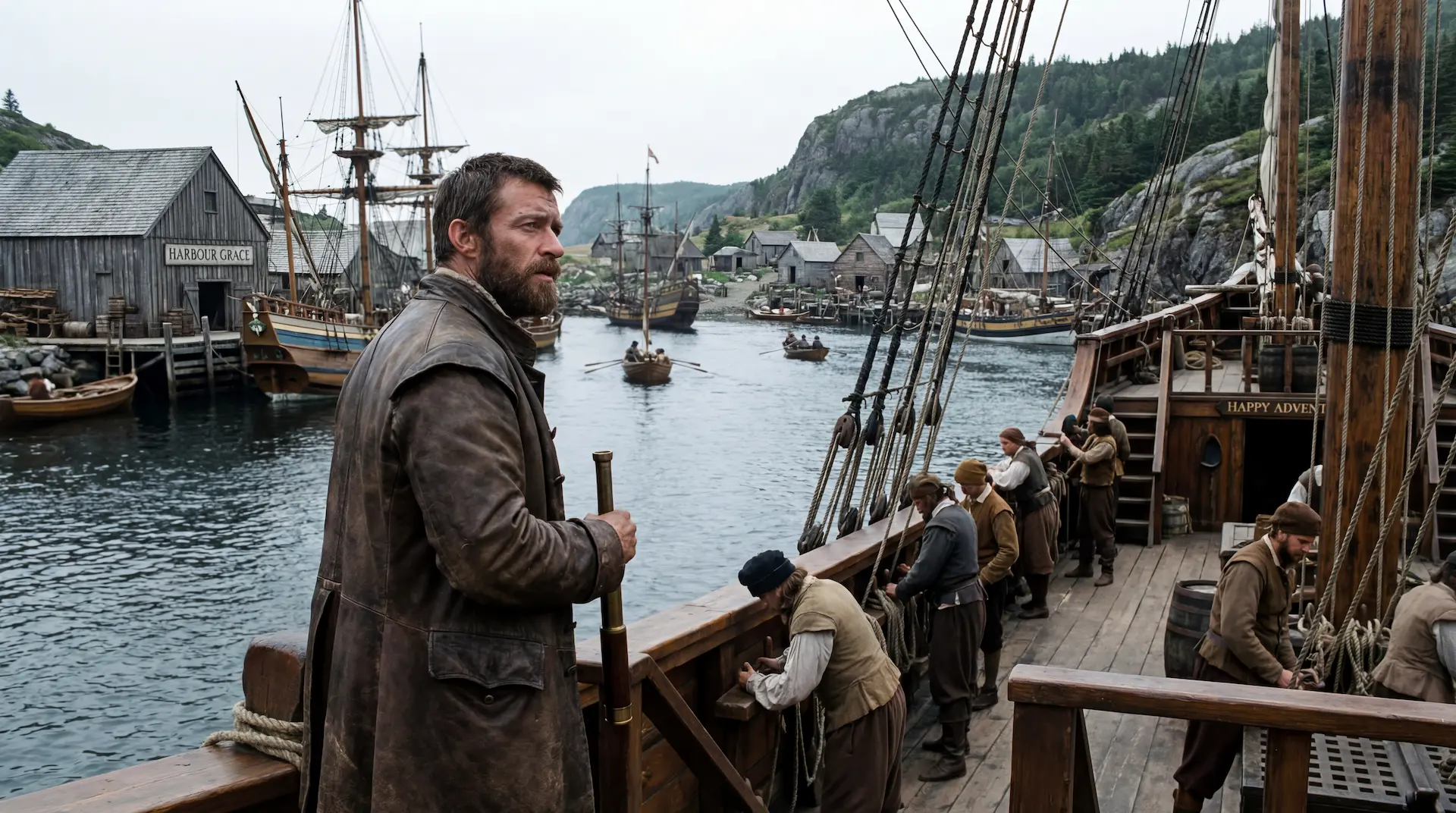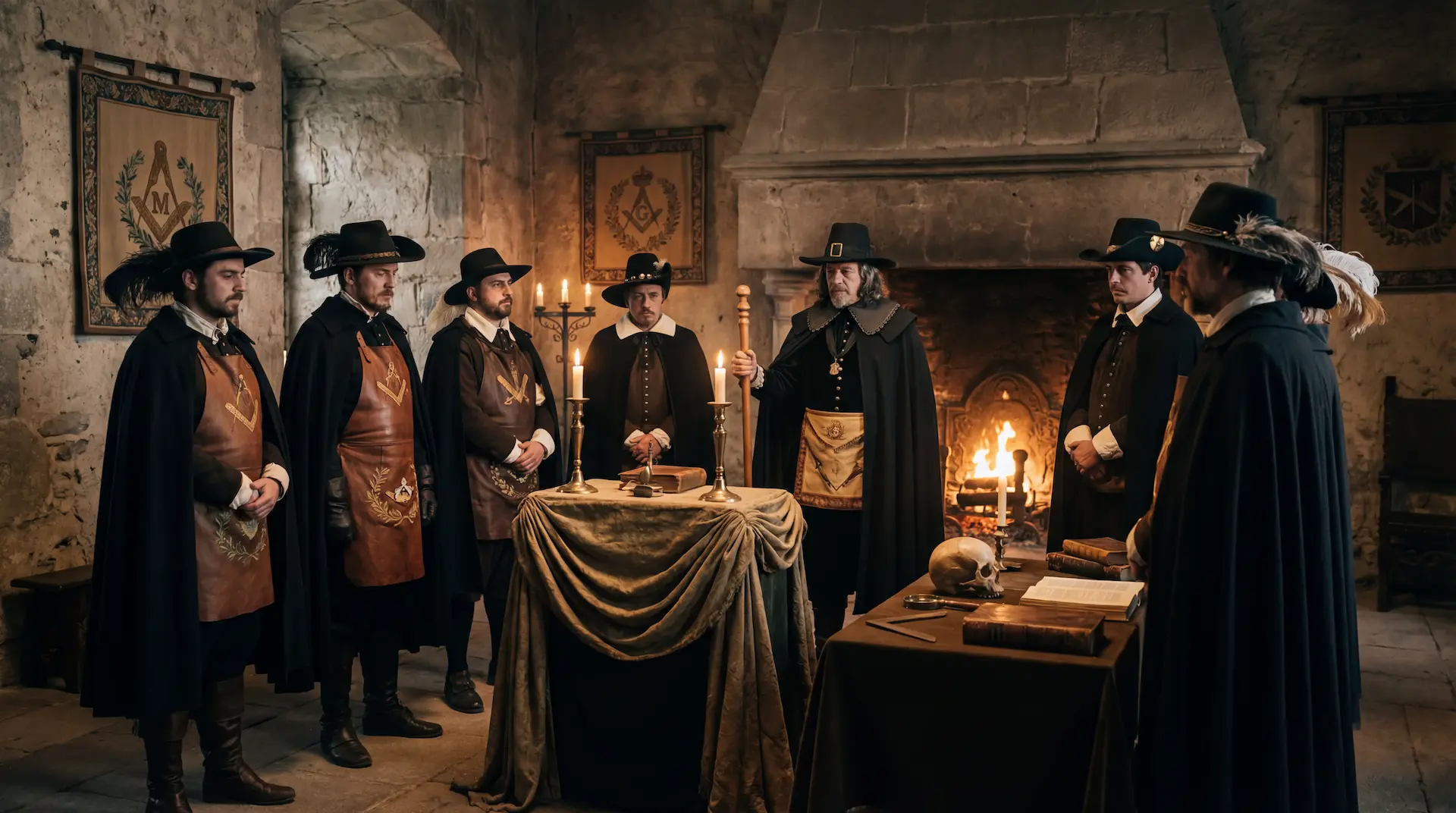
Of all the theories surrounding Oak Island, the Masonic connection may be the most deeply embedded in the story itself. Freemasonry does not simply appear at Oak Island as an external theory imposed by outsiders. It is woven into the island's documented history, into the men who surveyed it, into the symbols found upon it, and into the very structure of the legend as it has been told for over two centuries.
The question is not whether Freemasons were involved with Oak Island. The question is what they were doing there.
Freemasonry Arrives in Nova Scotia
The story of Freemasonry in Nova Scotia begins with a single man: Major Erasmus James Philipps. A military officer and member of the Nova Scotia Council, Philipps was initiated into "The First Lodge" of Boston on November 14, 1737, during a visit to settle boundary disputes between Massachusetts and Rhode Island. Henry Price, the Provincial Grand Master of Masons in North America, saw in Philipps a proper agent to carry the fraternity northward.
On March 13, 1738, the Boston Gazette announced that "Major Philipps is Appointed Provincial Grand Master over the Free and Accepted Masons, in the Province of Nova Scotia, and that a Deputation is getting ready for that purpose." Philipps returned to Annapolis Royal in June 1738, where he established the first Masonic lodge on Canadian soil. It was the fifth lodge chartered from Massachusetts and it was, in membership, virtually a military lodge, its brothers drawn almost entirely from the garrison.
Among the earliest members were names that would matter to the Oak Island story: John Easson, "made" a Mason in 1738, was a Master Artificer in the employ of the Board of Ordnance. Dr. William Skene, who had served at Annapolis Royal since 1715, was a member of the prominent Aberdeen Masonic family. The Craft took root quickly in the military and administrative elite of colonial Nova Scotia.
Philipps served as Provincial Grand Master until his death in 1760. In his final years, he developed a close personal relationship with another figure whose shadow falls directly across Oak Island: Charles Morris.
Charles Morris and the Survey of Oak Island
Charles Morris was Nova Scotia's Surveyor General for over 32 years. Born in Boston in 1711, he came to the colony as a military officer and rose to become one of its most powerful administrators, serving simultaneously as a member of the Nova Scotia Council, Justice of the Peace, and eventually Chief Justice of the Nova Scotia Supreme Court. He designed the layout of Halifax, Lunenburg, Lawrencetown, and Liverpool. He was, by any measure, the man who drew the map of colonial Nova Scotia.
Morris was also a Freemason, deeply connected to the fraternal networks that Philipps had established. And in 1762, he did something that no one has satisfactorily explained.
That year, Morris traveled 45 miles from Halifax to Oak Island and surveyed it into 32 lots of approximately four acres each, most abutting a common road and all with water frontage. No other island in Mahone Bay was ever surveyed in this manner. There were over 350 islands in the bay. Morris chose to divide this one, and only this one, with the precision and formality normally reserved for planned settlements.
Why? The standard explanation is that the Shoreham Grant, which had opened the area to settlement in 1759, required the land to be divided. But the grant covered a large area, and no comparable effort was made for the other islands. Oak Island, at roughly 140 acres, was a small and unremarkable piece of land. It had no harbour, no strategic value, no obvious reason to warrant the personal attention of the colony's Surveyor General.
Unless Morris already knew something was there.
The Morris Map and Its Symbols
In Season 11 of The Curse of Oak Island, 32nd degree Scottish Rite Mason and researcher Scott Clarke presented evidence he had found in the Canadian Archives: the original 1762 map of Mahone Bay created by Charles Morris. Clarke, a librarian, archivist, and records analyst from Toronto who has researched the Oak Island mystery for over two decades, had been examining the map's details with a Freemason's trained eye.
What Clarke found was striking. The first letter A in "Mahone Bay" on the map was written with a distinctive v-shaped crossbar, a form that differs from the other A's on the document, which are written normally. This v-bar A is a symbol found repeatedly in Templar and early Masonic stonework, appearing in churches across Portugal and Italy. It is commonly associated with the Holy Grail in Masonic tradition.
Clarke found the symbol used in three other places on the map. When these four instances were plotted on a compass circle, the lines intersected at Oak Island. Clarke's conclusion was direct: Freemasons within the colonial Nova Scotia establishment knew, as early as 1762, that something of significance was buried on the island.
Morris's superior was Lieutenant Governor Jonathan Belcher, himself a Freemason. Belcher was the grandson of Andrew Belcher, who had worked closely with Sir William Phips, the English privateer knighted for recovering Spanish treasure from the wreck of the Concepcion in the 1680s. The connections between Freemasonry, treasure, and the colonial administration of Nova Scotia run deep and interlocking.
The Secret Vault
The parallels between the Oak Island legend and the rituals of Freemasonry are so numerous that they have been noted independently by Masons and non-Masons alike. The resemblances centre on the allegorical story of the Secret Vault, a narrative used in the Royal Arch and Scottish Rite degrees that describes the discovery of a hidden underground temple built by the biblical patriarch Enoch.
In the Masonic allegory, the vault has nine levels, accessed through a succession of arches. It is discovered when three worthy sojourners notice a depression in the ground. They dig and descend through the levels, using ropes and tools. At the bottom, a stone is struck with a crowbar and found to be hollow. Behind it lies a golden plate inscribed with the secret name of God, placed on a pedestal within a chamber.
The parallels to the Oak Island story as traditionally told are remarkable. Three young men discovered a depression in the ground. They found nine distinct levels marked by oak platforms every ten feet. A stone with a cipher inscription was found at depth. Workers probed the bottom with a crowbar and struck what they believed to be a chest. The tools used by the diggers (spade, pickaxe, crowbar) correspond to the three Working Tools of the Royal Arch Mason. A stone with an iron ring was found in a pit near the main shaft, echoing the iron ring set in stone at the first level of Enoch's temple. Three gold chain links were recovered during excavation, and three oak trees reportedly formed a triangle around the pit, both motifs with direct Masonic significance.
The question, as researchers have debated for decades, is whether these parallels indicate that Freemasons built the Money Pit or that Freemasons shaped the story of the Money Pit. The answer may not be either/or.
Jotham McCully and the Masonic Lens
The most detailed early account of the Money Pit's features comes from an 1862 article written by Jotham Blanchard McCully, who had been involved in the treasure search since 1849. McCully's account introduced most of the Masonic-sounding elements into the public record: the nine levels, the inscribed stone, the systematic platforms of oak logs. An earlier account from 1861 by a writer identified as Patrick contained fewer of these elements.
Researcher Dennis J. King, himself a Freemason, demonstrated in his 2010 paper "The Oak Island Legend: The Masonic Angle" that many of the story's most evocative details were added by McCully and later writers, and that changes in the legend over time track closely with changes in Masonic ritual. The inscribed stone, for example, was not described as porphyry until the 20th century, after porphyry was introduced into the Masonic allegory of Enoch's temple.
In 1936, treasure hunter Gilbert Hedden found a stone at Joudrey's Cove on Oak Island bearing unmistakably Masonic symbols, including a point within a circle, a three-sided square (which appears in the Masonic pigpen cipher), and the letter H, a Masonic emblem for God. In 1967, a granite boulder was overturned by a bulldozer, revealing on its underside the letter G in a rectangle, one of the most public symbols in Freemasonry, denoting the Grand Geometer of the Universe. The stone was located on the eastern side of the island, the direction considered the source of light in Masonic teaching.
A metal set square was also found beneath the finger drains at Smith's Cove. The square is, of course, one half of the most recognisable symbol in Freemasonry.
Two Theories, Not One
The Masonic theory of Oak Island is really two theories that operate on different levels and are not mutually exclusive.
The first is that Freemasons were directly responsible for whatever was buried on Oak Island, and that the underground workings reflect Masonic engineering, Masonic symbolism, and Masonic purpose. This version of the theory ties naturally to the Baconian hypothesis (Francis Bacon's connections to early Rosicrucianism and Freemasonry are well documented), to the Knights Templar theory (Freemasonry claims symbolic descent from the Templars), and to the broader idea that the colonial Masonic elite of Nova Scotia was protecting or preserving something already on the island when Morris surveyed it in 1762.
The second is that Freemasonry became layered onto the Oak Island legend as the story was told and retold by men who were themselves Masons, shaping the narrative to fit the allegories and symbols they knew from their lodge rituals. This does not mean there is nothing on Oak Island. It means the story as we have received it has been filtered through a Masonic lens, and separating the physical reality from the ritual overlay requires careful work.
The truth, as Scott Clarke's research suggests, may lie in a combination of both. If Morris's 1762 map genuinely contains coded Masonic markers pointing to Oak Island, then the fraternity's involvement predates the "discovery" of the Money Pit by at least 33 years. And if Freemasons within the colonial administration knew what was on the island, the seemingly inexplicable decision to survey one small island with unusual precision begins to make a different kind of sense.
The Masonic Thread
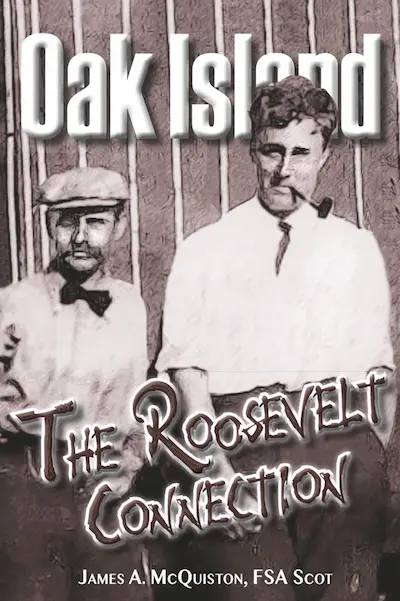
Freemasonry's relationship to Oak Island did not end in the 18th century. President Franklin D. Roosevelt, a Freemason initiated in 1911, followed the Oak Island mystery from his youth until his death in 1945, having participated in the work on the island as early as 1909. Actor John Wayne, also a Mason, was reportedly associated with one of the treasure syndicates. Charles Barkhouse, the Oak Island team's historian, is a Freemason. The fraternity's threads run through the story at every level, from the colonial surveyors to the modern-day treasure hunters.
What makes the Masonic theory compelling is not any single piece of evidence but the sheer density of connections. The symbols on the stones. The geometry of Nolan's Cross. The ritual echoes in the Money Pit legend. The fraternal networks linking Morris to Philipps, Belcher to Phips, and the colonial elite to each other through lodge memberships that were meticulously recorded. The decision to survey one island, and only one island, in the entire bay.
Freemasonry is a society built on the principle that truth is concealed within layers that reveal themselves only to those who have been properly prepared. If that principle was applied to Oak Island, the island itself becomes what a Mason would recognise as a degree: a stage on which a story unfolds, level by level, to those willing to descend.
The question that remains, after more than 230 years of searching, is whether the treasure at the bottom is literal or allegorical. The Freemasons, by design, would never tell you which.