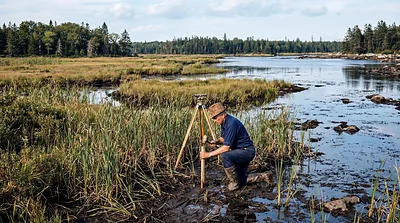
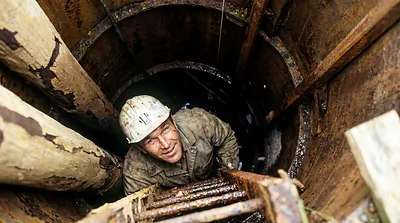
In the War Room, Rick and Marty Lagina and members of the team meet with professional surveyor Steve Guptill, who has compiled roughly a dozen historical survey plans into a single master map of the Money Pit area. By overlaying records from sources including R.V. Harris in 1958 and Fred Nolan, Guptill identifies a consensus location for Shaft Six, the searcher tunnel dug in 1861 that should connect directly to the original Money Pit. Marty asks Rick to put his finger on the map, and the team designates the new drill site as S-6. Using a 220-ton crane, the Irving Equipment crew positions a 35-ton bridge platform over the spot, and Vanessa Lucido, Danny, and John Lee begin driving a 60-inch steel caisson toward a target depth of 118 feet.
At Smith's Cove, Rick, Jack Begley, metal detection expert Gary Drayton, and archaeologist Laird Niven continue dismantling the slipway, with heavy equipment operator Billy Gerhardt removing the larger timbers so the team can search beneath the structure. From the wash plant spoils, Gary recovers what he identifies as a silver coin, possibly a Spanish one real. Its milled edge places it no older than the 1730s, but its encrusted condition and location alongside the slipway suggest considerable age. Rick also arranges for geophysicist Mike West to scan the excavated cove with an EM61 device capable of detecting metal targets up to 20 feet deep. West identifies five anomalies, the largest registering 600 millivolts near the edge of the crane pad.
Drilling at S-6 progresses through Chappell Shaft timbers, identifiable by their milled six-by-six construction. At roughly 95 feet, geologist Terry Matheson identifies a shift to undisturbed in-situ soil, a promising sign that the caisson has moved beyond ground previously worked by searchers. At 101 feet, the oscillator builds torque and then drops, the reverse of normal drilling behavior, suggesting the caisson may have cut through a hard structure. Doug Crowell, monitoring the spoils alongside Terry and Paul Troutman, begins to see timbers with up-and-down saw marks rather than circular-saw patterns, indicating the wood predates the Industrial Revolution.
As excavation pushes past 103 feet, Rick and Charles Barkhouse spot large pieces of leather in the spoils, possible remnants of the 1861 Money Pit collapse. At 110 feet, massive oak timbers emerge in vertical orientations, the first oak the team has ever recovered from underground on the island. Gary suggests the largest pieces resemble ship timbers, supporting the theory that the original Money Pit may have been constructed with wood salvaged from a large sailing vessel. Marty observes axe and adze marks confirming the timbers are hand-hewn, and the presence of two distinctly different construction styles suggests the caisson has intersected two separate structures.
At the wash table the following day, Jack, Doug, and Paul continue sorting S-6 spoils. Jack finds an iron chain link that Gary identifies as handforged and oval-shaped, consistent with considerable age, and possibly used in a pulley system during the original depositing of treasure. Doug then spots what appears to be a piece of bone with visible capillary holes. If confirmed as human, it could be related to the fragments of human bone recovered from nearby borehole H-8 the previous year, and its presence in the S-6 debris field would support the theory that material from the original Money Pit scattered across the connecting tunnel during the 1861 collapse.