About This Structure
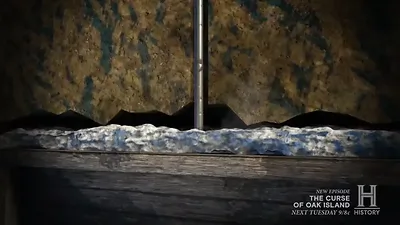
At approximately one hundred and seventy-one feet below the surface, drillers working for the Oak Island Treasure Company in 1897 struck a layer of iron so hard that three hours of drilling advanced less than a quarter of an inch. William Chappell's handwritten notes record that filings were pumped to the surface and tested with a magnet, confirming the obstruction was iron rather than hard rock. The barrier lay below eleven feet of blue puddled clay, which itself sat beneath the cement vault encountered at 153 feet.
Subsequent boreholes produced varying results at the same general depth. A fourth hole encountered iron at 166 feet but managed to pass through it, suggesting the barrier was either thinner at that point or the drill caught its edge. A fifth hole, drilled at a slight angle, bypassed the iron entirely and continued through soft material to 188 feet before reaching solid undisturbed clay. These findings indicate the iron does not form a continuous sheet across the entire shaft but sits at a specific level within the structure, covering a limited area.
The iron barrier is the deepest confirmed anomaly in the Money Pit. Its position nearly twenty feet below the cement vault indicates the original construction extended considerably further down than the suspected treasure chamber. During the 1931 Chappell expedition, when William Chappell's son Melbourne reopened the shaft to over 160 feet, an axe and a miner's pick were recovered at comparable depths, suggesting earlier workers had reached this level.
Historical Context
Oak Island Treasure Company
Where It Was Found
Found at Money Pit, 171 ft depth. Location: the original 1795 excavation shaft on Oak Island, Nova Scotia.