Gary Drayton reports to the War Room that the deep red gemstone discovered on Lot 8 has been identified by a certified gemologist in Halifax as a rhodolite garnet, not a ruby. The gemologist dates the hand-cut stone to 400-500 years old based on its pre-modern faceting technique, which predates the era of calculated refraction cuts. The silver setting contains up to 73 percent copper, consistent with centuries-old metallurgy, and the green patina from copper oxidization confirms its age. Rick and Marty Lagina, Alex Lagina, Craig Tester, Charles Barkhouse, Dave Blankenship, and Jack Begley examine the stone and agree it falls within the period of the original depositors rather than any searcher era. Marty notes the stone looks like what you would picture when opening a treasure chest and pledges to research the geographic origins of rhodolite garnet from that period.
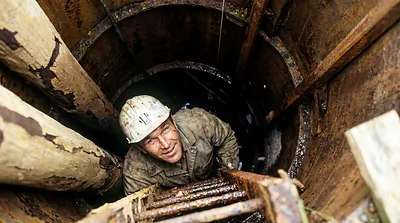
At the Money Pit, diver Mike Huntley and his crew prepare to descend the flooded DMT shaft to identify the obstruction at 77 feet. The team has pre-treated the water with flocculant to improve visibility, but the chemical reacts with clay sediment to create a gel-like slurry that causes Huntley to float upward. After exiting and repacking his suit with 60 pounds of lead weights, Huntley reaches bottom on a second attempt. In zero visibility, he conducts a tactile examination and initially reports feeling a hard, flat surface consistent with a metal plate. Doug Crowell and Jack Begley monitor the communications trailer while Craig Tester watches via video link from Traverse City.
Because Huntley has reached his dive time limit, backup diver Nick Perry descends with a pinpointing metal detector. Perry peels off his gloves for a bare-hand examination and reports feeling a smooth, rounded edge. Both divers ultimately conclude the obstruction is a boulder of hard granite rather than a steel plate. Rick acknowledges the disappointment and concedes the team must rule out steel at that depth. The following day, the Irving Equipment and ROC crew demobilizes from the Money Pit site, and Rick thanks them for a season of dedicated work while expressing his expectation that they will return.
In a final War Room session with the full team, Charles Barkhouse lays out the season's finds for review. Gary Drayton calls the lead cross the find of the season and notes experts have dated it to the 13th century or older with parallels to Templar prison carvings at Domme. Charles highlights the human bones from H-8 at 162 feet as evidence of pre-searcher burial, with carbon dating placing two individuals in the 1600s, one of Western European origin and one of Middle Eastern descent. Doug Crowell points to the parchment fragment from H-8 as corroboration of William Chappell's 1897 drilling results 120 years earlier. Archaeologist Laird Niven confirms the coins, brooch, and other surface finds suggest occupation well before the 1795 discovery of the Money Pit.
Dan Blankenship offers a measured assessment, cautioning that most of the finds are surface items that confirm human activity without proving the existence of a deeper treasure. He challenges the team to weigh whether continuing is worth the cost. Marty responds that he entered the search skeptical that anything significant happened on the island before 1790, but the cumulative evidence has changed his mind. Alex Lagina, once doubtful, agrees the preponderance of evidence demands continued investigation. Rick closes the meeting by invoking the Lagina family motto, sempre avanti, always forward, and declares that the puzzle of who, what, when, where, why, and how can only be assembled together. The team toasts to the fellowship of the dig and agrees to return for another season.