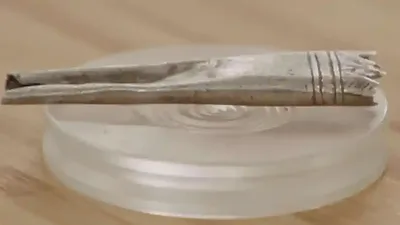
About This Artifact
A piece of decorative copper sheeting recovered on Oak Island and catalogued among the island's metalworking artifacts. Copper sheeting has been used since antiquity for a range of purposes, from decorative architectural cladding to protective hull plating on sailing vessels. The practice of sheathing ship hulls with copper became widespread in the Royal Navy from the 1760s onward, after trials proved the metal's effectiveness against shipworm and marine fouling.
On Oak Island, copper and copper-alloy artifacts have been found across multiple lots and at various depths. Carmen Legge identified copper sheathing tacks, or clouts, recovered on Lot 5 during Season 12 as fasteners used to secure copper sheeting to the underside of boats, dating them to 1720 to 1760. Emma Culligan confirmed those tacks were a pure bronze alloy containing lead and arsenic. The presence of copper sheeting and its associated fasteners on the island is consistent with maritime activity during the 18th century, and the decorative quality of this particular piece suggests it may have served an ornamental rather than utilitarian purpose, possibly from furniture, a chest, or a ceremonial object rather than a ship's hull.
Historical Context
Lagina team
Where It Was Found
Found at Lot 8. Location: Oak Island, Nova Scotia, Canada.