On August 31, 1688, Captain Francis Nicholson, lieutenant governor of the Dominion of New England, sat down in Boston to write a letter to Thomas Povey, an administrative agent for King James II. The letter, preserved in volume three of John Romeyn Brodhead's Documents Relative to the Colonial History of the State of New York, runs through the news of the summer. In the middle of it, Nicholson reports that he has eight pirates in prison. He calls them the remainder of "Yankey's and Jacob's company." He notes that one of the prize ships of that company had been taken north into Nova Scotia, to a place he records as Port-la-Bare, and burned there.
Twenty-four years later, in 1712, the same Francis Nicholson would be appointed Governor of Nova Scotia. The man who in 1688 reported pirates burning a ship somewhere on the Nova Scotia coast would, in 1712, take over the colony where it had happened. The letter is one of the earliest documentary references to pirate activity in Nova Scotia waters with a named crew and a named place. The crew was named after a Dutch sea captain who had died in the Gulf of Honduras seven months earlier. His name was Jan Willems. The English called him Yankey.
Petit-Goave
1 min
The records of Jan Willems begin in 1680, raiding the Spanish port of Rio de la Hacha on the Caribbean coast of present-day Colombia, in the company of the English privateer Thomas Paine. He was Dutch by birth, but he sailed out of Petit-Goave on the western coast of Saint-Domingue, the French port that served as the headquarters of the French flibustier fleet. The flibustiers were the French-licensed buccaneers, French in commission and increasingly multinational in crew, who raided Spanish shipping out of Petit-Goave and the older base at Tortuga. By the 1680s the French governor of Saint-Domingue was issuing commissions cheaply, and a Dutch captain who had something to lose in his home ports could find a working flag at the French quay.
In September 1681 Willems sailed from Bocas del Toro with the English privateer William Wright. The two captured a Spanish merchantman carrying sugar and tobacco off the New Granada coast. Willems took the prize as his own ship and gave his old barque to Wright, who burned his and sailed off in the captured one. They tried to sell the Spanish cargo at the Dutch port of Curacao, but the governor refused to do business with them. They wintered at Isla Aves and the Islas Roques.
Willems had no commission of his own at this point. Wikipedia's entry on him, drawing on Konstam and Marley, states the matter plainly: he captured the merchantman while sailing with Wright, "although Willems did not have a commission himself." He was at the French quay because the French would shelter him. He was raiding Spanish shipping because everyone at Petit-Goave was raiding Spanish shipping. The legal classification was, in the language of seventeenth-century law, somewhere between privateer and pirate. The Beneerson Little maritime histories call him "Dutch flibustier-in-French-service."
The Roatan Gathering
2 min
On April 7, 1683, twelve hundred buccaneers gathered at French Harbour on the island of Roatan, in the Gulf of Honduras. They came in their ships from across the Caribbean to plan a single raid. The convener was a Dutch sea rover named Nicholas "Claas" Van Hoorn, and the target he proposed was Veracruz, the largest and most important Spanish port on the Atlantic seaboard of Mexico. Veracruz had a population of more than six thousand and was considered impregnable. No buccaneer attempt had been made on it for nearly a century, since Sir Francis Drake and John Hawkins had lost most of their men trying it in 1568.
The 1683 Roatan meeting was the largest convocation of the Brethren of the Coast in their history. The Brethren were a loose multinational federation of English, French, and Dutch buccaneers, mostly Protestant by religion, mostly anti-Spanish by trade. They met irregularly across the Caribbean and rarely committed themselves to a single operation, but Van Hoorn had assembled a force large enough to make Veracruz attemptable. Among the captains present were Laurens de Graaf, the formidable Dutch flibustier who had defected from Spanish service as a gunner of the Armada de Barlovento, Michel de Grammont the French commander, Michiel Andrieszoon the Dutchman from Saint-Domingue, and Jan Willems.
It was Willems and de Graaf who took the lead. On the morning of May 17, 1683, the buccaneers approached Veracruz with two captured Spanish galleons in the vanguard, the Spanish flags still flying. The harbour watchmen, seeing what looked like friendly merchant ships at first light, raised no alarm. Willems and de Graaf landed a small force on the shore before sunrise, moved through the streets, and took out the city's defences while most of the Spanish garrison was still asleep in their barracks. By the time the main buccaneer fleet entered the harbour, Veracruz was already lost. They looted the city for three or four days, took Spanish hostages for ransom, and retreated only when the New Spain fleet appeared on the horizon. The dispute over the hostages led to a falling out, and de Graaf and Van Hoorn fought a duel. Van Hoorn survived the duel but died two weeks later of an infected wound.
Cartagena and the Princesa
1 min
Willems came out of Veracruz with his reputation made. In late November of the same year he rejoined de Graaf, Andrieszoon, and Francois Le Sage to attack Spanish shipping off Cartagena. The governor of Cartagena, Juan de Pando Estrada, commandeered two private slave ships and gave chase, and a running fight developed in the waters outside the harbour. In 1683 Governor Thomas Lynch of Jamaica, having failed to capture the French pirate Jean Hamlin with two Royal Navy ships and the retired pirate-hunter John Coxon, offered the commission to Willems. Willems refused even to look for Hamlin.
The decisive engagement came on Christmas Eve, 1684, outside Cartagena. Eight hundred Spanish defenders attacked the buccaneer blockade. Ninety Spaniards were killed against twenty buccaneer dead. The Spanish 40-gun San Francisco ran aground and the 34-gun Paz and a smaller galliot were captured. De Graaf refloated the San Francisco as his new flagship and gave Willems his old one, the Princesa. On Christmas Day the buccaneers released their Spanish prisoners ashore with a note for Governor Estrada thanking him for the Christmas presents.
In 1685 Willems sailed with de Graaf and de Grammont in the raid on Campeche. By 1686 he was operating alongside the Dutch buccaneer Jacob Evertson. The Beneerson Little histories describe Willems by this point as one of the three most powerful and famous buccaneers of the 1680s, alongside de Graaf and de Grammont. When the English captain Joseph Bannister, fleeing Jamaica in his ship Golden Fleece, tried to attach himself to a buccaneer flotilla, the French commanders of the flotilla had Willems among them and refused to surrender Bannister to a Royal Navy demand for his return.
The Crew of La Trompeuse
1 min
The crew Willems sailed with in his last years was an unusual collection. The French pirate Jean Hamlin had captured the frigate La Trompeuse in 1682 and used it to take eighteen Jamaican ships in a matter of months. When Royal Navy ships finally caught up with him at St Thomas in late 1683, they burned La Trompeuse in the harbour, but Hamlin escaped. He resurfaced in 1684 with a new ship, La Nouvelle Trompeuse, fitted out in New England, but he soon disappeared from the documentary record, possibly to Brazil. Of his original crew, almost fifty signed aboard the ships of Jacob Evertson and Jan Willems.
This is the crew Willems took to the Gulf of Honduras in 1687. On July 4, 1688, the Spanish captain Guarin was dispatched from Cuba in a half-galley with an urca to find a pirate frigate, brigantine, and canoe reported at Santa Lucia, Cuba, described in the Spanish records as commanded by "the notorious Dutch flibustier-in-French-service Jan Willems aka Captain Yanky." Guarin failed to engage them and was himself imprisoned by his own countrymen in Havana when he returned. That Spanish dispatch is the last confirmed sighting of Willems alive.
Sometime in early 1688, Willems died in the Gulf of Honduras. The cause is not recorded. Most sources agree that Evertson died with him, in the same engagement or the same passage. The Italian Wikipedia identifies the Captain who absorbed their remaining crew as George Peterson. By August 1688 Peterson was off the coast of New England with the Yankey-and-Jacob remnant in tow.
The Oak Island link, August 1688
3 min
Captain Francis Nicholson, writing from Boston on August 31, 1688, describes what happened next. Captain Peterson, with his ship and seventy men, was sighted at Rhode Island and escaped capture there. Soon after he was at Martin's Vineyard, the old name for Martha's Vineyard, where he was specifically observed trading with Captain Andrew Belcher. Two other ships were involved, and one had brought with them a prize ship taken in the West Indies. The cargo of the prize included fifty hides and about forty elephant teeth.
The trader Belcher purchased the hides and the elephant teeth. Nicholson's letter records the price at fifty-seven pounds in money, plus provisions that Belcher sent back to the pirates' "commerads." The detail that matters most for Oak Island is the carriage. The hides were not loaded onto Belcher's own vessel. They were put aboard Sir William Phips's ship. Belcher took the elephant teeth in his own ship, the Swan, then docked at London.
William Phips, in August 1688, was the most famous treasure hunter in the Atlantic world. The previous year he had returned to England from the wreck site of the Spanish galleon Nuestra Senora de la Concepcion off the coast of Hispaniola, where his expedition had recovered approximately twenty-six tons of silver. He had been knighted by King James II in June 1687 for the achievement. The Concepcion recovery is one of the foundational documents in the Oak Island treasure-theory literature, since the bullion officially returned to the English Crown was substantially less than the wreck was believed to contain, and one branch of the Oak Island argument proposes that the missing Concepcion silver was cached on the Nova Scotia coast within Phips's network. Whatever the truth of that argument, the August 1688 transaction places Phips's ship as the carrier of pirate trade goods one year after the Concepcion voyage, in a transaction where the seller was a buccaneer crew, the buyer was Phips's known associate Andrew Belcher, and the cargo had been taken from a Spanish prize. The triangle of Phips, Belcher, and the Yankey crew sits in a single primary document, in the year between the Concepcion silver return and the disappearance of the missing bullion.
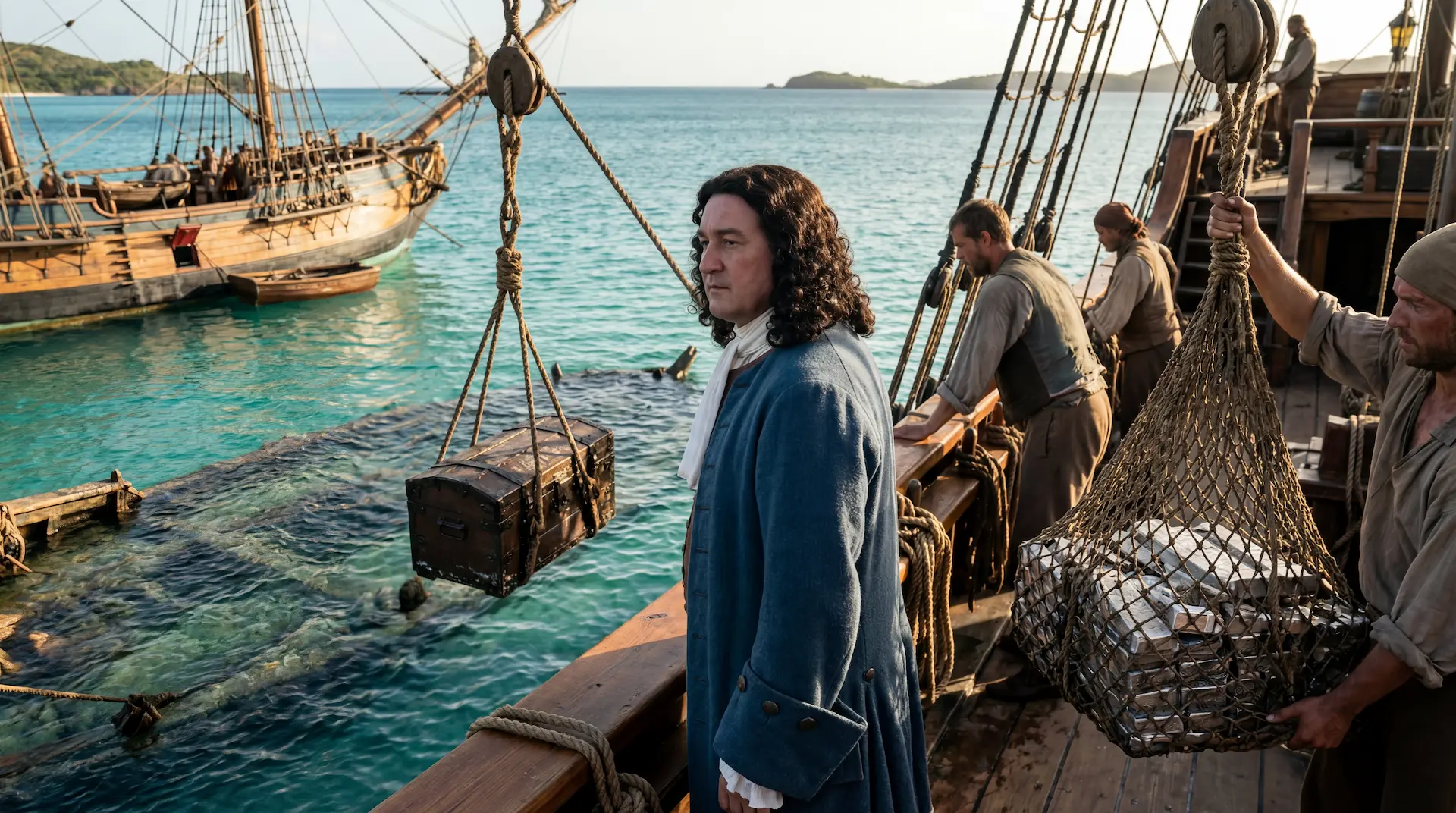 William Phips, the Treasure of the Concepción→
Andrew Belcher was also the grandfather of Jonathan Belcher Jr., the eighteenth-century Lieutenant Governor of Nova Scotia and Grand Master of the Grand Lodge of Nova Scotia, whose name recurs in the early ownership records of Oak Island. The 1688 transaction is the first documented contact between the Belcher family and a pirate crew, and the Belcher family would continue to operate on the Nova Scotia coast for the next three generations.
What happened to the prize ship is the part of Nicholson's letter that has drawn the most attention from Oak Island researchers. Captain Peterson sailed the prize north and took it, in Nicholson's spelling, to "Port-la-Bare in Nova Scotia." The pirates burned the ship there. The identification of Port-la-Bare with any modern Nova Scotia place name is not settled. Scott Clarke, who first brought the letter to wider attention in his book Oak Island Odyssey, reads it as a reference to the Mahone Bay area. Other plausible candidates include Port La Tour, Port Mouton, and the Acadian post at La Heve (Lahave), the principal French settlement on the south shore in 1688, a name that a New England writer might have rendered phonetically in any number of ways. What the letter establishes is that the Yankey-Jacob crew, having buried the bones of its captain in the Gulf of Honduras, ended its operational year burning a captured ship on the Nova Scotia coast in the late summer of 1688. The coast is the right one. The harbour cannot be pinned down.
The Yankee Question
1 min
The Dutch diminutive Janke, an affectionate form of Jan, is anglicized as Yankee. It is one of the two leading scholarly theories for the origin of the term that came to mean a New Englander, and later an American. Jan Willems was personally nicknamed "the Dutchy Yankey" by the English colonists who tracked his career through the Caribbean, and several language histories cite him by name as one of the earliest documented bearers of the nickname that would eventually attach itself to the inhabitants of the very coast where his last crew burned its last prize. The connection is etymological, not direct, but it is suggestive. The man whose crew came north to burn a ship at Port-la-Bare in 1688 may have been carrying the future name of the people who would, a century later, settle the lots on Oak Island.
The Brethren and the Nicholson Document
2 min
Nicholson's letter is significant for Oak Island for reasons that extend beyond the Belcher transaction. The Brethren of the Coast was the most successful pirate confederation of the seventeenth century. Its membership shows up repeatedly in the Oak Island theory literature: Henry Morgan, the Welsh privateer who became Lieutenant Governor of Jamaica, was its most famous figurehead. Edward Teach, who became Blackbeard, served his apprenticeship in its waters during Queen Anne's War. Bartholomew Sharp and Jean Levasseur sailed under its informal flag. Willems sat at the table of its largest single gathering, at French Harbour on April 7, 1683, in the company of the men who built and inherited its operational network.
Francis Nicholson, the man who recorded the Yankey crew's Nova Scotia activity in his August 1688 letter, came back to the same coastline as its governor in 1712. He had been a lieutenant in the earl of Plymouth's regiment at Tangier, lieutenant governor of the Dominion of New England, lieutenant governor of Virginia, governor of Maryland, governor of Virginia, and governor of Nova Scotia from 1712 to 1715. The man who first wrote about pirates landing on the Nova Scotia coast in 1688 administered that coast a quarter century later. Whatever he knew about Port-la-Bare and the burned prize ship, he carried with him into the office.
The 1688 transaction is documented. Andrew Belcher paid fifty-seven pounds to the Yankey-Jacob remnant for hides and elephant teeth at Martha's Vineyard, William Phips's ship carried the hides, and the prize ship the pirates had brought up from the Caribbean was burned in a Nova Scotia harbour the same season. The man whose name the crew carried, Jan "Yankey" Willems, had died in the Gulf of Honduras a few months before. He had been a Dutch buccaneer in French service who never held a commission of his own, who raided Veracruz and Campeche and Cartagena alongside the most powerful captains of his generation, and who attended the largest gathering of the Brethren of the Coast in its history.
The record does not extend Willems himself to Nova Scotia. He died before his crew came north. The record does not identify Port-la-Bare with Mahone Bay. The wording of Nicholson's letter is not specific enough to pin a harbour. What the record does establish is that by August of 1688, a crew bearing the name and the seal of Willems's outfit was operating on the Nova Scotia coast, doing business with Phips's ship and Boston's most pirate-friendly merchant, and burning a captured ship in a place its writer called Port-la-Bare. The pirate theory of Oak Island, in its earliest form, begins not with Captain Kidd in 1699 but with the Yankey crew in 1688, six years earlier, on a coastline whose southern shore would within a century contain the Money Pit.
Sources
4 min
Primary Documents
- Letter of Captain Francis Nicholson to Thomas Povey, dated Boston, 31 August 1688. Reports the capture of "Yankey's and Jacob's company" pirates, the transaction between Captain Peterson and Andrew Belcher (Belsharr) at Martha's Vineyard, and the burning of a prize ship at "Port-la-Bare in Nova Scotia." Published in John Romeyn Brodhead, Documents Relative to the Colonial History of the State of New York; Procured in Holland, England, and France, Volume III. Albany: Weed, Parsons and Company, 1853. Held in original at the British Public Records Office.
- Spanish Council deposition of Captain Guarin, 4 July 1688. Records Spanish dispatch from Cuba in a piragua and urca to seek a pirate frigate, brigantine, and canoe at Santa Lucia, Cuba, identified as commanded by "Dutch flibustier-in-French-service Jan Willems aka Captain Yanky." The latest confirmed contemporary sighting of Willems alive. Cited in Beneerson Little, Pirate Ships, Pirate Prey, and Pirate Hunters, drawing on Spanish Council of the Indies archives.
- Letter of Sieur de Pouancay, Governor of Saint-Domingue, 1682. Describes Laurens de Graaf as a buccaneer captain under official French commission since 1675 or 1676. Establishes the legal framework of the Petit-Goave fleet to which Willems attached himself.
- Calendar of State Papers, Colonial Series, America and West Indies, edited by J.W. Fortescue. London: Her Majesty's Stationery Office, 1899. Carries the official British dispatches on the Brethren of the Coast operations of the 1680s.
Books and Published Research
- Clarke, Scott. Oak Island Odyssey: A Masonic Quest. Halifax, 2023. Brings the 1688 Nicholson letter to wider attention through Clarke's 2009 archival work, identifying the "Bellsharr" of the letter as Captain Andrew Belcher and proposing the Port-la-Bare reference as the Mahone Bay area.
- Konstam, Angus. Pirates: An Illustrated History. New York: Skyhorse Publishing, 2007, pages 118 to 119. Standard reference on the 1683 Veracruz raid and the role of Willems and de Graaf in the landing.
- Marley, David F. Historic Cities of the Americas: An Illustrated Encyclopedia. Santa Barbara: ABC-CLIO, 2005, pages 751 to 752. Detailed entry on the Cartagena blockade of 1683 and the distribution of captured Spanish warships among the buccaneer captains.
- Marley, David F. Wars of the Americas: A Chronology of Armed Conflict in the New World, 1492 to the Present. Santa Barbara: ABC-CLIO, 1998. Cross-references the Cartagena, Veracruz, and Campeche operations.
- Rogozinski, Jan. Pirates: Brigands, Buccaneers, and Privateers in Fact, Fiction, and Legend. New York: Da Capo Press, 1996. Standard biographical dictionary.
- Gosse, Philip. The Pirates' Who's Who. New York: Burt Franklin, 1924. The classic 20th-century compendium that first standardised the spelling of "Yankey Willems" in English-language sources.
- Exquemelin, Alexander. De Americaensche Zee Roovers, originally published in Dutch in 1678, translated as The Buccaneers of America. The contemporary surgeon's account of the early Brethren of the Coast under Henry Morgan and the others. Predates Willems's career, but establishes the institutional context.
- Little, Beneerson. The Buccaneer's Realm and The Golden Age of Piracy. Cited blog posts at benersonlittle.com draw on French and Spanish primary records to position Willems among the three most powerful flibustiers of the 1680s, alongside de Graaf and de Grammont.
Reference and Tertiary Sources
- Wikipedia, Jan Willems (Dutch buccaneer). Synthesises Konstam, Marley, Gosse, Rogozinski, and Fortescue.
- Wikipedia, Jean Hamlin. Documents the transfer of approximately fifty of Hamlin's former crew to the ships of Evertson and Willems following the burning of La Trompeuse at St Thomas in 1683.
- Wikipedia, Francis Nicholson. Confirms the writer's career path from lieutenant governor of the Dominion of New England in 1688 through to Governor of Nova Scotia from 1712 to 1715.
- Italian Wikipedia, Yankey Willems. Identifies the Captain who absorbed the surviving crew as George Peterson.
- Encyclopedia Virginia, Francis Nicholson (1655-1728). University of Virginia. Detailed biographical entry on the writer of the 1688 letter.
- Golden Age of Piracy (goldenageofpiracy.org), Dutch Buccaneers section. Independent compilation of Willems's career drawing on the same Konstam, Marley, and Rogozinski material as Wikipedia.
- Trujillo Honduras Pages (trujillohonduras.com), the original online source identifying Willems's death location as the Gulf of Honduras in 1688.
Roatan and the Brethren of the Coast
- Roatan Tourism Bureau, Pirates of Roatan: Between History and Legend in the Caribbean. Describes the buccaneer activity at Roatan and the place names that survive from the Brethren era.
- PAYA: The Roatan Lifestyle Magazine, "Terror of the Caribbean," 17 February 2020. Dates the 1683 Brethren of the Coast gathering at French Harbour, Roatan to April 7, 1683 and identifies its convener as Nicholas "Claas" Van Hoorn. Most detailed published account of the meeting.
- Golden Age of Piracy, Brethren of the Coast entry. Standard reference on the institutional structure of the seventeenth-century buccaneer federation.
Etymology
- Pinstripe Alley, How the Yankees got their name, 28 May 2020. Cites Jan Willems as one of the early seventeenth-century bearers of the nickname "Yankey," sailing under the name "the Dutchy Yankey" through the Caribbean. Summarises the scholarly consensus that the term Yankee derives from the Dutch diminutive Janke.
Caution on Conflated Identity
- The blog sevenswords.uk carries an article titled Jan Willems Yankey: Dutch Privateer, Barbary Admiral dated 4 March 2026, which conflates Yankey Willems with the unrelated earlier Dutch corsair Murad Reis the Younger, born Jan Janszoon van Haarlem, who sacked Baltimore in Ireland in 1631 and died around 1641. These are two different men separated by approximately sixty years. The sevenswords article should not be used as a source for Yankey Willems.