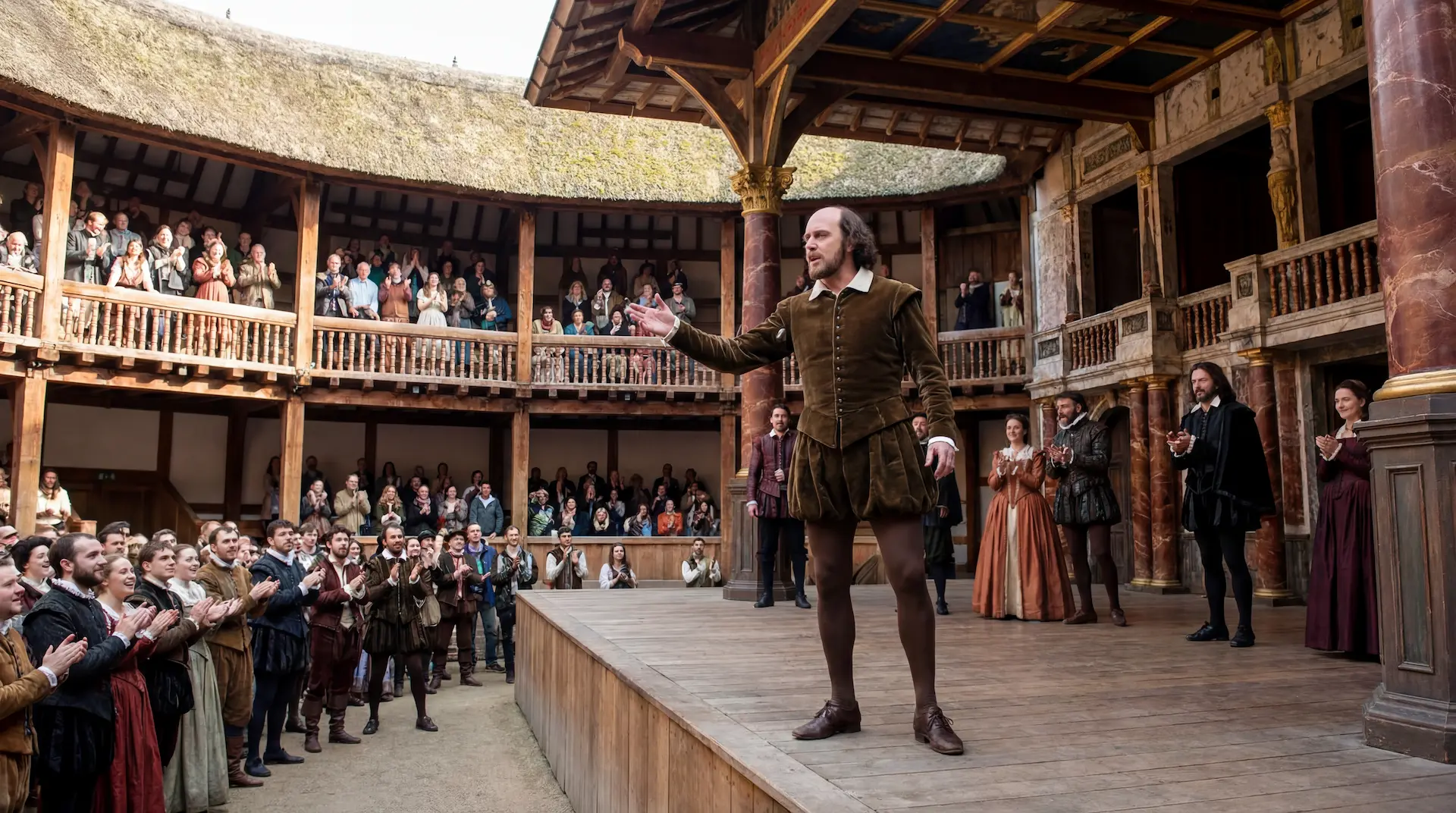
The idea that Shakespeare's works contain a hidden treasure map sounds, on first hearing, like the premise of a thriller novel. But four independent researchers, working from different source materials and using different methods, have each arrived at the same destination: Oak Island, Nova Scotia. Their work spans decades, crosses continents, and draws on steganography, gematria, Kabbalistic geometry, and close reading of 17th-century typography. The fact that drilling beneath the island has since produced parchment, leather bookbinding, and traces of mercury does not prove them right. But it makes them very difficult to ignore.
The Authorship Question
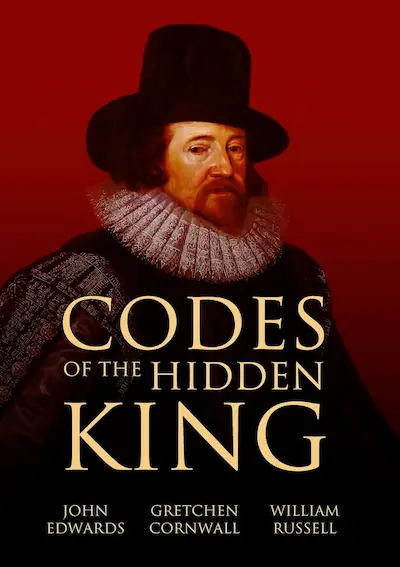
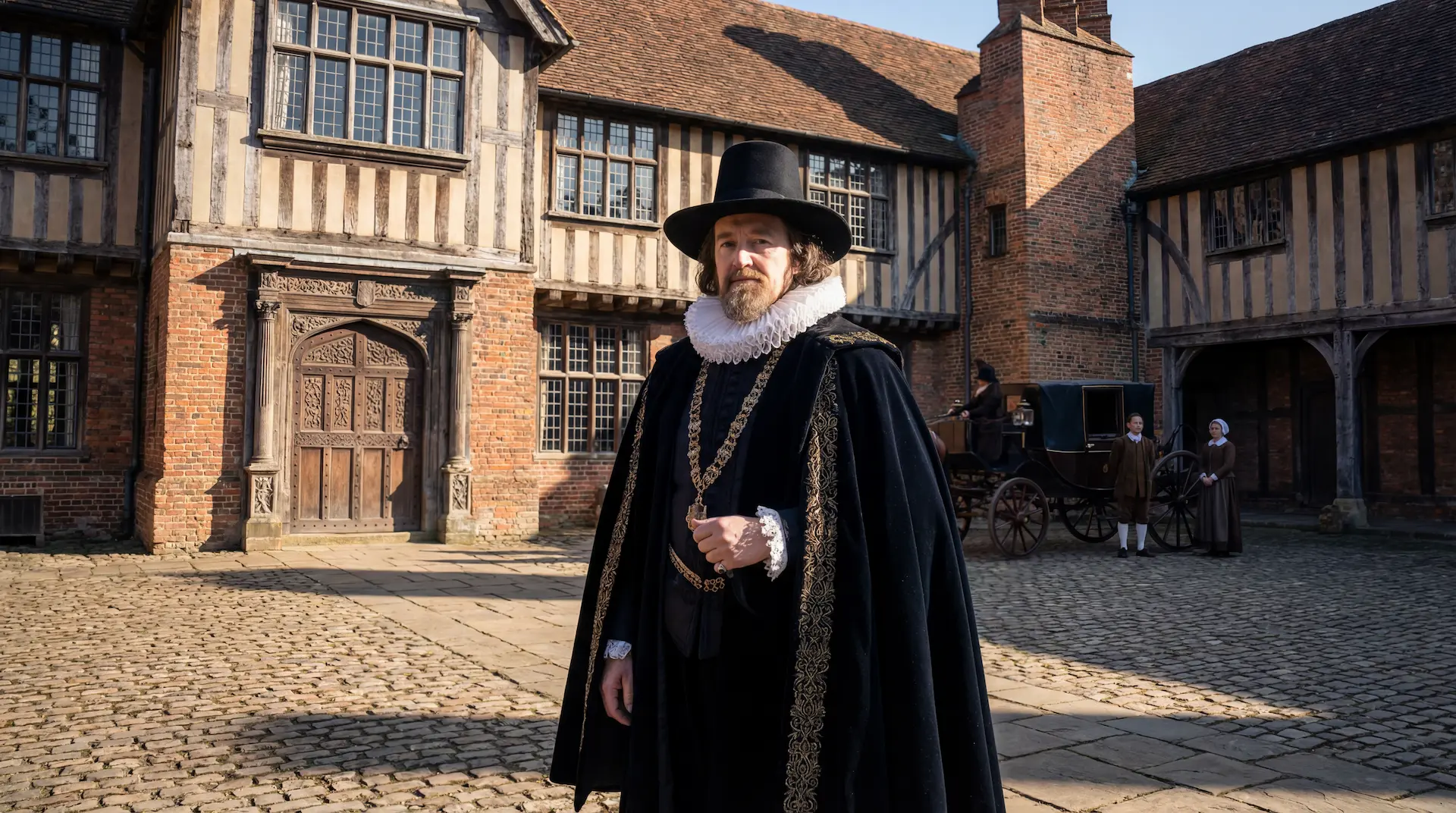
The theory that Francis Bacon wrote the works attributed to William Shakespeare was first proposed publicly by American scholar Delia Bacon (no relation) in 1857, in her book The Philosophy of the Plays of Shakspere Unfolded. Delia Bacon argued that the plays contained a hidden political philosophy too sophisticated to have come from the son of an illiterate glove-maker in Stratford-upon-Avon. She believed they were the work of a group of Elizabethan intellectuals led by Bacon and Sir Walter Raleigh, writing under cover of Shakespeare's name to avoid political persecution.
The theory gained extraordinary traction. By 1886, the Francis Bacon Society had been founded in England. By the early twentieth century, the authorship debate had drawn supporters including Mark Twain and Sigmund Freud, and spawned a cottage industry of cipher-hunters who claimed to find Bacon's name concealed in the text of the plays.
The academic establishment has never accepted the theory. The mainstream position remains that William Shakespeare of Stratford wrote his own plays. But for the researchers who followed, the authorship question was never primarily about literary credit. It was about what the ciphers pointed to. And for a growing number of them, the ciphers point to Oak Island.
 Francis Bacon's Secret Island→
Petter Amundsen and the First Folio Map
The modern connection between Shakespeare's works and Oak Island begins with a Norwegian church organist named Petter Amundsen. A Freemason and practitioner of steganography (the art of concealing messages within other content), Amundsen has spent over two decades decrypting what he believes are hidden ciphers in early editions of Shakespeare's works and those of Francis Bacon.
Amundsen's central claim is extraordinary: that Shakespeare's First Folio, published in 1623, functions as a treasure map. Through a series of decryptions involving seemingly random capitalisation, deliberate misspellings, out-of-sequence page numbering, and geometric patterns derived from the text, Amundsen identified what he calls the "Tree of Life" on Oak Island, a Kabbalistic symbol whose ten points, or sephiroth, correspond to physical locations on the island.
The decryption begins with the Folio's preliminary pages. Ben Jonson's dedicatory poem, "To the Reader," contains irregularities that Amundsen reads as coded instructions. These lead to specific pages within the Folio where further markers appear: the word "TWO" capitalised where grammar does not require it, the unusual spelling "BOWTHS," and numerical patterns that yield coordinates when processed through gematria, the ancient practice of assigning numerical values to letters.
From these markers, Amundsen extracted references to the constellations Bootes and Cygnus (the Swan, also known in Masonic tradition as "the Lighted Cross"). Working with the star Albireo at the base of Cygnus and the star Deneb at its apex, Amundsen projected celestial coordinates onto the terrestrial globe. The projection placed Deneb's position in the North Atlantic, and when corrected for the precession of the equinoxes using the date of the Folio's publication, the longitude aligned with the coast of Nova Scotia.
The latitude, Amundsen argues, was encoded separately. Using a Pythagorean 3-4-5 triangle derived from the geometry of the Folio's page layout and a reference to Euclid's Proposition I:47 (itself encoded in the Rosicrucian manifesto Fama Fraternitatis), he calculated a latitude that falls on Oak Island.
Amundsen then turned to Nolan's Cross, the formation of massive boulders discovered by surveyor Fred Nolan in the 1960s and 1970s. Five granite stones, each weighing between ten and fifteen tons and set on edge, form what Nolan believed was a simple cross. Amundsen recognised it as something else: five of the ten sephiroth on the Kabbalistic Tree of Life, specifically points 1, 2, 3, 6, and 9. The remaining five points, he proposed, had yet to be identified or searched.
Working from Mark Finnan's published measurements of the cross, Amundsen calculated the proportions. The ratio of height to width in the full Tree of Life pattern is 5:8, with a total height of 1,152 feet and a width of 720 feet. The basic unit of measurement is 144 feet, a number that equals six days measured in hours. Amundsen connected this to Bacon's New Atlantis, where the island society's governing institution is called Salomon's House, or "The College of Six Days' Work."
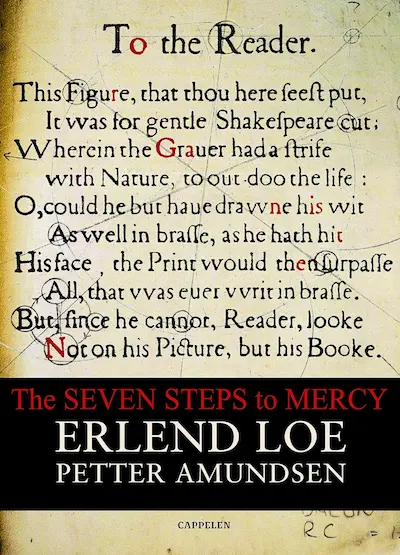
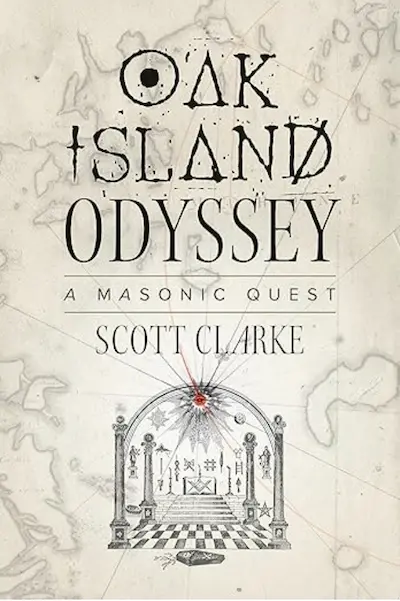
Amundsen visited Oak Island in 2003 and excavated two sites related to his theory. Rolling Stone magazine featured his work in January 2004. A four-episode Norwegian television series followed in 2009, and in 2014 he presented his findings to Rick and Marty Lagina in the first season of The Curse of Oak Island. He has since published multiple books, including Oak Island and the Treasure Map in Shakespeare and The Seven Steps to Mercy, written with Norwegian author Erlend Loe, whose Expedition Shakespeare documented the research in detail.
For Amundsen, what lies buried beneath Oak Island is nothing less than the original Shakespeare manuscripts, preserved in quicksilver, and possibly the lost menorah from the Temple of Jerusalem. He named the focal point of his Tree of Life geometry "Mercy Point."
Jake Roberts and the Holy Trinity Decryption
While Amundsen worked from the printed pages of the First Folio, another researcher approached the mystery from a different starting point entirely: a plaque on a wall in Stratford-upon-Avon.
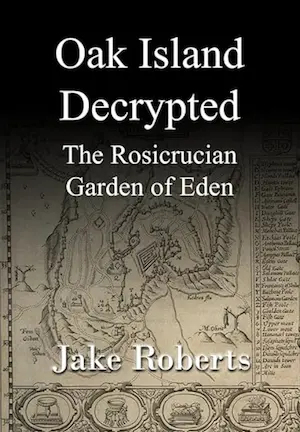
Jake Roberts is a veteran high school English teacher from Potsdam, New York, who has spent more than 30 years researching symbolism and secret societies. During the COVID-19 lockdown, friends researching for The Curse of Oak Island suggested he examine the plaque adorning Shakespeare's Funerary Monument in Holy Trinity Church. What Roberts found changed the direction of his work.
Using transposition cipher techniques, Roberts decrypted what he believes are multiple messages hidden within the monument's inscription by Francis Bacon himself. The messages, according to Roberts, confirm that Bacon wrote the works attributed to Shakespeare, identify Bacon's true parentage (claiming him as the son of Mary, Queen of Scots), and contain directions to Oak Island, Nova Scotia.
Roberts arrived at the same island as Amundsen, using a completely different source text and a different decryption method. Where Amundsen worked with steganography and celestial projection, Roberts worked with letter transposition and substitution. The convergence of their results is, at minimum, striking.
John Edwards and the Tree of Life on the Ground
If Amundsen identified the Tree of Life in the pages of Shakespeare and Roberts found directions in the walls of a church, researcher John Edwards took the theory into the field.
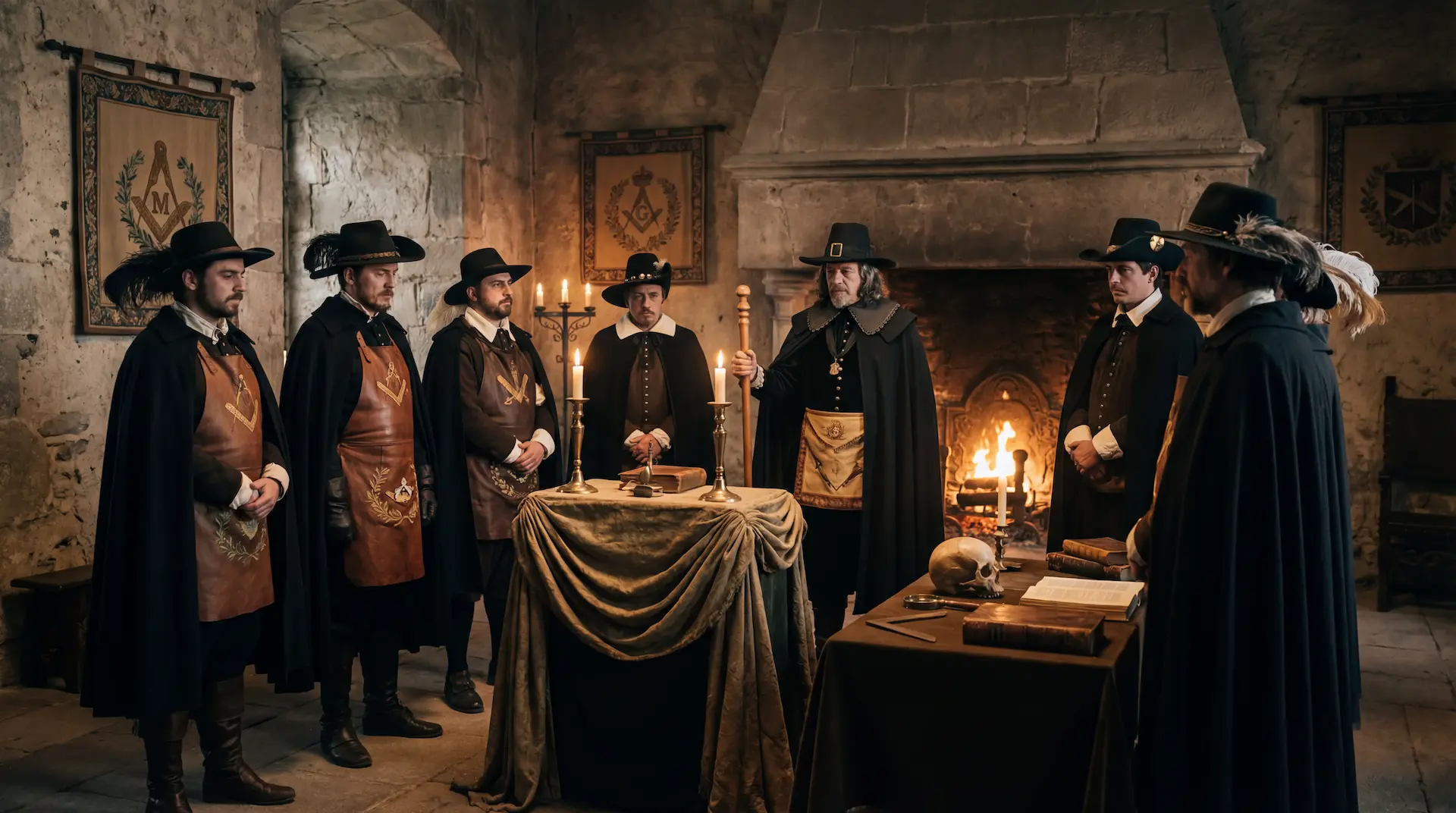
Edwards has spent over 30 years studying Templar-era symbols, Masonic codes, and the iconography of early Freemasonry in Nova Scotia. He appeared in the War Room during Season 11 of The Curse of Oak Island with a striking proposal. He had been studying two rare books from the 18th and 19th centuries connected to Daniel Dyson and John Easson, two of the first Freemasons in Nova Scotia. Within those books, Edwards found what he believed to be hand-drawn references to Oak Island, including what appeared to be a map of the island with its lots marked out, and a sketch he interpreted as the Ark of the Covenant.
 Early Freemasons→
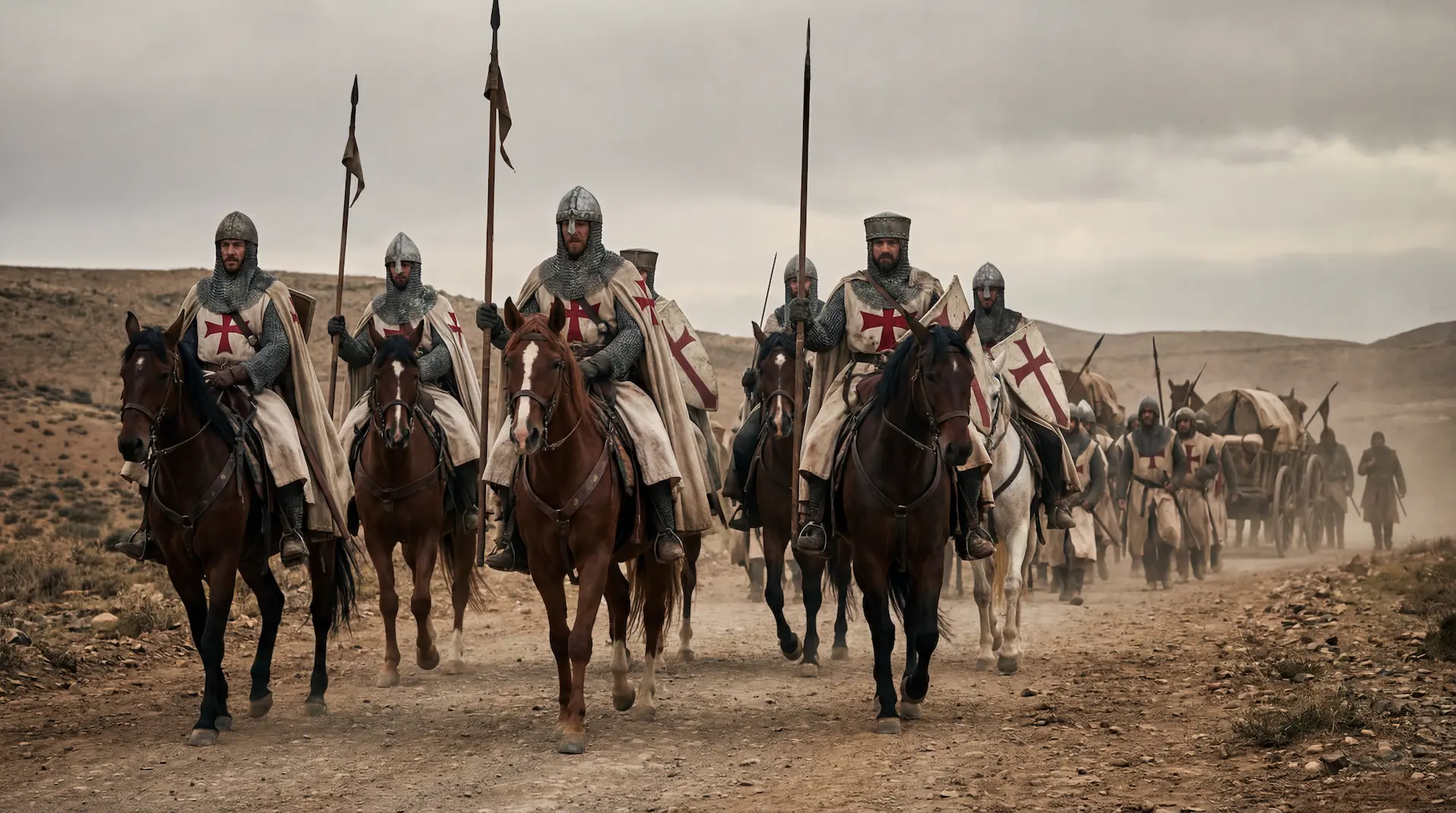
Edwards then turned his attention to Nolan's Cross. Working with surveyor Steve Guptill, he took precise measurements of the cross and found that the key distances (144 feet, 720 feet, 864 feet) were all divisible by 72. Edwards proposed that this number was the key to identifying who built the cross: the Latin Rule of the Knights Templar, written by Bernard de Clairvaux and Hugues de Payens, contained exactly 72 clauses. He suggested three specific locations along the main axis of Nolan's Cross where treasure might be buried, corresponding to points on the Tree of Life that had not yet been searched: Da'ath, Tiferet, and Yesod.
At the Tiferet location, the team subsequently found a large boulder sitting atop a formation that Dr. Ian Spooner confirmed was manmade. Beneath it, they recovered cut wood, chopped timbers, and a rock-lined depression with deliberate one-over-two and two-over-one stone construction. Stakes similar to those Fred Nolan had found and dated to the 1500s were also present.
Edwards returned in a later season with researcher Scott Clarke, presenting further decoded material from the same books. The decoded names included John Easson, a Freemason at the lodge in Annapolis Royal, the oldest in Canada, established in 1605 and home to the first Masonic fraternal organisation in 1738. The lodge met at the Sinclair Inn, which features painted murals depicting a Crusader or Templar tent of the type used when holy artefacts were being transported. Edwards and Clark concluded that the books documented a multigenerational endeavour linking Biblical treasures, the Knights Templar, and Oak Island.
 The Knights Templar→
Daniel Ronnstam and the 90-Foot Stone
Swedish researcher and amateur cryptographer Daniel Ronnstam brought yet another piece to the puzzle. His subject was the inscribed stone slab found at 90 feet in the Money Pit during the original excavation in 1804, a stone whose symbols had famously been translated as "Forty feet below two million pounds are buried."
Building on earlier work by Dr. Ross Wilhelm, a former US military cryptographer who in 1971 used a 16th-century cryptography manual to identify a second hidden message in the stone's symbols, Ronnstam claimed to have corrected an error Wilhelm had made by applying the English rather than Spanish alphabet. His translation read: "At eighty guide corn long narrow sea inlet drain," followed by a lost letter he identified as F, for Francis Bacon.
Ronnstam argued the inscription was a dual cipher: one layer containing the known message about buried treasure, and a second set of instructions for defeating the flood tunnels by pouring corn into shafts at strategic points, where it would swell and block the flow of seawater. The theory depends on the accuracy of the symbols attributed to the stone, which has been missing for nearly a century. No photographs or rubbings were ever made, and all existing versions are copies from books or drawings done from memory. The stone was displayed in the window of the Creighton and Marshall bookbindery on Upper Water Street in Halifax in 1865, used to raise capital for treasure operations. Captain Henry Bowdoin, accompanied by future US President Franklin Roosevelt, saw it there in 1909, by which time its inscription had been worn away from use as a cutting board for leather book jackets. The stone vanished around 1919.
Ronnstam presented his theory in Season 1 of The Curse of Oak Island, in the same episode that Petter Amundsen first presented his First Folio cipher. Two researchers, two different source texts, two different methods, the same island.
The Physical Evidence
If the cipher researchers provided the theory, the drilling has begun to provide something resembling corroboration.
The earliest physical evidence came in 1897, when treasure hunters William Chappell and Frederick Blair drilled into what became known as the Chappell Vault at 153 feet. From within a seven-foot wooden structure encased in a cement-like substance, they recovered a small ball of fibrous material. When unrolled, it proved to be a fragment of parchment bearing the letters "V I" or something very similar. Dr. Andrew Porter swore an affidavit to that effect on 6 September 1897.
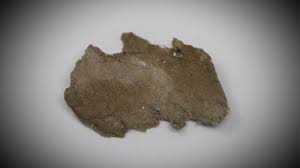 Parchment scrap (H8)→
More than a century later, the drilling confirmed there was something to find. In Season 5, material recovered from borehole H-8 in the Money Pit area was examined at Saint Mary's University by Dr. Christa Brosseau and Dr. Xiang Yang. Under the scanning electron microscope, a paper-like fragment revealed collagen fibres and traces of nitrogen, identifying it as animal-skin parchment rather than plant-based paper. Parchment was historically reserved for documents of high importance, and its presence 150 feet underground suggested deliberate placement.
A leather fragment from the same borehole proved even more significant. One side was dimpled animal skin; the other showed bundled textile fibres spun together and bonded to the leather, a construction consistent with bookbinding. Medieval bookbinding expert Joe Landry at the Dawson Printshop in Halifax identified the material as genuine parchment and vegetable-tanned calf leather consistent with books capable of surviving for 2,000 years. A purple-stained wood fragment from the same spoils drew the strongest reaction. Landry compared the colour to Tyrian purple, an ancient dye so costly it was restricted to church documents and royal decrees. He suggested the staining could result from ecclesiastical leather bleeding into a book board, and noted that the thickness was consistent with a book cover.
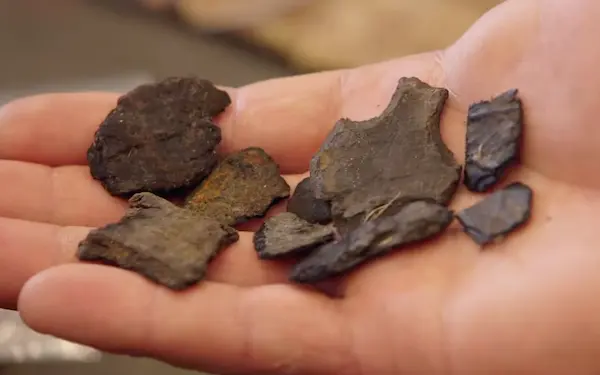 Leather book binding fragments→
In Season 6, Dr. Brosseau confirmed that another H-8 sample was cellulose-based cotton rag paper, an older form of paper used in book production from as early as the 12th century. The discovery echoed the 1897 parchment fragment and strengthened the case that bound documents had been deliberately placed at depth.
Under the digital microscope at the Oak Island Research Centre, Doug Crowell identified red and yellow pigment on paper fragments from H-8 spoils. He noted the colouring resembled the illuminated drop caps used in medieval manuscripts, where large decorative letters marked the opening of chapters in religious texts.
The Convergence
The Baconian theory of Oak Island has always been cryptographic rather than archaeological. Ciphers are slippery things. The same text that yields a startling message to one decoder may yield nothing to another. Critics have long argued that with sufficient ingenuity, hidden messages can be found in almost any text of sufficient length.
But the convergence of evidence is difficult to dismiss entirely. Amundsen, Roberts, Edwards, and Ronnstam each started from different source material, used different methods, and arrived at the same island. The 1623 date of the First Folio sits within the carbon dating window for Oak Island's underground structures, including a wood sample from borehole FG-12 dated to as early as 1626. Nolan's Cross, measured on the ground, produces the exact proportions of the Kabbalistic Tree of Life, with a 5:8 ratio and a base unit of 144 feet that links directly to Bacon's New Atlantis. And beneath one of its sephiroth points, the team found a manmade stone feature with timbers dating to the 1500s.
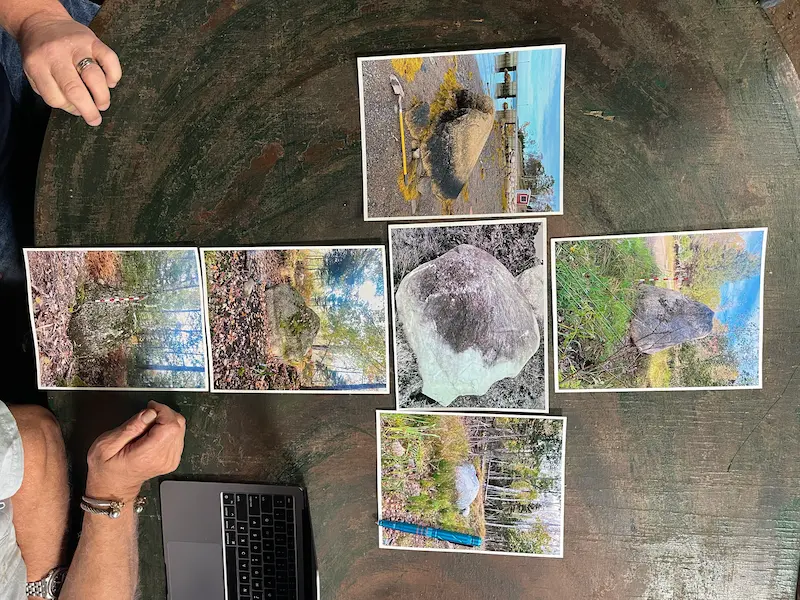 Nolan's Cross (5 boulders)→
Most importantly, the physical evidence from the Money Pit now includes parchment, leather bookbinding with Tyrian purple staining, cotton rag paper with pigment traces, and a cement-encased vault at 153 feet. These are not the contents of a pirate's chest. They are the components of a library.
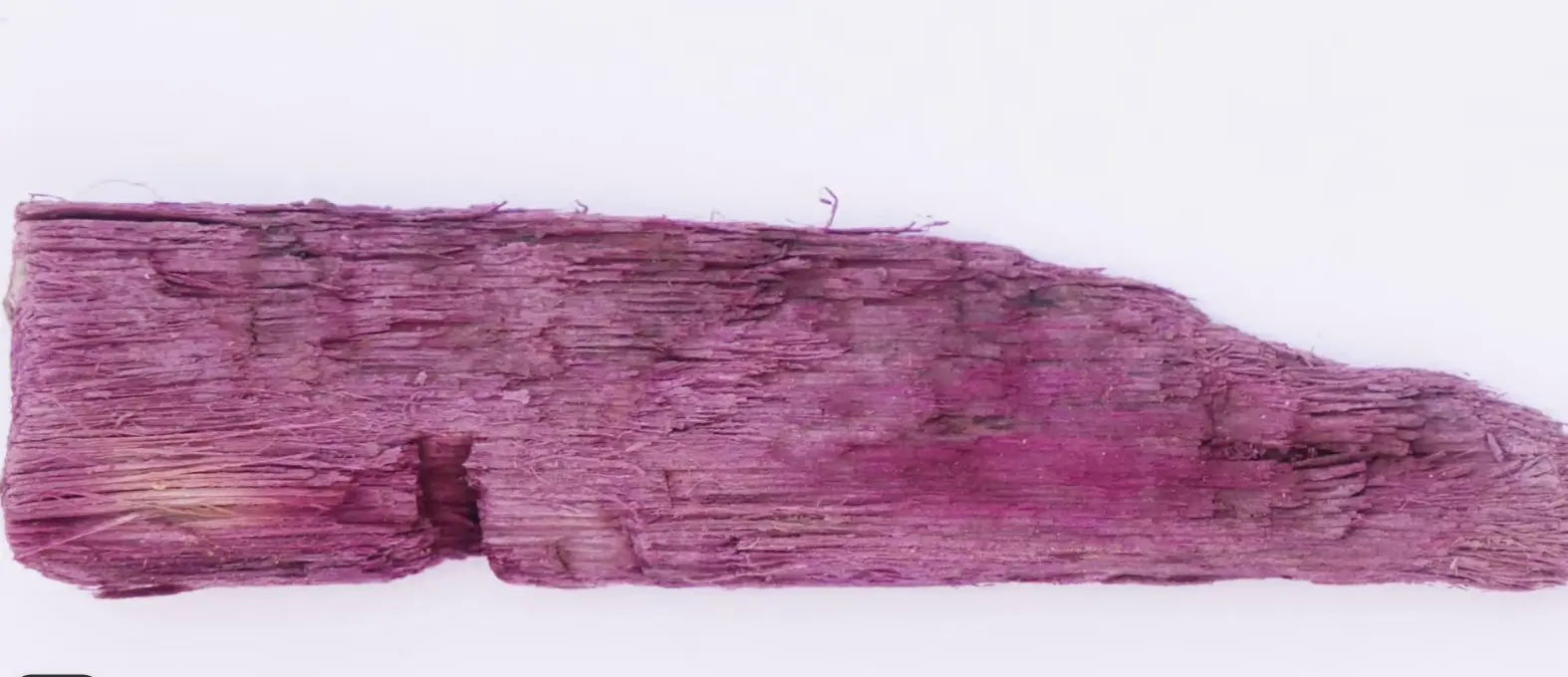 Purple-stained wood fragment→
Whether those pages were written in the hand of Francis Bacon, or William Shakespeare, or someone else entirely, remains the question that Oak Island has not yet answered. But the pages are there. The drilling has confirmed it. And the cipher researchers, working independently from the surface of the text, keep pointing to the same coordinates beneath the ground.