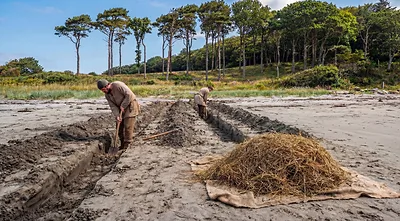
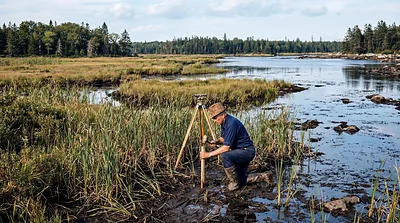
The search for Shaft 9 reaches its conclusion as the team traces the 1863 sluiceway, originally identified with help from veteran treasure hunter Dan Henskee, back to its source. Surveyor Steve Guptill takes GPS measurements along the exposed sluiceway to calculate where the shaft should lie. Billy Gerhardt digs a series of trenches, initially finding nothing, until wood begins appearing in the spoils. A massive timber structure emerges from the earth, measuring roughly 6 by 12 feet, matching the historical accounts of searcher shafts dug in the 1850s and 1860s. When a horizontal tunnel connecting the shaft to the sluiceway is uncovered, the discovery is confirmed beyond doubt: the team has found Shaft 9, the searcher shaft built by the Oak Island Association in 1863 at a time when the location of the Money Pit was still known. Rick Lagina, Craig Tester, and Doug Crowell recognize the find as critically important, since Shaft 9 was constructed roughly 100 feet southwest of the original Money Pit and now provides a fixed landmark from which to calculate its position.
Eagle Canada launches the most ambitious seismic survey in the island's history, deploying 6,000 active geophones and firing approximately 20,000 explosive charges across the entire eastern half of Oak Island. The operation covers the Highlands between the swamp and the Money Pit, as well as Smith's Cove and the Cave-In Pit, where earlier core drilling had detected evidence of a flood tunnel. Rick, Marty Lagina, Craig, and Steve Guptill observe the first round of blasting, which begins at sunset to minimize sound interference from daytime search operations. Each charge contains 20 grams of dynamite, and the resulting sound waves are measured as they reflect off voids and structures as deep as 300 feet below the surface. After several days of round-the-clock work, Rick, Jack Begley, and Doug Crowell meet with the Eagle Canada crew to confirm completion. Full data processing will take several weeks, but the team is hopeful the results will reveal the flood tunnel's path from Smith's Cove to the Money Pit and identify new underground targets across the Highlands.
On the beach at Lot 32, southwest of the swamp, metal detection expert Gary Drayton and Peter Fornetti recover a series of iron artifacts that strengthen the case for pre-Money Pit seafaring activity on the island. Gary identifies a decking spike consistent with 1700s ship construction, similar to a barrote-type spike found in the swamp three years earlier that antiques expert Dr. Lori Verderame had identified as coming from a 17th-century Spanish galleon. A second find, a hand-forged wrought iron cribbing spike matching those recovered from the 18th-century slipway at Smith's Cove, deepens the pattern. Alex Lagina and Gary later bring the decking spike to blacksmithing expert Carmen Legge at the Ross Farm Museum, roughly 20 miles north of the island, where Carmen confirms the artifact is consistent with ship construction hardware.
In the War Room, Canadian journalist and author D'Arcy O'Connor, who has spent over 50 years researching the Oak Island mystery since writing a feature for The Wall Street Journal in 1970, presents his theory alongside his daughter Miranda. Having recently published a new edition of his book The Secret Treasure of Oak Island, O'Connor argues that Spanish galleons following the Gulf Stream from Havana to Europe were driven off course by storms, with at least 200 ships disappearing on the route. He proposes that one such vessel, carrying plundered New World gold, silver, and gemstones along with engineers from the Bolivian silver mines, was beached at Oak Island, where the crew buried the cargo and protected it with flood tunnels. The team notes that the theory aligns with multiple finds, including the 1652 Spanish maravedi coin, the barrote-type decking spike, and the wooden scuppers Fred Nolan discovered after draining the swamp in 1969.