Irving Equipment Limited and ROC Equipment deliver the heavy equipment for the season's most ambitious Money Pit excavation: eight-foot-wide steel caissons, a custom-built 110,000-pound oscillator from South Korea (nearly double the 64,000-pound unit from the previous year), and a 220-ton crane. Vanessa Lucido confirms the caissons can reach 202 feet. The target site, OC-1, was selected based on this season's core-drilling program, which recovered ax-cut wood from 106 feet in borehole FG-12, carbon dated to 1626, more than 150 years before the discovery of the Money Pit. Rick and Marty Lagina, Craig Tester, Doug Crowell, and Steve Guptill oversee the setup as preparations begin.
At the swamp, Rick meets with geoscientist Dr. Ian Spooner to continue investigating the Eye of the Swamp. Core samples from the area have revealed high levels of lead and mercury at the base, an anomalous finding Spooner connects to significant human activity. The mercury raises a particular point of interest: 17th-century philosopher Sir Francis Bacon detailed a method for preserving documents in sealed containers filled with mercury in his 1620 work Novum Organum, and Baconian theory has long been one of the leading Oak Island explanations. Spooner concludes the Eye was excavated to extract clay, effectively serving as a clay mine, and that the stone-paved area nearby may have been leveled to allow horse and cart access for transporting the heavy material. Author and researcher Corjan Mol and researcher Chris Morford have previously theorized the Eye of the Swamp marks the location of a treasure vault.
Marty, Alex Lagina, archaeologist Laird Niven, and Tom Nolan meet with Dr. Spooner and his colleague Aaron Taylor, an archaeologist from St. Mary's University in Halifax with nearly a decade of wetland site experience. Taylor examines both the paved area and the Eye, confirming the paved surface is too level and too uniform to be natural. He supports Spooner's clay mine theory and suggests a direct connection between the two features. With five experts from four disciplines now agreeing the paved area is man-made, Marty acknowledges Rick may have been right about the swamp's significance all along. The team toasts to the swamp over drinks at the Mug and Anchor pub in Mahone Bay.
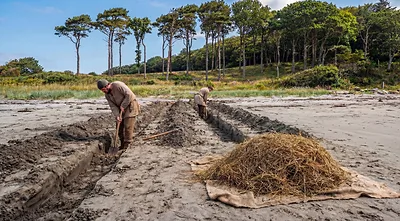
Rick returns to the swamp with Jack Begley, Gary Drayton, Billy Gerhardt, Terry Matheson, and Craig Tester to excavate further along the paved area. They uncover a layer of rocks with significant water flowing through from multiple directions. A taste test confirms the water is brackish, raising the possibility that they have encountered part of the flood tunnel system or another previously unknown feature. Dr. Spooner later examines the rock formation and confirms it matches the paved area, with sticks and rocks identical to the structure previously documented.
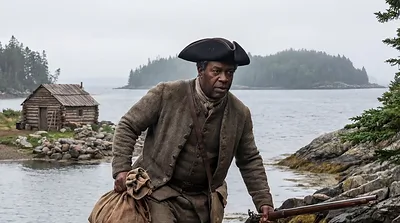
On Lot 25, Doug Crowell, Charles Barkhouse, and Laird Niven oversee a ground-penetrating radar scan of the Samuel Ball property, conducted by GPR experts Steve Watson and Don Johnston. Laird has obtained a special government permit for the heritage-protected site. Ball, a former enslaved person who became one of Nova Scotia's wealthiest landowners after settling on Oak Island in 1786, has long been suspected of discovering part of the treasure. The GPR identifies two subsurface anomalies resembling walls, one approximately six feet wide, at a depth that could represent an entrance or tunnel beneath the foundation.