Choice Drilling sinks an exploratory borehole near the Cave-In Pit to investigate underground anomalies detected by ground-penetrating radar. The target sits on the northern side of the GPR anomaly, slightly closer to the Money Pit than previous efforts. Jack Begley, geologist Terry Matheson, Doug Crowell, and Paul Troutman monitor the cores as the barrel reaches the target zone. Between 99 and 109 feet, four feet of uniform sand appears, sharply distinct from the consolidated till above and below and matching the historical description of the flood tunnel intercepted by the Oak Island Treasure Company in 1897 at 111 feet. Jack notes a perfect alignment from the U-shaped structure at Smith's Cove through the drill site to the Money Pit. A second borehole five feet to the west fails to replicate the find, and the team decides to turn to seismic scanning for a broader picture.
On Lot 27, once owned by Daniel McGinnis, metal detection expert Gary Drayton, Jack Begley, and Peter Fornetti recover an iron chisel with a mushroomed head consistent with repeated hammer blows. Gary connects the find to the ancient swages, rock-drilling tools estimated to date as far back as the 1400s, uncovered on neighbouring Lot 21 just three weeks earlier. The chisel's size and wear suggest it was used for breaking rock, possibly as part of a tunneling operation on the western side of the island.
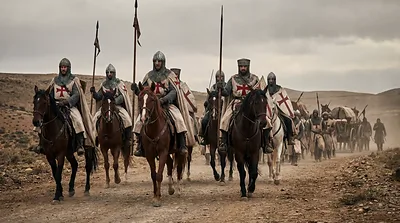
In the War Room, naval historian and author Chipp Reid, associated with the U.S. Naval Institute at Annapolis and a retired U.S. Marine, presents research suggesting the 18th-century structures unearthed at Smith's Cove could be the remains of a water battery, a military artillery position constructed close to the shoreline, common from roughly 1600 to the mid-1800s. A diagram of a historical water battery closely resembles the L-shaped structure found at the cove. Reid argues that the French military was active on the island after founding Louisbourg in 1713, and that when Colonel William Pepperrell's English forces seized the fortress in 1745 and found no gold, the French had likely moved their treasure to Oak Island. The discussion turns to the 1746 Duc d'Anville expedition, a fleet of 97 ships and 13,000 men led by Jean-Baptiste Louis de la Rochefoucauld, a descendant of a family with ties to the Knights Templar. Doug Crowell recalls the d'Anville ship's log transcript he had previously presented, describing the digging of a deep pit with a secret entrance by tunnel from the shore.
Craig Tester, Alex Lagina, and archaeologist Laird Niven meet GPR experts Steve Watson and Don Johnston at the McGinnis Foundation on Lot 21. The scan detects a strong anomaly roughly four feet deep and four feet wide near the old stone well, with clear evidence of disturbed soil. The ground inside the foundation reads differently from the surrounding earth, and what appear to be cellar steps descend deeper than expected, raising the possibility of a hidden second cellar beneath Daniel McGinnis's home. A government permit will be needed before any excavation can proceed.
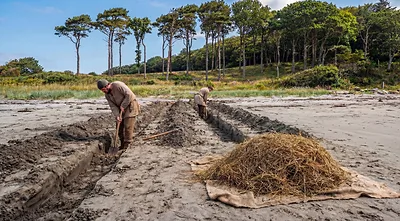
Rick, Marty Lagina, and Doug Crowell head to the island's southern shore to follow up on information from veteran treasure hunter Dan Henskee about a wooden sluiceway built in 1863 to drain water from Shaft 9, the 120-foot searcher shaft dug by the Oak Island Association roughly 100 feet from the Money Pit at a time when the Money Pit's location was still known. Billy Gerhardt excavates near the shoreline, and after hitting large rocks and heavy water flow, the team uncovers an intact box-shaped wooden drain preserved in puddled clay, still channeling water after 159 years. Surveyor Steve Guptill marks the position, and the team plans to trace the sluiceway back uphill toward the shaft itself. Separately, Rick, Craig, Gary Drayton, and Dave Blankenship welcome the Eagle Canada geophysical team, which arrives with 6,500 geophones and plans for 18,000 explosive charges to conduct the first seismic survey of the island's eastern half, covering Smith's Cove, the Cave-In Pit, and the Highlands to a depth of 300 feet.