At the Oak Island Research Centre, surveyor Steve Guptill shows Rick Lagina and historian Doug Crowell a diagram plotting the recently confirmed location of Shaft 9, built roughly 100 feet southwest of the Money Pit in 1863. With that distance established, Guptill draws an arc of possible Money Pit locations northeast of the shaft. Crowell then produces a 1931 aerial photograph taken during the Chappell exploration, in which two depressions are visible: one at Shaft 9's known position and another that Crowell believes marks Shaft 2, the searcher shaft dug by Daniel McGinnis and members of the Onslow Company in 1805, just 14 feet southeast of the Money Pit. If the team can confirm Shaft 2's location, two known distances from two confirmed shafts would allow Steve to triangulate the exact position of the original Money Pit.
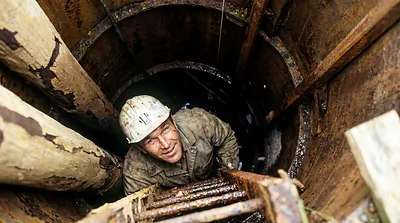
At the Money Pit site, Craig Tester, Alex Lagina, Steve Guptill, Charles Barkhouse, and geologist Terry Matheson oversee a new core drilling operation using a sonic drill rig. Choice Drilling sinks borehole FG-10 at the location Steve has calculated from the 1931 photograph. Early core samples show disturbed soil, and at roughly 33 feet the barrel brings up unmistakable stacked wood. Craig identifies the find as the edge of a shaft wall rather than a tunnel, noting the structure is far too close to the surface for horizontal passage work. The team plans additional adjacent holes to locate all four walls of the shaft and determine its precise orientation, which would indicate the direction to the Money Pit just 14 feet away.
Rick Lagina, Peter Fornetti, Doug Crowell, and Billy Gerhardt travel 52 miles to the Helen Creighton Heritage Museum in Dartmouth, Nova Scotia, following a lead Rick received at Dan Blankenship's funeral. Kevin Rideout told Rick that over 40 years earlier, a museum curator pointed out a stone in the backyard said to have come from Oak Island. The museum occupies the Evergreen House, purchased by Dr. Helen Creighton in 1919, the same year the Halifax bookstore where the 90-foot stone was last documented closed its doors. Augustus Oliver Creighton, a partner in that bookstore, was a relative of Helen Creighton. Museum curator Terry Eyland takes the group to the backyard, where Rideout estimates the stone was embedded beneath a large rhododendron bush. The team does not locate the stone but plans to return with a government excavation permit.
On the beach at Lot 6, metal detection expert Gary Drayton and Jack Begley search the largely unexplored western shoreline. They recover two square iron pins that Gary dates to the 1700s, consistent with ship construction, followed by a large cribbing spike of the same period, a type used in building substantial structures such as wharves. The concentration of 18th-century iron in one area leads Gary to conclude they have found evidence of a previously unknown landing site on the island's western side.
At Smith's Cove, Irving Equipment Ltd. completes a massive bump-out extension to the 525-foot steel cofferdam, removing 22 interlocking steel sheets with a vibratory hammer mounted on a 440-ton crane to open a 6,000-square-foot exploration area. Rick, Marty Lagina, Craig, and Dave Blankenship meet with Irving project manager Mike Jardine, who reports finding a wooden structure sitting ten feet below high tide, with horizontal and vertical timbers forming a box-like shape unlike anything in the historical record. Once the area is drained, Rick, Craig, and archaeologist Laird Niven begin excavating the feature. They uncover tar paper covering parts of the wooden structure, suggesting 19th-century construction, alongside deliberately stacked cobblestones and water flowing from underneath. Jack Begley raises the possibility that the stacked rocks could be part of the flood tunnel finger drain system, which, if confirmed, would mean the team has intercepted the hydraulic connection between Smith's Cove and the Money Pit.