In the War Room, geophysicist Jeremy Church of Eagle Canada presents the results of the seismic scanning conducted earlier in the season using 18,000 dynamite charges across the island's eastern half. Among 80,000 sample points, Church identifies a 13-by-13-foot anomaly at 160 feet that he calls the "teardrop," sitting directly in the core of the Money Pit area and just south of borehole H8. Two years earlier, the team struck what they believed was the Chappell Vault at 170 feet in H8, only for it to shift into a nearby void. Rick and Marty Lagina and Craig Tester agree the anomaly demands immediate investigation and name the new shaft RF-1, short for Restall Family 1, in honor of the visiting Restall family.
Lee Lamb and her brother Richard Restall, children of the late Robert Restall Sr. who died on the island in 1965, join the team for a War Room presentation of the season's most significant finds, including the lead cross whose lead has been traced to a French mine that closed around 1300. Lee has also brought an oak leaf and acorn that her father recovered from the Smith's Cove flooding system roughly 60 years earlier. Botanist Dr. Rodger Evans examines the specimens and confirms the acorns are markedly different from native red oak, raising the possibility that a non-indigenous species was deliberately brought to the island. The material is too old for DNA testing, but Evans notes the acorns would not survive drifting across the Atlantic in salt water, meaning someone had to carry them. Rick takes Richard to Lot 13 to see the remains of the small cabin he and his brother Bobby Jr. shared for six years on the island, now on property belonging to Tom Nolan and once owned by the late Fred Nolan. Scott Barlow and Doug Crowell plan to refurbish it.
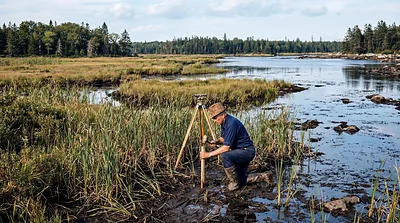
At the swamp, Rick meets with Dr. Rodger Evans to examine the large stump uncovered near the Eye of the Swamp. Evans finds the bark peels apart with unusual ease, raising the possibility that it could be a cork oak, a species native only to Portugal. The team discusses the known Portuguese presence in Nova Scotia from the 16th century onward and the theory that Portuguese Knights of Christ may have visited even earlier, potentially planting non-indigenous trees to mark the island.
Drilling begins on RF-1 with the teams from Irving Equipment Limited and ROC Equipment repositioning the 60-ton oscillator. Lee Lamb and Richard Restall witness the start. Vanessa Lucido reports the caisson advancing well, reaching 86 feet with full grabs and pulling up wood identified as Chappell Shaft timbers. At the wash table, Jack Begley and Steve Guptill recover a thick shard of pottery from roughly 100 feet, the thickest they have seen, which could indicate original Money Pit deposits. Gary Drayton and Terry Matheson recover a broken pickax from approximately 90 feet, similar in style to the 18th-century pick found near the swamp earlier in the season.
As RF-1 pushes past 100 feet, the hammergrab brings up massive hand-hewn timbers joined with hand-cut wooden dowels, a shipbuilding technique predating iron fasteners. Archaeologist Laird Niven, Charles Barkhouse, and Terry all identify Roman numerals carved into the timbers, including a clear "XI" spotted by Barkhouse. The markings match those found on the U-shaped structure at Smith's Cove, which was dendrochronologically dated to 1769. The team plans to send samples for dendrochronology testing, and Billy Gerhardt sets aside the largest timbers for further analysis. Rick observes that none of the wood matches anything associated with the Hedden or Chappell shafts, and that if dendrochronology dates it prior to 1795, it could represent original depositional construction.