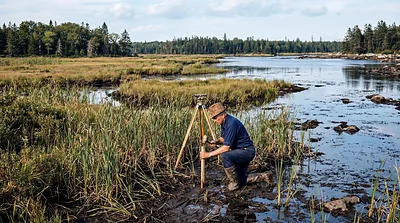
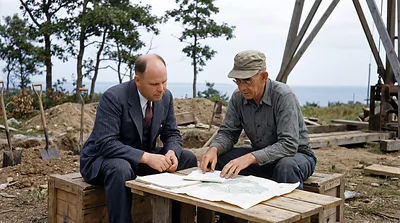
With Hurricane Dorian, a powerful storm that has already caused catastrophic damage in the Bahamas with 185-mile-per-hour winds, approaching the Atlantic coast, the team races to make progress before it hits Nova Scotia. At the swamp, Rick Lagina, Marty Lagina, Craig Tester, and Billy Gerhardt excavate the stone-paved area discovered earlier in the season by diver Tony Sampson. Within minutes, Billy uncovers wooden stakes with points sharpened by six cuts, matching the survey markers that Fred Nolan found during his 1969 swamp excavation, which carbon-dated to as far back as the 16th century. As a professional land surveyor, Nolan believed the stakes had been used to lay out and artificially create the swamp. At Smith's Cove, Jack Begley and Gary Drayton metal detect spoils from the slipway area and recover another wrought-iron cribbing spike consistent with those found in recent weeks, dating to at least the 1700s. Alex Lagina and Gary later take a collection of cribbing spikes to blacksmithing expert Carmen Legge at the Ross Farm Museum in New Ross, Nova Scotia. Carmen dates them to as early as the 17th century and identifies curved examples as a form of early rebar used in heavy construction.
At the Money Pit, Alex Lagina, geologist Terry Matheson, and the drilling crew continue boring near the Shaft Two tunnel at borehole FG-12, searching for the original Money Pit. Shaft Two was constructed in 1805 by the Onslow Company just 14 feet from the Money Pit and featured a horizontal tunnel at 110 feet that collapsed two feet from the treasure shaft. At 106 feet, the drill brings up dark wood unlike anything from the Hedden Shaft or Shaft Two. The pieces are thin, hand-cut with an ax rather than sawed, and appear significantly older than previously recovered timbers. Terry notes they are deeper than any known shaft or tunnel intersection in the area. Marty arrives and agrees the wood could represent original Money Pit construction rather than later searcher activity, and the team sends samples for carbon-14 dating.
Rick, Marty, Craig, Steve Guptill, and Billy work to expose more of the paved stone area before the hurricane arrives. Craig wades in and finds the stones are not flagstones but a layered rock surface with a linear edge and an elevation change of about one foot across the feature. The area fills with water too quickly to fully examine. At Smith's Cove, Rick obtains a dendrochronology sample from a log at the bump-out structure near the slipway, hoping the date will differ from the slipway's known 1769 construction date and prove the structures were built in different periods.
Hurricane Dorian makes landfall as a Category 1 storm with winds near 100 miles per hour, passing directly over Oak Island. Trees fall across the island, the causeway connecting Oak Island to the mainland loses more than two feet of surface to storm surges and nearly becomes impassable, and the swamp floods completely with ocean water. Two days later, Rick and project manager Scott Barlow assess the damage and begin staking out repairs needed for the causeway. The road is in poor condition and unsafe for heavy equipment. The swamp will require at least a week of pumping to return to working condition. Smith's Cove did not suffer structural damage, but the season's remaining time has been significantly reduced. Despite the setback, Rick remains determined to resume operations as soon as repairs allow.