Fouquet's Ship
1 min
The Saint-Sebastian was built between 1658 and 1660 for one of the most powerful men in France: Nicolas Fouquet, Superintendent of Finances to Louis XIV. Fouquet's fall from grace in 1661 is one of the great episodes in French court history. Accused of embezzlement and ambition that rivalled the king's own, he was arrested, tried, and imprisoned for the rest of his life. Among his many confiscated assets was the Saint-Sebastian, which passed into royal hands in 1663.
The Fouquet name carries particular weight in the Oak Island story. It was Fouquet's brother, the bishop Louis Foucquet, who in 1656 wrote to him about a meeting with the painter Nicolas Poussin in Rome. In that letter, he described a secret so significant that kings would go to great lengths to possess it, one that Poussin had uncovered and that, according to Louis, perhaps no one else on earth would ever recover. That letter, its implications for Poussin's painting The Shepherds of Arcadia, and Louis XIV's subsequent obsession with acquiring the canvas are examined in detail in our article on the Versailles Alignment. The confiscated ship that once belonged to the man at the centre of that mystery is the same vessel that, seven years later, would carry a team of French scientists and soldiers to the coast of Nova Scotia.
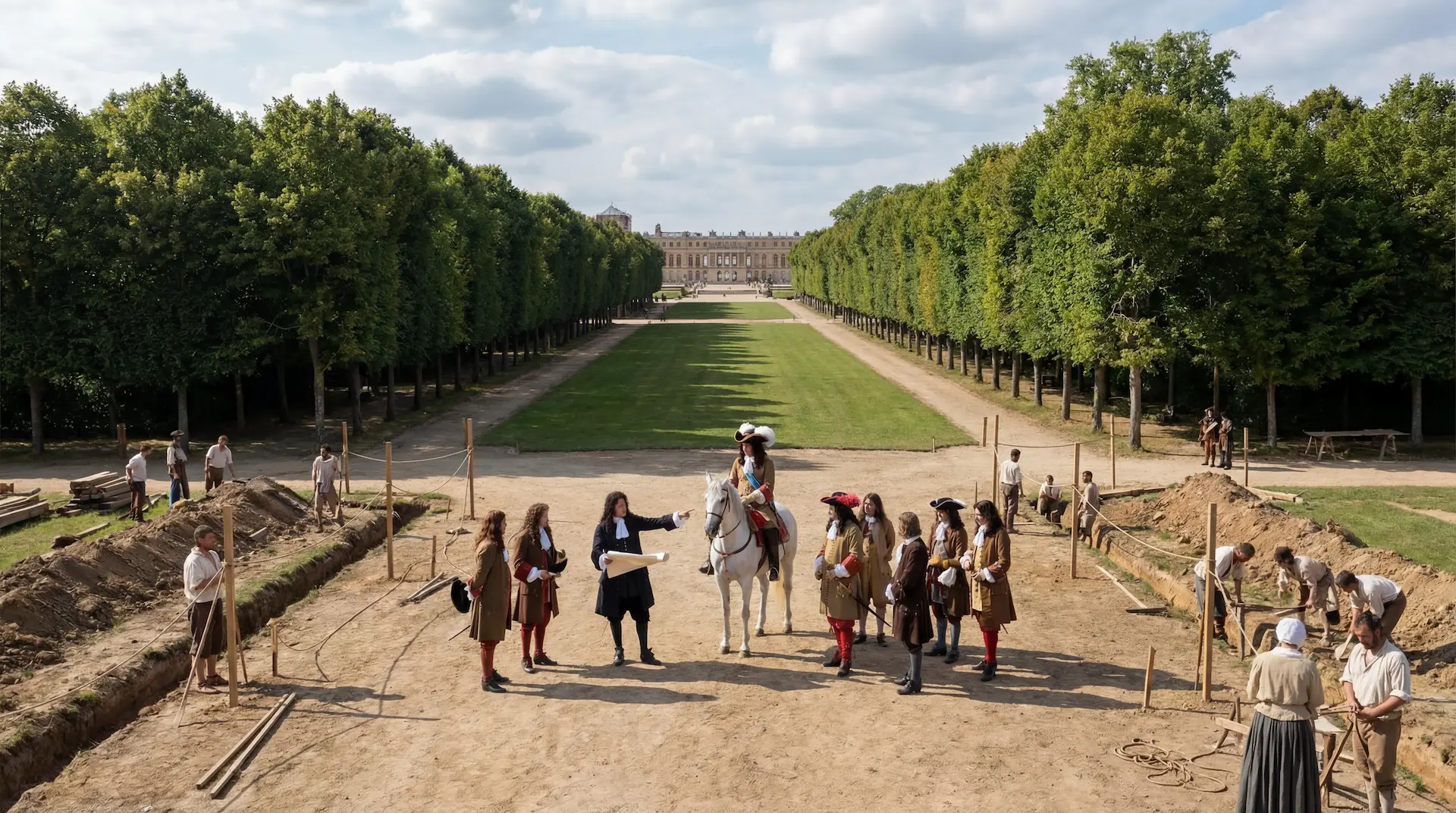 The Versailles Alignment to Oak Island→
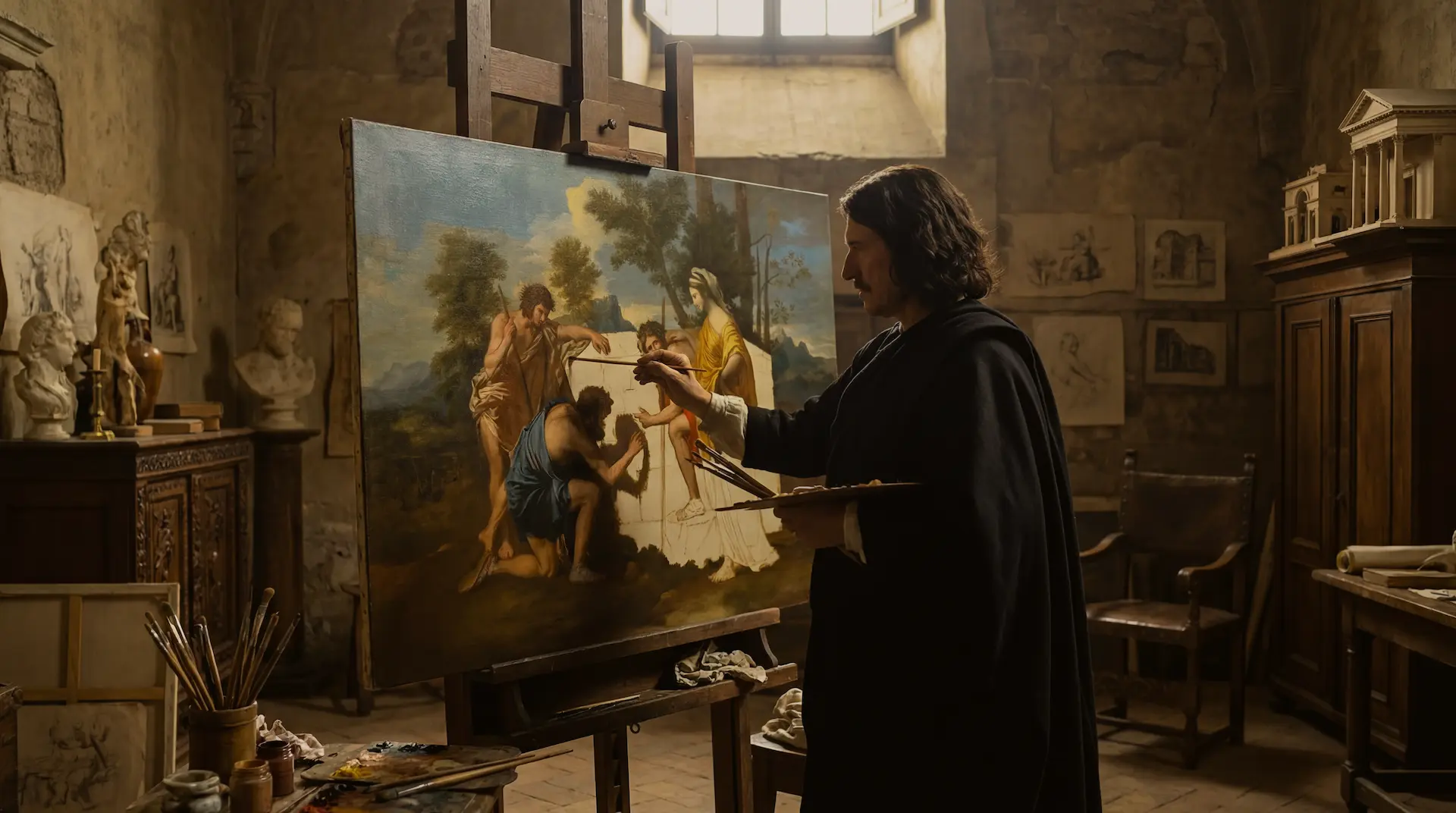 Nicolas Poussin, Keeper of Secrets→
The Voyage to Acadia
1 min
In the spring of 1670, the naval intendant at Rochefort, a man named Colbert de Terron, a cousin to the Secretary of the Navy Jean-Baptiste Colbert, proposed using the Saint-Sebastian to transport the newly appointed Governor of Acadia, Grandfontaine, across the Atlantic. The ship departed La Rochelle on the 1st of May 1670. Apart from Grandfontaine, it carried fifty soldiers from his regiment and high officials. Several of these passengers had originally embarked on the ship Saint-Charles, a vessel bound for Quebec carrying Intendant of New France Jean Talon and 300 soldiers. But the Saint-Charles had been forced to detour to Lisbon after encountering severe weather, and sank off the Portuguese coast in the final days of December 1669. Some of the survivors were rerouted to Acadia aboard the Saint-Sebastian.
Two additional passengers turned the journey into a scientific mission: Jean Richer, a promising young astronomer attached to the French Royal Academy of Sciences, and his assistant Monsieur Meurisse. A third figure, listed as Monsieur Deshayes, was probably Jean Deshayes, the royal cartographer, though this has never been confirmed.
The Longitude Mission
1 min
Richer had been selected by the Academy to conduct astronomical observations aimed at improving the calculation of longitude at sea, one of the most urgent scientific problems of the age. He carried two large pendulum clocks designed by Christiaan Huygens, the Dutch mathematician who was a senior member of the same Academy. The clocks were among the first of their kind to be tested on an ocean voyage.
The assignment had originally placed Richer on a ship bound for the East Indies, but the clocks arrived too late and Richer missed the departure. Now, in last instance he was sent to Acadia instead. A 1960 study by the American Philosophical Society suggests that the late arrival of the clocks may have been a convenient pretext. Colbert de Terron, eager to resolve the longitude question, saw the Atlantic crossing as more favourable to his goals and wanted Richer paired with Deshayes, his own protégé. In a letter to his powerful cousin, de Terron wrote that it would be advantageous for the two men to travel together, as they could serve as controllers for each other's work. Colbert, who did nothing without royal authority, approved the reassignment and instructed them to produce maritime maps of the voyage. The order to redirect a member of the Académie des Sciences to a different continent, aboard a different ship, on a different mission, at short notice, carried the weight of the Crown.
Five Weeks in Acadia
1 min
The Saint Sebastian spent approximately five weeks along the coast of Acadia and New England before returning to France. The few dates that survive come not from any report of the 1670 voyage itself, but from Richer's later published account of his expedition to Cayenne in 1672, where he referenced earlier Acadian observations for comparison. From these notes we know that on the 16th of July 1670, Richer recorded tidal observations at Pescatoué, a port on the coast of New England at a latitude of 43 degrees and 7 minutes. By the 6th of August he was at Fort Pentagoûet in Acadia, where he noted the latitude as 44 degrees, 12 minutes, and 20 seconds, and continued making observations through at least the 4th of August.
After Pentagoûet, the record goes silent. Le Saint-Sébastien returned to France around the 18th of August, give or take two days. If the ship followed the standard return route, it would have sailed along the eastern Acadian coast, passing through the waters of Mahone Bay.
The Missing Records
2 min
The most striking feature of this voyage is what does not exist: a written account. Jean Richer produced no known report of his five weeks in Acadia. Neither did Deshayes. This absence is difficult to explain. Under Colbert's administration, documentation was not optional. His 1681 Ordonnance de la Marine required pilots to maintain two separate journals on every long voyage, with fines for non-compliance and lists of offenders sent directly to the Secretary of the Marine. Colbert centralized all charts and records, established the Royal School of Hydrography, and personally ordered maritime maps from all trips. The Crown published the scientific results: in 1693, the Imprimerie Royale issued a single volume collecting observations from voyages to Cayenne, Denmark, Provence, and elsewhere, all made by order of His Majesty. Richer's Cayenne report fills 71 pages of that volume. His Acadian voyage, three years earlier and with the same mandate, produced nothing. The sudden reassignment, the timing of the expedition, and the complete absence of records make it feel less like a scientific voyage and more like a clandestine one.
The clocks present a partial explanation. Both pendulums broke early in the crossing due to a severe storm, rendering them useless for the longitude calculations that were the expedition's stated purpose. Huygens, writing in February 1671, was openly critical, attributing the failure to the carelessness of the observers rather than any fault in the instruments. He speculated that the rough seas had overwhelmed Richer, who was unaccustomed to such conditions, and noted that a small amount of lead ballast would have been sufficient to keep the clocks running. Whether the broken clocks explain the absence of all records, or whether other factors were at work, remains an open question.
What is certain however, is that the state of the clocks didn't stop Richer from making impressive observations. His precision was exceptional by any standard of the age. His latitude reading at Pentagoûet, recorded in degrees, minutes, and seconds, was the most accurate astronomical measurement yet made in the Western Hemisphere, and his later work at Cayenne produced data that Newton himself cited in the Principia as the first proof that gravity varies across the surface of the Earth.
Talon and the Colonial Enterprise
1 min
While Richer was on the Acadian coast, Intendant Jean Talon was running an industrial reconnaissance from Quebec: miners, blacksmiths, tar makers, forge masters, and shipwrights, all deployed under royal authority. He reported iron and copper mines of excellent quality, sent adventurers to discover unknown regions for the Crown, and had oak trees planted along the St. Lawrence for future shipbuilding. New France in 1670 was a surveying operation, happening within reach of Mahone Bay.
None of this connects directly to Oak Island. But it establishes that French colonial Acadia in 1670 was not a passive outpost. It was the site of active industrial reconnaissance, mineral extraction, and shipbuilding, organized by officials who reported directly to the Crown and who operated with a mandate to survey, exploit, and develop.
What Can and Cannot Be Established
1 min
The facts of the Saint-Sebastian voyage are documented in French naval and colonial archives: the ship, its passengers, the scientific mandate, the departure date, and two confirmed positions along the Acadian coast. What is not documented is everything that happened between Fort Pentagoûet in early August and the ship's return to France roughly two weeks later. If the Saint-Sebastian followed the standard route, it passed through the waters adjacent to Mahone Bay. Whether anyone on board made observations there, or had reason to, cannot be established from the surviving record.
What can be said is this: a ship once belonging to the man at the centre of the Poussin-Fouquet mystery carried a team of France's best scientific observers to Acadia on a mission approved at the highest level of the French state, and those observers produced no account of what they found. Richer would have been an excellent choice for a reconnaissance mission, a trained astronomer capable of calculating precise coordinates for any location he visited. The five-week window on the Acadian coast gave him ample time. But nothing in the archives confirms that such a mission took place, and this article does not claim otherwise. The absence of evidence is not evidence of absence, but neither is it proof of anything at all. It is simply a gap, one that sits uncomfortably alongside every other gap in the early record of European activity near Oak Island.
The story of Jean Richer was published earlier in The Jerusalem Files, the secret journey of the Menorah to Oak Island.