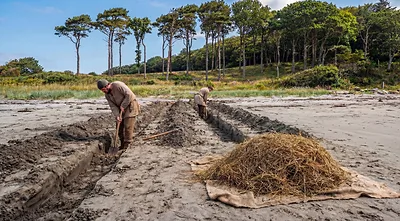
At Smith's Cove, Rick Lagina, Peter Fornetti, and Gary Drayton investigate the massive wooden structure exposed in the bump-out area during the cofferdam extension. Archaeologist Laird Niven examines the logs and associates the structure with the nearby slipway, noting it is far larger than anything previously connected to that feature and may represent where ships pulled alongside for loading or unloading. Laird gives the team permission to hand-excavate around it. Gary metal detects the area and recovers a strip of black metal with scalloped edges and a possible design, trapped against one of the large logs. He identifies the patina as consistent with silver oxidized in a saltwater environment and believes the artifact could be hundreds of years old. In the War Room, Dr. Christa Brosseau of Saint Mary's University reports via videoconference to Marty Lagina, Gary, Charles Barkhouse, and Steve Guptill that the object is actually impure lead, not silver. Although initially disappointing, the team notes that lead artifacts have told more stories on Oak Island than any other metal and plan to submit the piece for laser ablation isotope analysis.
At the Money Pit area, geologist Terry Matheson, historian Doug Crowell, and veteran treasure hunter Dan Henskee continue the core drilling operation to trace the Shaft Two tunnel. At borehole F.25-12.5, the drill recovers hand-sawn lumber at a depth of 108 feet, offering evidence they have intercepted the tunnel built in 1805 by Daniel McGinnis and the Onslow Company just 14 feet from the original Money Pit. The team also finds a four-foot section of sand packed between layers of hard clay, matching an 1897 account by the Oak Island Treasure Company of a flood tunnel at 111 feet and consistent with similar sand layers found five weeks earlier near the Cave-In Pit. Rick, Marty, and Alex Lagina arrive to review the cores and agree they are very close to pinpointing the original Money Pit location.
Craig Tester, Jack Begley, and Scott Barlow begin the long-awaited pumping operation at the swamp, using a six-inch trash pump and smaller four-inch pumps positioned at target sites. Rick and Tom Nolan meet contractor John Skierka of Great Excavations Incorporated, who visits the swamp to assess conditions for deploying a specialized 36-ton amphibious excavator, the Trax X300AD-L, equipped with six-foot-wide pontoon tracks and a long-reach boom capable of digging to 70 feet. Days later, the machine is delivered and assembled on site, representing the most extensive investigation of the swamp ever attempted and a milestone Tom's late father Fred Nolan spent decades hoping to see.
Dr. Chris McFarlane of the University of New Brunswick presents laser ablation results for the lead artifact to the full team in the War Room. The piece contains nine weight percent tin, higher than anything McFarlane has previously analyzed. Using a database of over 6,000 European lead ore isotope measurements, he determines the lead is clearly not of North American origin and is most consistent with Italian, French, or Spanish sources from the Western Mediterranean, the same region associated with the Knights Templar. With the swamp now drained after three days of pumping, Billy Gerhardt takes the amphibious excavator into the bog for the first time. Tom watches from shore with Rick, reflecting on the decades his father spent convinced the swamp held the key to the Oak Island mystery. The team begins removing the top layer of muck toward the paved area discovered earlier in the season by diver Tony Sampson.