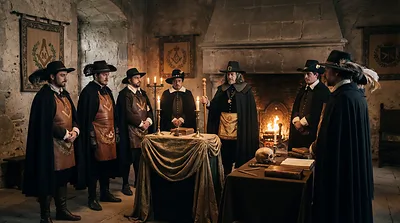
Season seven opens with the team gathering in the War Room for their first meeting without veteran treasure hunter Dan Blankenship, who passed away during the off-season after devoting more than half a century to the Oak Island mystery. Rick Lagina leads a moment of silence and pledges to pursue the breakthrough Dan never received. Marty Lagina and Jack Begley join by video conference as surveyor Steve Guptill presents seismic data from the swamp revealing a 200-foot-long anomaly roughly 25 feet wide, its shape consistent with a large ship. The object sits between 15 and 55 feet below sea level. Craig Tester outlines the season's priorities: core drilling the swamp anomaly, expanding the Smith's Cove cofferdam to uncover more of the slipway, and continuing the search for the flood tunnel between Smith's Cove and the Money Pit. Tom Nolan, son of the late Fred Nolan, joins the team as a full-time member, uniting all major Oak Island landowners for the first time in nearly half a century.
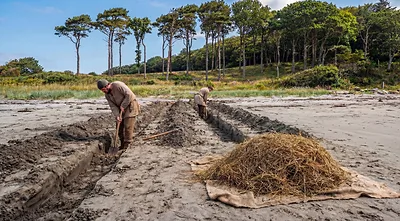
Diver Tony Sampson explores the swamp on behalf of Rick, Craig, and Steve Guptill. Working in zero-visibility conditions, Tony uses a metal probe to locate a solid feature roughly five feet beneath the surface. Flat stones with uniform surfaces emerge at every contact point, cutting across the natural geological grain rather than running parallel to it. Tony deploys buoys along the feature, and despite navigating blind, the markers surface in a remarkably straight line. Back in the War Room, Guptill overlays Tony's GPS data with the seismic results: the stone structure measures roughly 60 to 70 feet long and 12 feet wide, sits precisely at sea level, and lies just two metres north of the anomaly. Craig describes it as a working platform or wharf built for loading and unloading cargo, strengthening the case that the anomaly may be a deliberately scuttled vessel.
Metal detection expert Gary Drayton and Charles Barkhouse search the eastern shore at Isaac's Point, near Smith's Cove. Gary, using an oversized 13-inch detecting coil to scan the eroded banks, recovers a silver-plated button bearing a starburst design with a hand-crafted shank. He estimates a date range of 1650 to 1750. At the research centre, Doug Crowell examines the button under a digital microscope at up to 2,000 times magnification, revealing hand-cut striations and a stamped rather than moulded design. Rick and archaeologist Laird Niven bring the button to conservator Kelly Bourassa, who cleans it and identifies it as a Noel Hume type seven or eight, datable between 1726 and 1776, a range that brackets the 1769 construction date of the slipway established by dendrochronology the previous season. Whether civilian or military remains uncertain.
The following day, Gary and Alex Lagina return to Isaac's Point, where they recover a Victorian-era hand mirror and a thick, unusually shaped iron object from the beach. Rick and Gary take the iron piece to blacksmithing expert Carmen Legge at the Ross Farm Museum, roughly 20 miles north of the island. Carmen identifies it not as a spike but as a hand-point chisel, a stonemason's tool used for fine detail work on rock or stone, and estimates it could date as far back as the 14th century. He notes the chisel was designed for use with a wooden mallet rather than an iron hammer, explaining its undeformed striking surface. At the Mug and Anchor pub in Mahone Bay, the team discusses the find's implications: the progression of artifacts now includes the medieval lead cross from Smith's Cove and a possible companion tool, both predating the Money Pit's discovery by centuries and pointing toward Templar or Freemasonic connections.
Preparations advance on two fronts. At Smith's Cove, Rick and Marty meet with representatives from Irving Equipment Limited to plan a 120-foot cofferdam extension, a bump-out that will add roughly 6,000 square feet of unexplored seabed beyond the existing steel wall. The goal is to uncover the far end of the slipway, where artifacts may have fallen during cargo transfer from ship to shore. In the swamp, teams from Choice Drilling and RMI Marine Limited assemble a 20-ton floating barge composed of four ten-by-twenty-foot sections to support the five-ton sonic drill rig. Tom Nolan, Dave Blankenship, Dan Henskee, and other team members watch as the barge is towed into position using rope lines secured by five steel anchors. The first cores are extracted as the season's most anticipated investigation begins.