Of all the theories attached to Oak Island, the one involving the jewels of Marie Antoinette may be the most romantic and the most problematic in equal measure. It involves a doomed queen, a secret chest of diamonds and pearls, a loyal servant's flight across the Atlantic, and a sitting president of the United States who believed every word of it. The story has circulated in one form or another since at least the early 20th century, and it gained its most famous advocate in Franklin D. Roosevelt, who followed the Oak Island mystery from his twenties until his death in office.
 The Roosevelt Connection→
A Queen and Her Jewels
1 min
Marie Antoinette arrived at the court of Versailles in 1770 as a fourteen-year-old Austrian archduchess, betrothed to the future Louis XVI. On the day of her wedding, she was presented with the traditional jewels of a French dauphine: an elaborate diamond necklace that had belonged to Anne of Austria, along with pieces once worn by Mary Queen of Scots and Catherine de' Medici, all valued at roughly two million livres. Over the following two decades, she added substantially to her collection, amassing diamonds, rubies, emeralds, sapphires, and natural pearls that made her one of the most lavishly adorned women in Europe. Her spending habits, combined with the dire state of French finances after the Seven Years' War and France's costly support of the American Revolution, earned her the nickname "Madame Deficit" and helped fuel the public fury that would eventually consume the monarchy.
In 1785, the Affair of the Diamond Necklace, a fraud orchestrated by the Comtesse de la Motte involving a 2,800-carat necklace worth 1.6 million livres, further damaged the queen's reputation even though Marie Antoinette had no involvement in the scheme. By 1789, when revolutionaries stormed the Bastille and forced the royal family from Versailles to the Tuileries Palace in Paris, the queen's name had become synonymous with royal excess. What happened to her vast personal jewel collection in the chaos that followed is a question with more than one answer, and it lies at the heart of the Oak Island connection.
The Flight to Varennes
1 min
By early 1791, Louis XVI and Marie Antoinette were effectively prisoners in the Tuileries, surrounded by revolutionary guards and a hostile public. The couple planned a desperate escape to Montmedy, a royalist stronghold near the Austrian border, where they hoped to rally loyal troops and negotiate from a position of strength. Before the flight, according to accounts written by her lady-in-waiting Madame Campan, Marie Antoinette spent an entire evening wrapping her diamonds, rubies, and pearls in cotton and placing them in a wooden chest. The jewels were sent ahead to Brussels, then under the control of the queen's sister Archduchess Marie-Christine, and into the care of Count Mercy-Argenteau, the former Austrian ambassador to Paris and one of the few men the queen still trusted. Mercy forwarded the chest to Vienna and the safekeeping of the Austrian Emperor, Marie Antoinette's nephew.
On the night of June 20, 1791, the royal family slipped out of the Tuileries in disguise. They were recognised and arrested at Varennes, barely 30 miles from safety. No jewels were found on them. Louis and Marie Antoinette were returned to Paris under guard, and both were executed by guillotine in 1793. Meanwhile, the official Crown Jewels of France, a separate collection kept at the Garde-Meuble (Royal Treasury), were stolen in a brazen multi-night burglary in September 1792. Most were eventually recovered, though notable pieces vanished permanently, among them the Royal French Blue, which resurfaced decades later in London, recut into what is now known as the Hope Diamond.
The Legend of the Lady-in-Waiting
1 min
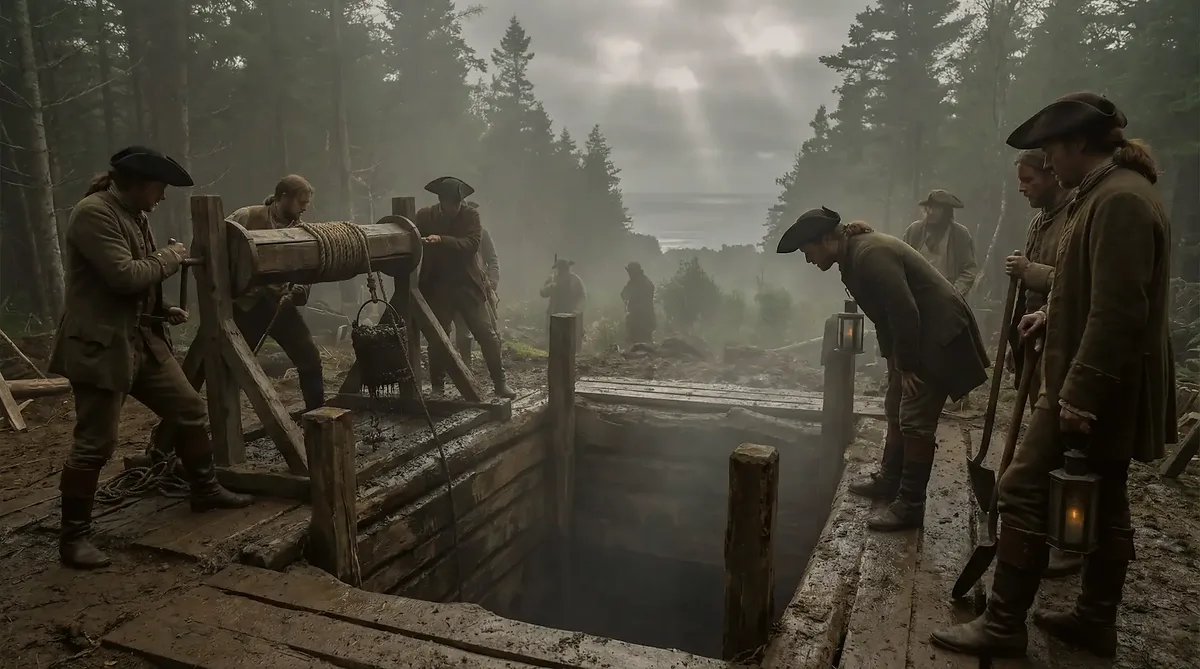
The Oak Island version of events diverges sharply from the documented historical record. According to this theory, Marie Antoinette did not send her jewels to Austria at all. Instead, she entrusted them to a lady-in-waiting (whose identity has never been established) who fled Paris with the gems and made her way to London. From there, the faithful servant crossed the Atlantic to the former French fortress of Louisbourg in Nova Scotia. Accompanied by loyalist French soldiers, she then buried the jewels in a secure underground vault, possibly the very shaft that would become known as the Money Pit when it was discovered in 1795.
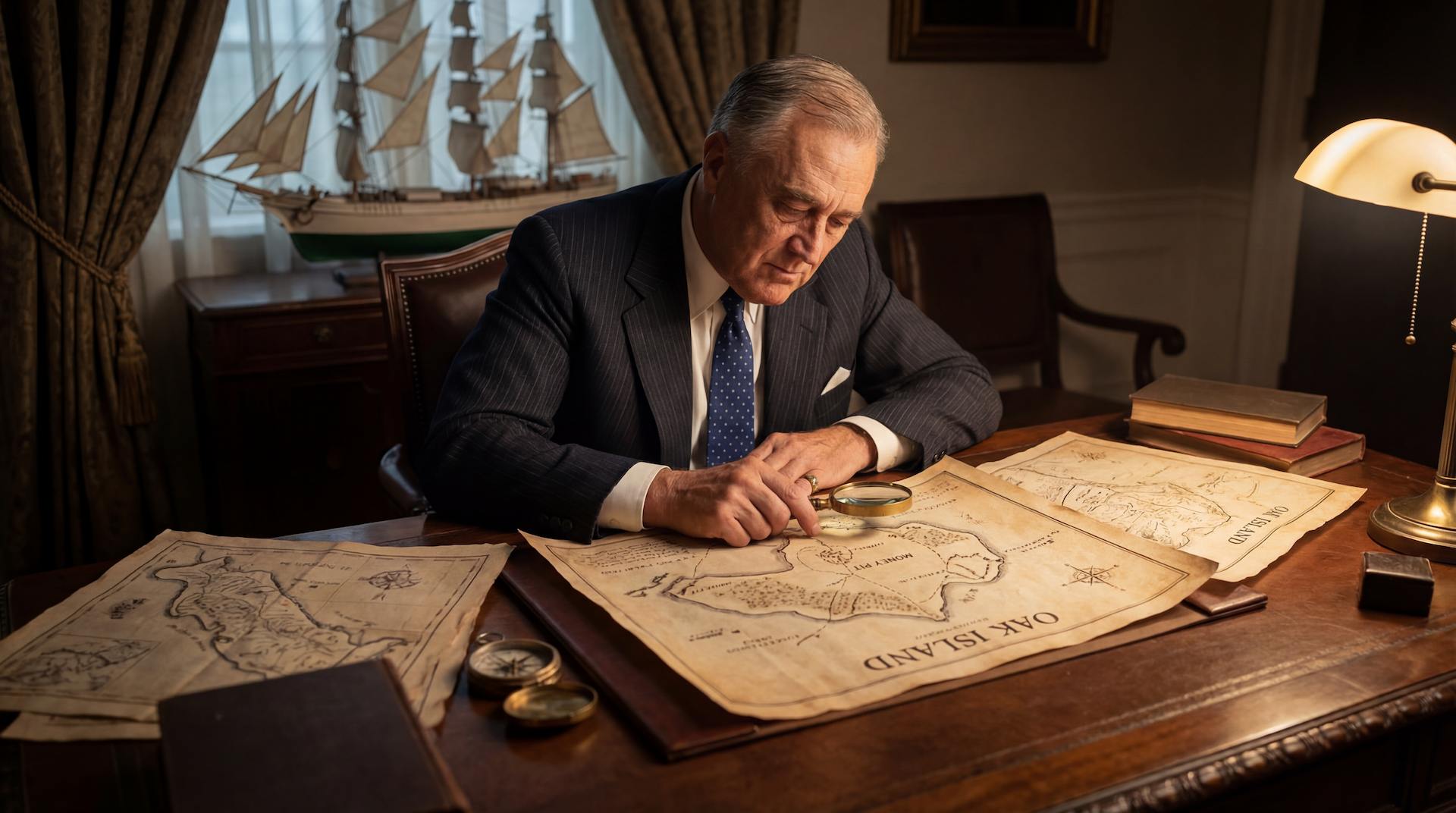
The theory gained its most prominent endorsement from Franklin D. Roosevelt, the 32nd President of the United States. Roosevelt's connection to Oak Island ran in the family: his maternal grandfather, Warren Delano Jr., a wealthy trader who had made his fortune in the China trade, was a shareholder in the Truro Company, the second major treasure-hunting syndicate to work the island, which operated from 1849 to 1851. The young Roosevelt, stirred by family stories of buried treasure, invested in the Old Gold Salvage and Wrecking Company in 1909 and visited Oak Island that summer. He retained his interest in the mystery for the rest of his life, corresponding with landowners and treasure hunters through his presidency and even planning a visit to the island during a trip to Halifax in 1939, though fog and the approaching war prevented it.
Documents uncovered at the FDR Presidential Library in Hyde Park, New York, by researcher Paul Troutman and shown to Rick Lagina and Alex Lagina in Season 4, Episode 12 ("Hyde Park and Seek"), confirmed that Roosevelt believed Oak Island's treasure consisted of the lost jewels of Louis XVI and Marie Antoinette. A transcript of an interview with Duncan Harris, a schoolmate and confidant of Roosevelt, recorded by biographer Joseph P. Lash, specifically names the French crown jewels as the treasure FDR believed was buried on the island.
Evidence on the Island
1 min
While no artifact recovered on Oak Island has been definitively linked to Marie Antoinette or the French court, a discovery in Season 5 briefly reignited interest in the theory. In Episode 16 ("Seeing Red"), metal detection expert Gary Drayton and Rick Lagina were working on Lot 8 when Drayton unearthed a metal brooch with an empty socket at its centre. Moments later, probing the same hole, he recovered a red gemstone enclosed in a metal ring, the brooch's missing centrepiece. A gemologist later identified the stone as a rhodolite garnet, cut to fit the brooch approximately 400 to 500 years ago. While the dating placed the piece well before the French Revolution, the discovery of a genuine jeweled artifact on the island lent a certain weight to theories involving buried gems of any origin.
Beyond the brooch, the broader pattern of 18th-century artifacts found across the island, including coins, buttons, and military hardware from the 1700s, confirms that people were active on Oak Island during the period in question. The theory does not require that the Money Pit itself was built by Marie Antoinette's agents; some proponents suggest the jewels could have been deposited in an existing structure or hidden elsewhere on the island entirely.
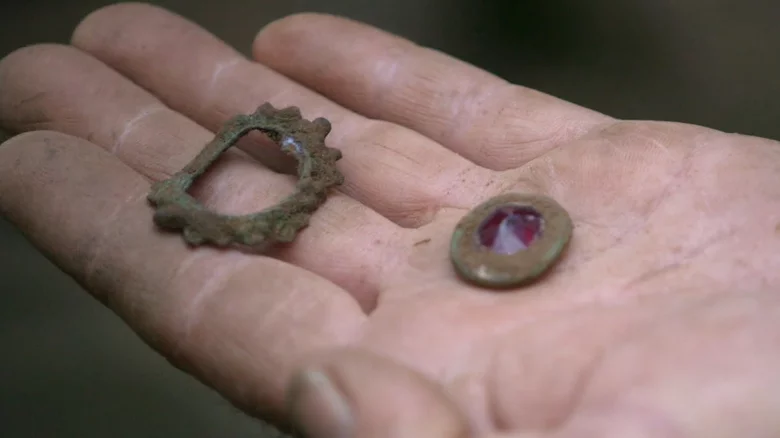 Jewelled brooch (rhodolite garnet)→
The Problems
2 min
The Marie Antoinette theory faces serious historical objections, several of which were identified as early as 1958 by R.V. Harris, a Nova Scotian lawyer and Freemason closely associated with the Oak Island treasure hunt, in his book The Oak Island Mystery.
The most damaging is the documented fate of Marie Antoinette's personal jewels. History records, through Madame Campan's own accounts and the paper trail left by Count Mercy-Argenteau, that the queen's private collection was sent to Vienna in the spring of 1791, months before the Flight to Varennes. The jewels passed through the hands of the queen's surviving daughter, Marie-Therese de France, to the Duchess of Parma, and down through the royal House of Bourbon-Parma. In November 2018, ten pieces from this collection, unseen in public for over 200 years, were sold at Sotheby's in Geneva. Among them were Marie Antoinette's natural pearl and diamond earrings, a diamond brooch, a pearl necklace, and a diamond ring containing a lock of the queen's hair. Their provenance was meticulously documented. Separately, a set of 21 natural pearls given by Marie Antoinette to Lady Sutherland, the wife of the British ambassador, before the flight were auctioned by Christie's in 2007.
As for the official Crown Jewels, they were stolen from the Garde-Meuble in September 1792, more than a year after the Flight to Varennes, by common thieves rather than royal agents. Most of the stolen pieces were eventually recovered by French authorities.
Harris also noted a geographic problem: the Fortress of Louisbourg, where the lady-in-waiting supposedly made landfall, had been in British hands since 1758, captured during the Seven Years' War more than three decades before the Revolution. A French loyalist fleeing revolutionary Paris would have found the fortress garrisoned by British troops, not the sympathetic French soldiers the legend requires. Finally, the timeline is extremely compressed. The jewels would have had to cross the Atlantic, reach Nova Scotia, and be buried in an elaborately engineered underground vault sometime between mid-1791 and the summer of 1795, when the Money Pit was first discovered. By that period, Oak Island and the surrounding communities along the Mahone Bay shore were inhabited by English-speaking settlers, making a large, secret construction project difficult to carry out unnoticed.
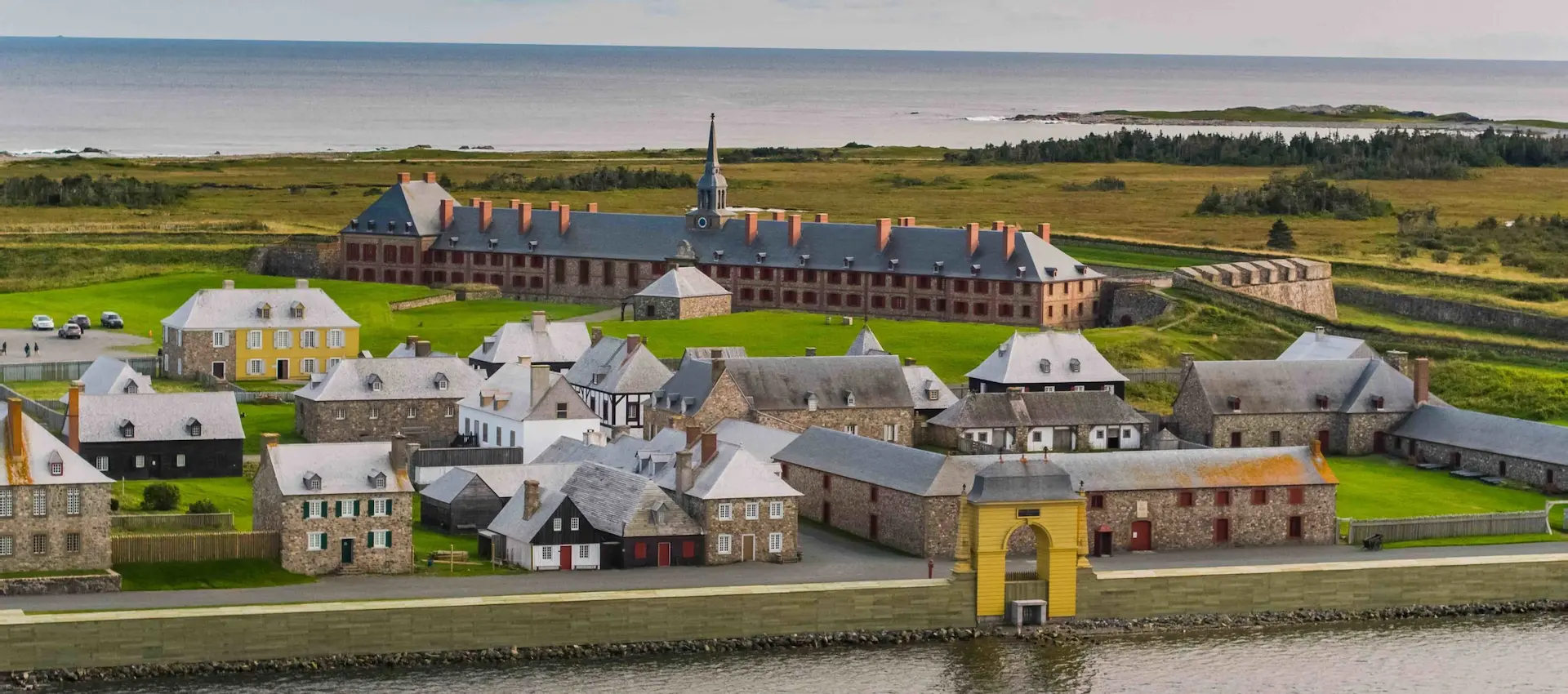 Fortress of Louisbourg→
A Theory That Endures
1 min
Despite these objections, the Marie Antoinette theory has proven remarkably durable. It benefits from a story too dramatic to easily dismiss: a queen facing the guillotine, a secret chest of diamonds, a loyal servant's flight to the New World. It also carries the weight of Roosevelt's endorsement, a detail that lends it a gravity that more obscure theories lack. The Sotheby's auction of 2018 may have accounted for the queen's personal collection, but it did not account for every jewel that passed through the French court during the revolutionary period. Gems disappeared into private hands, were broken from their settings and recut, or simply vanished in the chaos. Whether any of them reached Nova Scotia remains, like so much about Oak Island, a question that the evidence has yet to answer.
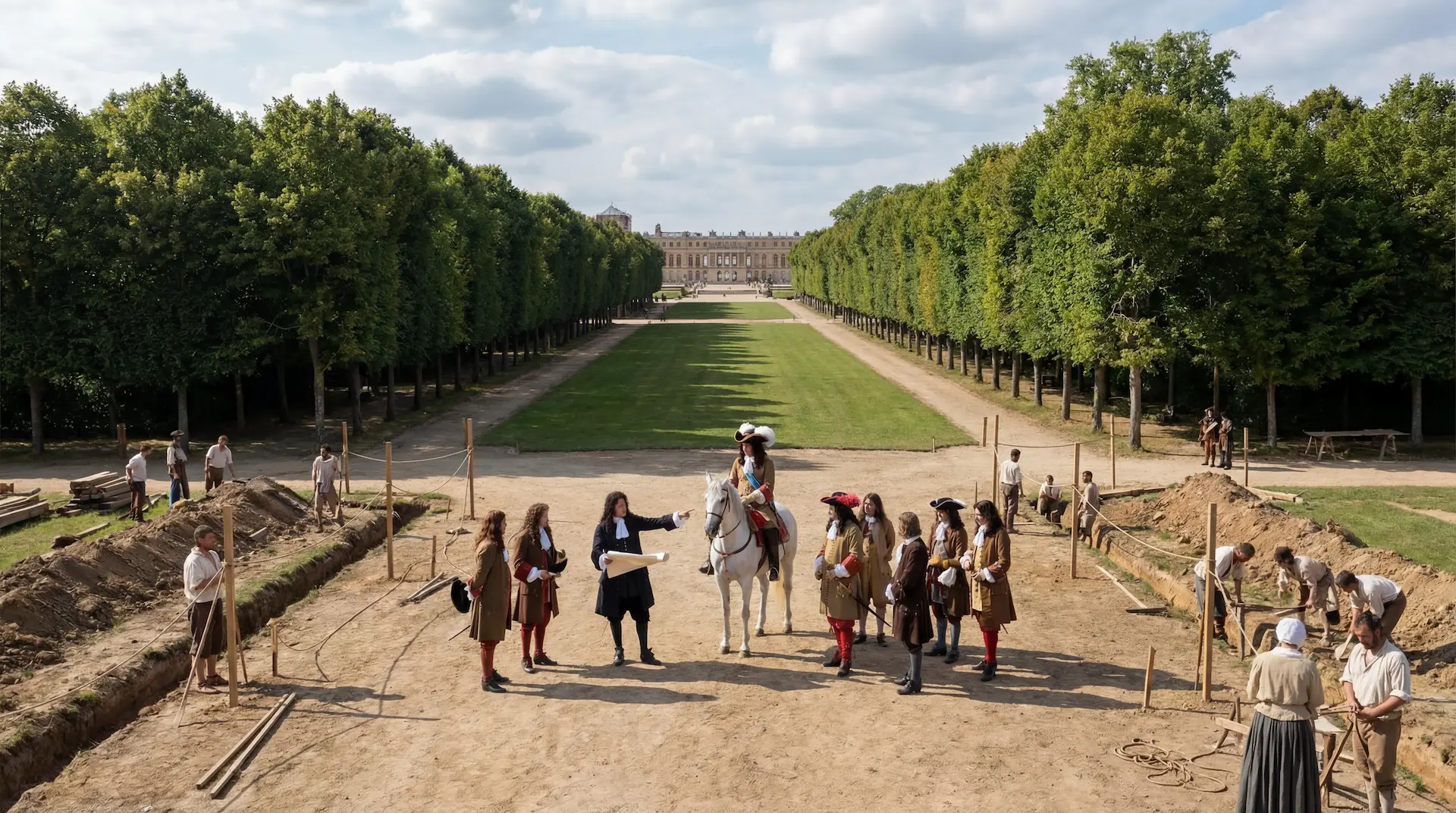 The Versailles Alignment to Oak Island→