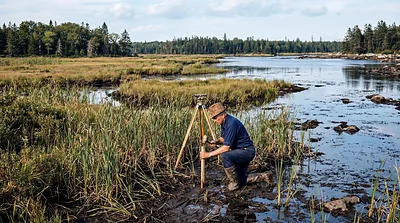
Choice Drilling begins retrieving core samples from the swamp ship anomaly, operating a five-ton sonic rig staged on an 800-square-foot floating barge. Rick and Marty Lagina, Craig Tester, Tom Nolan, Paul Troutman, Charles Barkhouse, and Doug Crowell monitor the extraction. The organic layer proves remarkably thin, giving way almost immediately to hard, dry clay similar to what is found in the Money Pit area. At roughly 21 feet, the clay is bone dry, an unexpected condition that Craig and Rick find significant. At approximately 29 feet, the drill encounters a rock-like cap layer so dense it reaches the point of refusal, forcing the team to reposition the rig. Later cores drilled into "ship anomaly 4" at 54 to 57 feet return no wood, ruling out a sunken vessel at that location. The dry clay, however, raises a new possibility: the conditions are ideal for tunneling, and the anomaly may represent a buried passage rather than a ship. Meanwhile, Rick and Marty bring the swamp cores to geoscientist Dr. Ian Spooner, a professor of earth and environmental science at Acadia University in Wolfville with over two decades of experience in wetland geology. After examining the thin organic layer and the marine sediment interface, Spooner determines the swamp was once open ocean and appears far younger than expected. He takes the samples to his lab for detailed analysis.
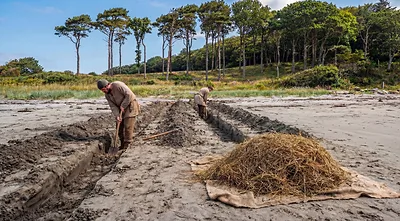
Craig Tester, Alex Lagina, and archaeologist Laird Niven meet with ground-penetrating radar experts Don Johnston and Steve Watson at Smith's Cove. Using a Noggin 100 GPR device, the team scans the upper beach area where they believe the five stone box drains may converge into a single flood tunnel leading to the Money Pit. The scan identifies anomalies at approximately five metres below the surface. The GPR team then moves to the Cave-In Pit, the sinkhole created in 1878 when farmer Sophia Sellars and her oxen fell through the ground roughly 350 feet east of the Money Pit. At a depth of 28 metres, roughly 90 to 100 feet, the radar detects a feature with both a top and bottom surface consistent with a tunnel. The alignment runs cleanly from Smith's Cove through the Cave-In Pit toward the Money Pit.
On Lot 21, metal detection expert Gary Drayton, Rick Lagina, and veteran treasure hunter Dan Henskee uncover two heavy iron objects initially mistaken for quarry hammers. The artifacts are brought to the War Room, where blacksmithing expert Carmen Legge examines them alongside other recently discovered metal items. Legge identifies the objects not as sledgehammers but as swages, specialised tools used to sharpen rock-drilling chisels, and estimates they could date as far back as the 1400s. The find carries particular weight because the western drumlin of Oak Island, where Lot 21 is located, is composed of compacted slate, a metamorphic rock that would require exactly this kind of drilling tool to penetrate. The eastern drumlin, where the Money Pit sits in softer anhydrite limestone, would not. Fred Nolan and Dan Blankenship had each independently concluded that depositor activity extended beyond the Money Pit into the western side of the island, and the swages now provide the first physical evidence to support that theory.
Craig, Doug Crowell, and Laird Niven oversee the positioning of additional drill sites at Smith's Cove based on the GPR results. Geologist Terry Matheson and surveyor Steve Guptill join the effort, targeting depths between 50 and 120 feet in the upper beach area where the flood tunnel is believed to pass. The team plans a series of boreholes along the projected tunnel line, with the goal of intercepting the structure at two or more points and tracing its path back to the Money Pit.