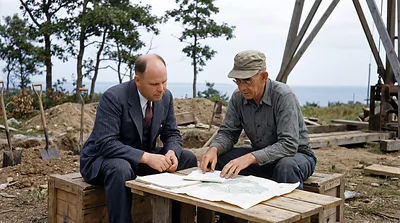
At Smith's Cove, Rick Lagina, Craig Tester, and geologist Terry Matheson continue excavating a newly discovered wooden structure that appears to parallel the U-shaped structure found by Dan Blankenship in the 1970s. They determine it is the L-shaped structure, a 50-foot-long formation of wood and small stones that Blankenship partially exposed before a massive storm destroyed his cofferdam and halted his investigation. Rick notes the structure is open-ended and packed with an inordinate amount of clay-rich till and rock, but its purpose remains unclear. Metal detection expert Gary Drayton, working nearby, recovers a curved piece of lead with a scrolling design and sloped edges near the same area where the medieval cross was found the previous year. Laird Niven records the find, and Gary speculates it could be connected to the cross.
In the War Room, gyro survey expert Tory Martin, along with Rob Hyslop and Ryan Levangie of Azimuth Consulting Limited, present a three-dimensional laser scan analysis of the inscribed stone Tory discovered near the Money Pit two weeks earlier. The scan reveals a perfectly flat surface too straight to be natural and a series of markings with regular linear spacing perpendicular to the flat face. Doug Crowell identifies the characters as possibly futhark, a runic language used by Germanic tribes and in Scandinavia dating back to the first century AD. Alex Lagina and researcher Paul Troutman travel 140 miles southwest to the Yarmouth County Museum, where museum director Nadine shows them the Yarmouth Runic Stone, discovered in 1812. Its most widely accepted translation reads "Leif to Erik," suggesting a Viking connection to Nova Scotia.
Rick, Marty, and Craig meet in the War Room with Dave Blankenship, Charles Barkhouse, and the rest of the team to finalize the season's Money Pit strategy. They agree on two priorities: relocating the Shaft Six tunnel to zero in on the original treasure shaft, and re-entering borehole H-8 to recapture the Chappell Vault, the seven-foot-tall wooden structure first identified by treasure hunters William Chappell and Frederick Blair in 1897. The previous season, the object was pushed aside into a mud-filled void at roughly 170 feet when the 50-inch caisson attempted to penetrate it. The plan is to raise the caisson several feet to create a vacuum effect that draws the displaced material back into the shaft, then use the hammer grab to extract it.
The ROC Equipment team returns to Oak Island with the 50,000-pound rotating oscillator capable of applying three million pounds of torque. Danny, Vanessa Lucido, and John Lee begin unloading equipment while Irving Equipment assembles a 220-ton Liebherr 895 duty cycle crane at the Money Pit site. Marty expresses strong conviction that H-8 is the original Money Pit area, and the team prepares to begin hammer-grabbing as soon as the crane is operational.
Back at Smith's Cove, as Rick, Alex, archaeologist Laird Niven, and heavy equipment operator Billy Gerhardt continue exposing the L-shaped structure, they uncover a series of notched beams and horizontal logs arranged as rollers, consistent with a slipway designed for hauling heavy loads. Laird identifies it as the structure first reported by treasure hunter Gilbert Hedden in 1936, who discovered two large timbers held together with wooden pegs while building a wharf at Smith's Cove. Hedden concluded the formation was an ancient boat slip but lacked the resources to dig below the low-tide mark. Like the U-shaped structure, the slipway contains no metal fasteners, a detail Laird considers archaeologically unique and potentially significant for dating purposes.