Alex Lagina, Doug Crowell, and Paul Troutman travel ten miles northeast to the Lordly House in Chester, Nova Scotia, where the Chester Municipal Heritage Society maintains an extensive archive of Oak Island searcher records. Among the collection, Doug discovers a remarkably detailed 1863 article from The Yarmouth Herald describing the five finger drains found at Smith's Cove by the Truro Company in 1850. According to the account, each drain measured 66 feet long, the two outermost were 66 feet apart, and they converged within four feet of each other at a collection point leading to a flood tunnel. The drains were built from two flat stones placed on their edges in a triangular configuration, covered with coconut fiber. At the Mug and Anchor pub in Mahone Bay, the researchers share the findings with Rick, Marty, Gary Drayton, and Jack Begley. Marty notes the U-shaped structure measures 20 meters across, nearly matching the 66-foot dimension.
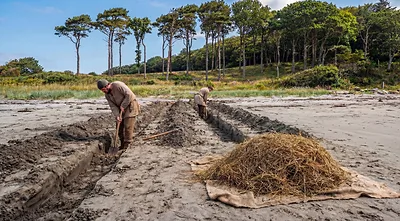
At Smith's Cove, Doug Crowell and Charles Barkhouse pump out water that has flooded the area around the U-shaped structure overnight. Between two rocks near the wall, Doug spots a triangular-shaped opening matching the 1863 description of the box drains, with a steady trickle of water flowing through it. Charles pulls coconut fiber from the adjacent soil, a material historically associated with the original flood tunnel system and found over 1,500 miles from the nearest coconut tree. Rick Lagina arrives and agrees the formation appears man-made. Archaeologist Laird Niven and geologist Terry Matheson examine the stones and confirm the construction is consistent with a drain system, though Terry cautions the proof will come from following the feature back toward the Money Pit to see if a pattern emerges. Billy Gerhardt begins carefully removing overburden as the team traces the possible drain.
At the Money Pit, Craig Tester meets with gyroscope operator Tory Martin to survey the exploratory boreholes drilled during recent coring operations. Using a down-hole gyroscope that measures deviation as it descends, Tory determines that one borehole walked 8.7 feet east and four feet north at depth, while recording 5.3 feet of eastward deviation at the critical 100-foot level where the team expects to intersect the Shaft Six tunnel. The data will help the team understand whether their drill targets are hitting their intended locations or drifting off course, information essential for pinpointing the original Money Pit.
While assembling his equipment near the Money Pit, Tory Martin notices a strange stone lying in the woods by the old well. Rick, Craig, and Dan Henskee examine it and find a flat surface too straight to be natural, with raised ridges and linear carvings resembling Roman numerals. At the Oak Island Research Center, geologist Terry Matheson identifies the rock as metamorphosed graywacke and concludes it appears to have been worked and possibly decorated. Paul Troutman arranges for Rob Hyslop and Ryan Levangie of Azimuth Consulting Limited to laser-scan the stone using a Trimble CX scanner, with talcum powder applied to increase surface reflectivity. The preliminary 3-D model reveals undulations and markings requiring further digital enhancement.
Back at Smith's Cove, Rick and Craig check on the excavation progress as the team continues tracing the possible box drain northwest toward the Money Pit. Terry Matheson identifies a layer of black sand that marks a transition point in the stratigraphy. Below it, the team uncovers yet another structure: a series of wedge-bottomed boards backed by a dense concentration of uniformly sized boulders. Terry observes that the stones appear deliberately selected for their manageable size, and Rick wonders whether the formation represents an aborted construction effort or part of the original depositors' work. The discovery adds to the growing inventory of previously unknown structures beneath Smith's Cove.