The season opens with the team gathered in the War Room to outline plans for the year. Gary recalls nonferrous detector hits at the bottom of the Garden Shaft from the previous season. Although the 82-foot structure is not believed to be the original Money Pit, it contains wood dated to 1735 and water with traces of gold. Dumas will deepen the shaft another 20 feet once permits arrive, enabling lateral tunnel construction if targets are found. Dr. Fred Michel joins by video conference to review water testing from the Money Pit boreholes: samples taken between 80 and 120 feet showed gold, silver, and other metals concentrated in the Baby Blob, a zone just west of the Garden Shaft where a tunnel at 95 feet may run underneath. Laird introduces new archaeologists Jamie Kouba and Moya MacDonald and explains that new team member Danny Hennigar has provided historical photographs of the circular feature from the Young family, who previously owned Lot 5. Four permitted swamp areas are discussed, and Tony Sampson is proposed for a dive in the waters north of the island.
At the Money Pit, the season's first borehole B5N13 produces a dense core at 88 feet and saturated, loose material at 109 feet, just 2.5 to 5 feet from the Baby Blob's highest metal readings. Charles and Alex speculate they may be near Shaft 6, an 1800s excavation dug 18 feet west of the original Money Pit to a depth of 118 feet. A lateral tunnel from Shaft 6 toward the Money Pit flooded catastrophically, collapsing both shafts and burying the tunnel with debris and possibly treasure. Borehole E5N-9.5 is drilled a few feet west of the Garden Shaft in the Baby Blob area, followed by DN12, positioned less than 3 feet from last year's DN11.5 where an eight-foot-high chamber was struck at 90 feet containing gold-bearing wood. A core from 97 feet reveals more wood in what appears to be a collapsed chamber. The team will test the wood for metals.
On Lot 5, Jack, Laird, Jamie, and assistant Fiona Steele continue investigating the circular depression found the previous year. The feature was altered by the late Robert Young, who once owned the lot. Fiona locates pieces of red earthenware with unusual purple and black glaze that Laird dates to the 1600s. Gary scans the area and detects substantial iron. Laird recovers an iron piece from the depression that Marty takes to the lab. Rick and Gary return later and unearth a decorative strap along with multiple coins. At the Interpretive Center, Emma's CT scan of the iron piece reveals a shape Marty compares to a doorknocker, though Laird identifies it as a river raft spike. The XRF shows high iron with no manganese, indicating it is pre-1840, and it does not match any item in Emma's database. Laird then reveals that Frank White provided artifacts from the William Phips birthplace in Maine for analysis, and Emma found them to be a 100 percent match to the latch from Lot 5.
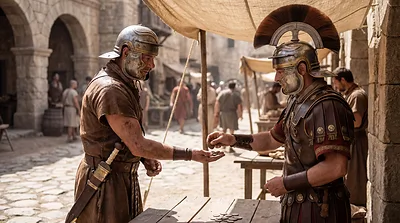
Numismatist Sandy Campbell examines the coins. The first, containing 94 percent copper and 5 percent silver with no tin or lead, is a British Tudor portcullis coin from the 1500s. The second, with copper, silicon, lead, and tin, is a Roman coin from 100 to 300 A.D. The third carries a woven pattern and a brass, iron, manganese, calcium, and phosphorous composition that Emma says matches a 13th-century French denier. Sandy believes it could be from India and from the 6th to 8th century. The fourth coin Sandy identifies as Roman and probably more than 2,000 years old.
Diver Tony Sampson, joined by Alex, Jack, and underwater imaging expert Ken Deboer with an ROV, explores waters just north of Oak Island looking for evidence of the artificial wall Fred Nolan believed existed near the swamp. Tony metal detects the bottom as he searches and discovers a piece of worked timber measuring roughly 12 by 6 inches, followed by additional timber nearby. Near a large boulder he finds pieces of pottery with blue markings and a clay pipe stem. His metal detector then picks up what he thinks could be a coin near the boulder, but provincial government permission will be needed before it can be removed and examined.