Scott Barlow, Paul Troutman, and Charles Barkhouse meet with Roger Fortin to resume the probe drilling program beneath the Garden Shaft, now using a six-inch bit to reach the tunnel believed to lie just a few feet below. The tunnel is also thought to run toward the Baby Blob, where water samples have revealed evidence of silver and gold. The following day Rick and Marty Lagina arrive to check progress. At 93 feet the drill begins to bind up, and Paul notices material clinging to the side of the bit. Roger radios his team to stop drilling and bag the filings. Rodney MacIver tells the group he is 99.9 percent sure they struck wood on the north side, and he and Scott agree the bit likely went down the side of the tunnel, giving Rick a way to project its line. Rick and Marty then descend into the shaft with Roger, and Rick suggests bringing metal detection expert Gary Drayton down to scan below the flooring. Gary arrives with the CTX-3030, which can differentiate between metals, and picks up a nonferrous signal at the depth where tunnels and gold-bearing water have been found. The season is ending, however, and Dumas does not have the permits needed to extend the shaft, leaving the source of Gary's signal for next year.
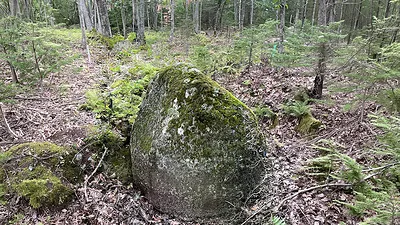
On Lot 5, Rick, Marty, Alex Lagina, Jack Begley, and archaeologist Laird Niven continue excavating the 13-foot-diameter circular stone feature located close to where the team recovered a half Roman coin and a lead barter token. Because the pit's dimensions match those of the original Money Pit, the team considers whether this could be the Hole Under the Hatch noted on Zena Halpern's map. Gary scans the feature and Laird recovers an old nail, which he says could indicate a structure once stood above the pit. As excavation progresses, Laird taps the ground beneath the lowest rocks and it does not sound solid. The construction resembles the wall on Lot 26 that contained charcoal dated to the 15th century and that Portuguese researcher Francisco Nogueira identified as consistent with Portuguese building techniques.
In the War Room, the team reviews carbon dating results from organic material found beneath the stone ramp in the swamp. A stick recovered under the second layer of rock dates to 1495 to 1656, placing the ramp's construction in roughly the same period as the stone road and stone path.
The season closes with a final War Room session. Scott reports that more than 800 artifacts were recovered across the island, while Steve Guptill confirms the team drilled over 500 boreholes and more than 20 caissons. Dr. Ian Spooner shares a water testing update on behalf of Dr. Fred Michel, noting that the Garden Shaft water contained some of the highest gold levels found anywhere on the island, with the data pointing to something significant within a 15-foot radius of the shaft. Terry Deveau and Ian discuss the tunnel systems tracked during the season. Rick outlines next year's priorities: deepening the Garden Shaft, accessing the tunnel below, and tunneling from the bottom of the shaft. The team also reviews the Lot 26 wall, dated to 1464, and the nearby well believed to have been constructed between 1028 and 1172, placing it in the same era as the swamp's paved area. Discussion turns to the Italy trip, where the team found Templar carvings in cave systems at Camerano and Osimo, Alex Lagina proposed that the Latin letters HIC carved in a church pillar at Santa Maria Nuova in Viterbo could be transformed into the symbols on the HO stone to read "Here Templar Gold," and archaeoastronomer Professor Adriano Gaspani used stellar alignments to date the creation of Nolan's Cross to 1200 A.D. Rick reflects on the ten-year journey that began with a Reader's Digest article and tells the group he is more committed than ever to continue.