The Most Dangerous Commodity
1 min
In the early 18th century, the substance that kept the British Empire afloat was not gold or silver but a thick, black, foul-smelling liquid extracted from burning pine trees. Tar, and its concentrated derivative pitch, were as essential to the Royal Navy as gunpowder. Every rope on every warship was dressed in tar to prevent rot. Every hull was sealed with pitch to keep the sea out. Every mast, every spar, every plank on every deck depended on these products for preservation against salt water, sun, and the relentless biological assault of the open ocean. A single first-rate ship of the line consumed between 30 and 40 barrels of tar and pitch per year just for maintenance, and Britain in this period maintained the largest navy in the world.
The problem was supply. For centuries, Britain had purchased virtually all of its tar and pitch from Sweden and the Baltic states, a dependency that left the entire fleet hostage to Scandinavian politics and the whims of foreign merchants. When the Great Northern War disrupted Baltic shipping routes after 1700, the Admiralty faced a genuine strategic crisis. Parliament responded with the Naval Stores Act of 1705, offering generous bounties to anyone who could produce tar, pitch, turpentine, and ship masts in the American colonies. The race to find new sources of naval stores became one of the defining economic imperatives of early colonial America, and it would eventually reach a small island in Mahone Bay, Nova Scotia, or so one theory contends.
A Kiln in the Ground
2 min
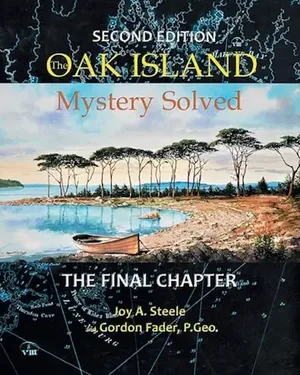
Joy A. Steele, a freelance researcher based in Sydney, Nova Scotia, spent nearly two decades investigating Oak Island's history through primary and secondary archival sources before publishing The Oak Island Mystery, Solved in 2015 through Cape Breton University Press. Her conclusion was unlike anything proposed before: the Money Pit was not a treasure vault, a Templar repository, or a pirate cache. It was, she argued, the collapsed remains of a pine tar kiln.
To understand the argument, it helps to understand how colonial tar kilns actually worked. The process was described in detail by Jonathan Bridger, the Surveyor General of the Woods in America, who was sent to New England in the 1690s to organize colonial naval stores production (his 1706 kiln-building instructions appear as an appendix in Steele's book). A tar kiln was not a surface structure. Workers began by excavating a shallow, bowl-shaped depression in the ground, typically 15 to 25 feet in diameter, sloping inward toward a central drain. They lined the bottom with a channel, often made from a split and hollowed pine log, which led outward to a collection point where barrels could catch the liquid tar as it flowed. The pit was then filled with carefully stacked pine logs, branches, and stumps, rich in resin. The entire mound was covered with earth and turf to restrict airflow, and the wood was set alight. Over the course of several days, the slow, oxygen-starved burn drove tar out of the pine, and gravity carried it down through the stacked wood to the drainage channel below. A kiln 20 feet across and 14 feet high could produce roughly 200 barrels of tar, a single cord of good pitch pine yielding between 40 and 60 gallons.
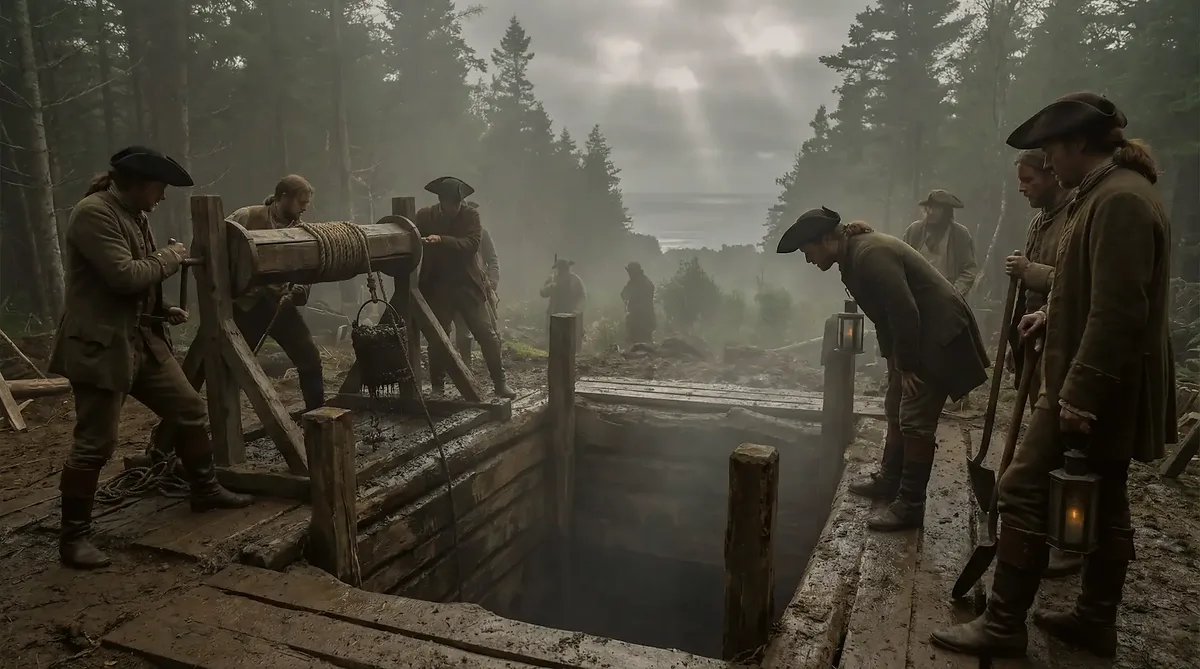
The parallels to the Money Pit, as described by early treasure hunters, are what caught Steele's attention. The layered oak log platforms found at approximately ten-foot intervals during the original 1795 and 1803 excavations resemble the stacked fuel layers of a kiln. The charcoal discovered at 40 feet, the putty at 50 feet, and the coconut fibre at 60 feet all have functional equivalents in kiln construction and maritime caulking. The underground channels interpreted since the 19th century as ingeniously engineered flood tunnels could, in this reading, be the drainage infrastructure through which liquid tar once flowed to collection barrels. Even the depression in the ground that reportedly first attracted Daniel McGinnis and his companions in 1795 is consistent with the subsidence pattern of a spent and collapsed kiln. Steele further proposed that the Cave-in Pit, discovered approximately 350 feet east of the Money Pit in 1878, represents a second kiln, and that the structures at Smith's Cove may have functioned as a ship repair and careening facility rather than as the inlet for an artificial flooding system.
The South Sea Company and the Bubble
1 min
If Oak Island was a tar manufacturing site, who operated it, and why did they stop? Steele's answer centres on the South Sea Company, one of the most notorious enterprises in British financial history.
Founded in 1711 by an Act of Parliament, the South Sea Company was established as a public-private partnership to consolidate Britain's mounting national debt while exploiting trade monopolies with Spanish colonies in South America. Under the Treaty of Utrecht (1713), Britain secured the asiento, a contract granting exclusive rights to supply enslaved Africans to the Spanish Empire, and the Company became the vehicle for that trade. Its operations extended beyond slave trafficking to encompass a wide range of colonial commercial ventures, including, Steele argues, the production of naval stores at remote coastal sites in Nova Scotia.
The Company's ambitions collapsed spectacularly in September 1720 when its massively inflated stock price crashed from a peak of roughly 1,000 pounds per share to under 200 by December. The South Sea Bubble, as the event became known, ruined investors across Britain (Isaac Newton reportedly lost the equivalent of 40 million pounds in modern currency), brought down government ministers, and triggered what many historians consider the first international stock market crash. Subsidiary operations, including any colonial manufacturing ventures, would have been abandoned virtually overnight as the Company's financial structure disintegrated.
Steele proposes that this timeline explains one of Oak Island's enduring puzzles: why the site shows evidence of significant industrial activity that was suddenly and permanently abandoned. If a South Sea Company operation was producing tar on Oak Island around 1720, the Bubble's collapse provides a clean economic motive for walking away. It also aligns with one of the oldest elements of Oak Island folklore, the accounts from mainland settlers who reported seeing mysterious fires burning on the island at night during this period, fires that abruptly ceased. Tar kilns, which burned continuously for days and flared unpredictably, would produce exactly this kind of nocturnal glow.
The Geological Framework
1 min
The 2019 expanded edition, The Oak Island Mystery, Solved: The Final Chapter, brought a significant new voice to the argument. Gordon Fader, a professional marine geologist registered in Nova Scotia and former Emeritus Scientist at the Geological Survey of Canada (Atlantic) at the Bedford Institute of Oceanography, contributed a chapter on the island's geological framework that addressed one of the treasure narrative's central pillars: the supposed flood tunnel system.
Fader's geological analysis begins with the bedrock. The southeastern half of Oak Island, where the Money Pit is located, sits on Mississippian Windsor Group limestone and gypsum, while the northwestern portion rests on older Cambro-Ordovician Halifax Formation slate. Gypsum is roughly 150 times more soluble than ordinary limestone, meaning that groundwater moving through the substrate naturally dissolves voids, channels, and cavities over time. This process produces exactly the kind of water intrusion that treasure hunters have attributed to elaborate man-made flood tunnels since the 19th century. In Fader's analysis, the water that has defeated every excavation attempt for over two centuries is not evidence of engineering genius but of basic hydrology: tidal pressure pushing seawater through naturally dissolved channels in soluble bedrock.
Fader also documented the presence of sinkholes in the waters surrounding Oak Island through multibeam bathymetric surveys conducted for the Geological Survey of Canada. Small circular depressions visible on the seabed southwest of the island may represent pockmarks or sinkholes formed by the same dissolution processes at work beneath the Money Pit area. The implication is that the original depression discovered in 1795 may not have been the surface expression of an excavated shaft at all, but rather the natural subsidence of material into an underground void, a sinkhole that was subsequently misinterpreted through the lens of treasure-hunting expectation.
Evidence on the Ground
1 min
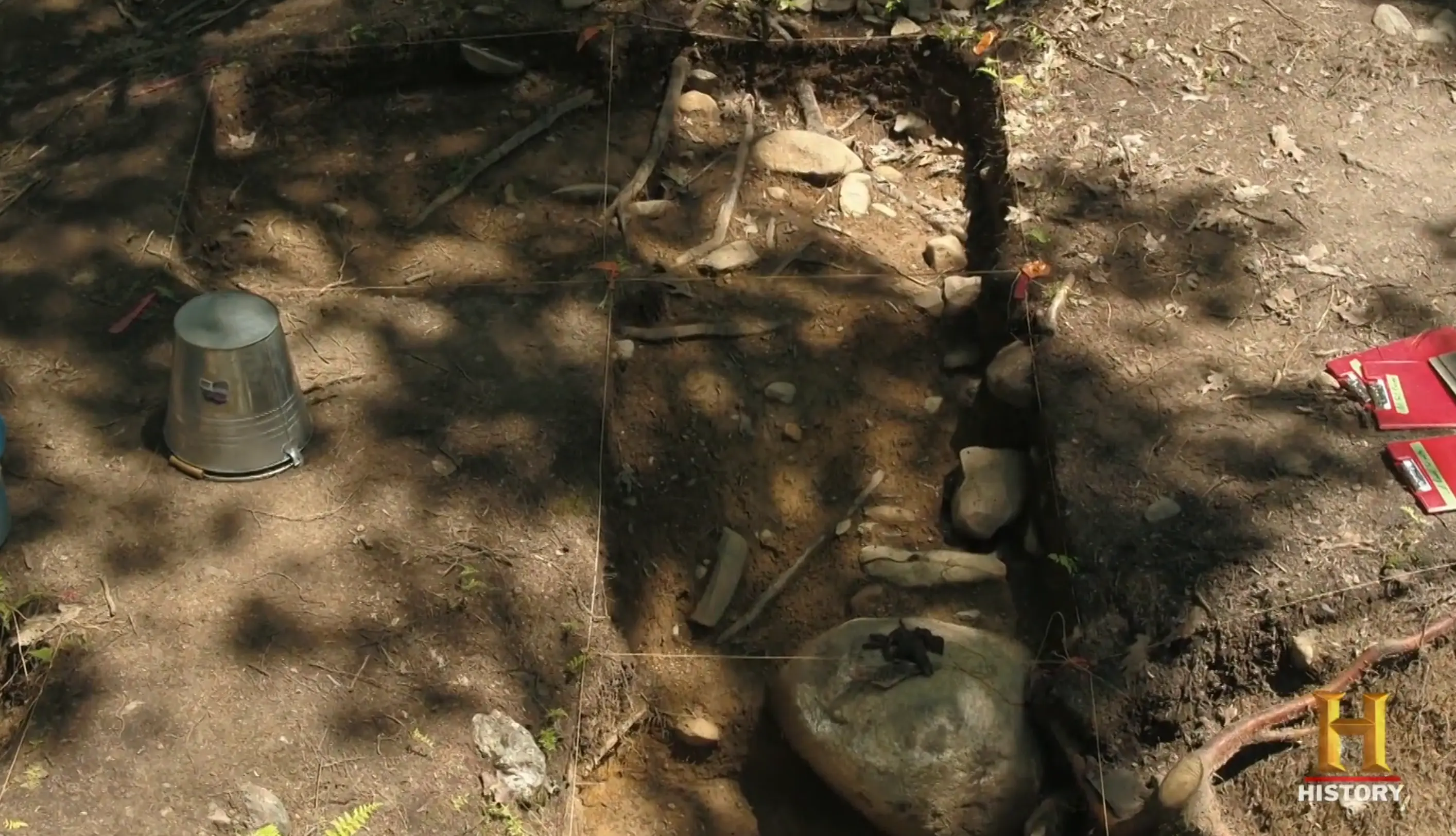
The theory received a tangible boost during Season 8 of The Curse of Oak Island (2020) when archaeologists excavated a stone structure on Lot 15, not far from the Money Pit area. Archaeologist David MacInnes, a direct descendant of Daniel McGinnis who discovered the original pit in 1795, led the excavation alongside Aaron Taylor. The team identified the feature as the remains of a pine tar kiln, noting extensive charcoal deposits indicating repetitive and continuous burning over time. Laird Niven, the project's senior archaeologist, observed that while tar kilns were typically associated with ship maintenance, this one could also have been used in construction of the Money Pit itself, a statement that acknowledged the Steele thesis without fully endorsing it.
The discovery prompted further investigation. Metal detection expert Gary Drayton and Jack Begley recovered a string of ox shoes along a line running from the swamp toward Lot 15 and onward to the Money Pit. Blacksmith expert Carmen Legge dated the shoes to approximately 1650 to 1750 and identified them as British military pattern, suggesting heavy cargo was being hauled along a consistent route during the period Steele's theory describes. The ox shoes were found in terrain unsuitable for farming, which pointed to industrial transport rather than agricultural activity. Later excavation beneath the tar kiln revealed a layer of deliberately placed stones, raising the question of whether the structure concealed something more complex, possibly a backfilled tunnel entrance matching Fred Nolan's survey data.
 Pine Tar Kiln→
What the Theory Explains
1 min
The tar kiln theory's principal strength is its ability to reinterpret a large number of Oak Island's features through a single, historically documented framework. The oak platforms become fuel layers. The charcoal becomes combustion residue. The coconut fibre, which has puzzled researchers since its discovery (coconut palms do not grow in Nova Scotia), becomes caulking material imported from tropical ports for ship maintenance at the Smith's Cove careening facility. The underground channels become tar drainage infrastructure. The flooding becomes natural hydrology. The mysterious nocturnal fires become kilns burning through the night. The sudden abandonment of the site becomes a consequence of financial collapse. Each element that treasure theorists have cited as evidence of elaborate construction, Steele reinterprets as a standard component of 18th-century naval stores manufacturing.
The theory is also grounded in documented history rather than speculation about lost relics or secret societies. Britain's desperate need for colonial naval stores is a matter of parliamentary record. The Naval Stores Act, the bounty system, the appointment of surveyors general, the South Sea Company's commercial activities, and the Bubble's collapse are all thoroughly documented. Tar kilns of exactly the type Steele describes were built by the thousands across colonial New England and the Carolinas; North Carolina earned the nickname "Tarheel State" from the industry. The question is not whether such operations existed in colonial America but whether one existed on this particular island.
What It Struggles to Explain
2 min
For all its archival rigour, the theory faces several challenges.
The most significant is the island's growing body of evidence for activity well outside the proposed 1720 time frame. Carbon dating of wood samples from the Money Pit area has returned dates ranging from the late 1500s to the early 1600s, a century or more before the naval stores period. Artifacts recovered across the island span over two thousand years, including items with apparent medieval European, Roman-era, and even earlier provenance. The theory's tight chronological window, essentially the first two decades of the 18th century, cannot comfortably accommodate these findings.
The precious metals present a second difficulty. Soil samples from deep boreholes in the Money Pit area have repeatedly shown elevated concentrations of gold and silver at depths well below what any surface-level kiln operation would produce. The solution channel beneath the island has yielded silver concentrations that geochemists have called anomalous. If the site was only ever a tar manufacturing facility, the presence of precious metals at depth requires an alternative explanation, and natural geological deposition, while possible, has not been convincingly demonstrated for gold and silver at these concentrations in this specific geological context.
The scale and complexity of the underground workings also pose questions. While a tar kiln requires drainage channels, critics have argued that the scope of tunnelling documented beneath Oak Island, multiple intersecting shafts at depths exceeding 100 feet, flooding mechanisms that defeated industrial-scale pumping operations throughout the 19th century, far exceeds what any kiln or cluster of kilns would require. The U-shaped structure at Smith's Cove, dendrochronologically dated to 1741, also falls outside the pre-1720 window Steele proposes, though it could represent a later, unrelated phase of activity.
Finally, there is the "pretty island" question. Steele's connection of the operation to the South Sea Company rests in part on archival references to a "pretty island" associated with Company activities in the region. As reviewers have noted, Mahone Bay alone contains 365 islands, and colonial-era Nova Scotia encompassed a much larger territory with thousands more. The identification of that island as Oak Island specifically requires a degree of inference that not all readers have found persuasive.
A Theory That Will Not Be Ignored
1 min
Joy Steele and Gordon Fader did something that few Oak Island theorists have attempted: they built their case primarily from archival evidence and geological science rather than from the allure of hidden treasure. The result is a theory that functions less as a treasure hypothesis and more as an industrial history, one that places Oak Island firmly within the documented economic activity of early 18th-century colonial Nova Scotia. Whether or not the theory accounts for everything found on and beneath the island, it almost certainly accounts for part of it. The tar kiln on Lot 15 is real. The ox shoes are real. The charcoal is real. The geological conditions Fader describes are measurable and verifiable.
The question that divides Oak Island researchers is not whether industrial activity occurred on the island, the evidence for that is now beyond reasonable dispute, but whether industrial activity is all that occurred there. Steele's title declares the mystery "solved." The Lagina brothers and their team, digging ever deeper into bedrock that continues to yield anomalous metals and artifacts from centuries that tar kilns cannot explain, are not yet ready to agree. The tension between these two positions, the archivist's confidence and the excavator's stubborn hope, may be the most honest summary of where Oak Island stands today.