With the Garden Shaft on hold pending permits, Rick Lagina, Marty Lagina, Craig Tester, and the team plan the next borehole. The 103-foot tunnel has been intercepted at five separate locations and appears to be heading toward the Garden Shaft. Craig questions whether to continue following the tunnel or move to Borehole D17.5, located 20 feet south of the shaft, which could intercept the 70-foot tunnel first found in D17. That tunnel could lead to an offset chamber, and there are no records of it. The team agrees to target D17.5 and perform water testing as they drill. On Lot 5, Rick and Gary Drayton check targets Gary has already flagged. Gary pulls out what he calls a metal acorn, heavy and found only about 30 feet from an earlier bell-metal find. At the next flag they recover an unfired musket ball that Gary dates to possibly the 16th century.
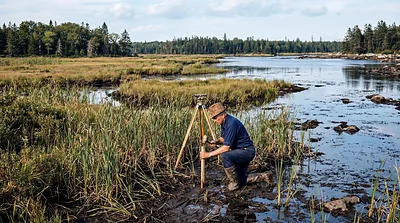
GPR expert Stephan Grund presents results from scanning the north end of the swamp by video conference, showing anomalies at depths of three and eight feet in the area where Fred Nolan believed there could be a manmade dam. The team will inform Tom Nolan of the results. On Lot 10, Rick and members of the team meet with Tom to investigate the anomaly. Steve Guptill marks the center of the 12-by-15-foot feature, and Doug Crowell shows Tom the "basin" and "dam" on Zena Halpern's map, suggesting the anomaly could be the dam. Billy Gerhardt begins to excavate and Gary quickly gets a hit: a possible iron pin that Gary says could have been used in an old wooden wall. The piece appears to be wrought iron and will be sent for XRF testing. Billy then pulls out a shaped piece of wood with oil on it. Oil was used in Asia as early as 400 B.C. to protect sailing vessels and in Europe from the 13th century until the 18th century, when it was replaced by creosote. At about eight feet Billy pulls out a log and a plank. Tom and Rick agree they will need a permit for a larger excavation to determine whether a dam exists.
At the Money Pit, Charles Barkhouse and Terry Deveau supervise the drilling of Borehole D17.5. Brandon brings over a core from 39 feet containing a large amount of wood. Charles thinks they may have hit the edge of a shaft, and Craig arrives and agrees. When Rick and Marty are notified, they come to inspect. Terry finds a piece of wood that appears to have been cut with a pit saw rather than a circular saw. Pit saws date to ancient Rome and were used by Europeans beginning in the 15th century, meaning the shaft could predate the discovery of the Money Pit. Brandon then brings a core from 109 feet containing more wood, this piece cut by an axe. Craig notes the team has no record of this shaft; it could be a depositor shaft or one built by searchers they did not know about.
At the Interpretive Center, Alex Lagina, Jack Begley, and Emma Culligan meet with numismatist Sandy Campbell to examine the half coin found by Rick and Gary on Lot 5. Emma shows Sandy the CT and XRF results. Sandy confirms the coin is definitely pre-1500s and notes with surprise that it weighs exactly one gram. He explains it was not unusual to see coins deliberately cut as partial payment and identifies the piece as either Roman or Byzantine, most likely Roman based on visible Roman characters and a style dating from 300 B.C. to 600 A.D. When Rick and Gary arrive, Sandy reaffirms the Roman identification, citing the design and the unrefined copper. Alex reminds the group of the Roman road they saw in Portugal that resembles the road in the swamp.