Charles Barkhouse and Scott Barlow meet with Paul Cote for an update on the Garden Shaft reconstruction. Dumas has reached 73 feet, with the final 10 feet being cleaned and prepped for reconstruction to 82 feet. Wood from the structure dates its construction to as early as 1735, and the north corner appears sunken, possibly from softer ground in the area. Scott notes that Borehole DN-11.5 and two other boreholes contained wood at a depth of 95 feet, indicating a tunnel running through the Baby Blob toward the shaft's north corner. That tunnel tested positive for gold. Later, Rick Lagina, Scott, and Craig Tester meet Ronnie MacKenzie and Bert Marceau at the shaft, where something was found earlier that morning. Bert presents part of a large barrel hoop, the first hoop recovered despite the team having previously found barrel staves. Rick says they need Carmen Legge to examine the piece.
In the swamp's northeast corner, Rick, Jack Begley, archaeologist Laird Niven, and Craig investigate a stone feature uncovered after the swamp was drained following a magnetometer survey by Jeremy Church that showed several metallic anomalies. The team has exposed a stone ramp that appears to head toward the paved feature dated to the 1200s. Archaeologist Miriam Amirault arrives and directs the group to clear the top of the ramp before beginning any excavation. In a later session, Craig and members of the team return to find the ramp's edges. Billy Gerhardt excavates while Gary Drayton scans the exposed areas. Jack finds a piece of hand-cut wood, and once Billy hits C-horizon, Rick tells Craig they have established the borders. Craig says they need to follow the ramp and will fill this section back in.
On Lot 5, Gary and Jack search for artifacts near the stone structure, ancient tools, and half Roman coin previously found on the lot. They unearth a large square nail Gary dates to the late 1700s and a piece of lead with a scalloped edge that Gary suggests could be a trade token, a form of exchange originating more than 200 years ago in ancient Rome. At the Interpretive Center, Laird describes the piece as brittle and old, with intentional scalloping that would have been molded. Emma Culligan runs both XRF and XRD scans. The XRF reveals the light layer is 99.96 percent lead, with trace amounts of copper and iron; the dark layer contains higher concentrations of iron, copper, and silicon. Emma's XRD analysis initially matches the mineral to samples from mines in Iran, but the geological belt extends across Italy, near France and Spain, and a sample from off the coast of Italy also matches. The lead in the artifact came from either Iran or Italy.
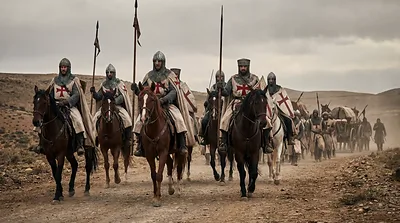
In the War Room, Emiliano Sacchetti and Judi Rudebusch share research on Zena Halpern's material, including the Cremona Document and the deposition by Ralph de Sudeley of his 12th-century voyage to the New World. The manuscript was found in 1970 in a medieval church in Cremona, Italy, and contained maps, ciphers, and journal entries. Emiliano explains that Seborga was an important principality close to the Templar pilgrimage route and that the Templars had received information from sailors about trips to North America. Doug Crowell points out that the document references a stop at an "island of oak." Emiliano adds that after the 1178 voyage, 150 more years of Templar history unfolded before Pope Clement V and King Philip IV ordered the persecution and disbanding of the order in 1307. Many knights were arrested and executed, but some are believed to have escaped with their treasure. Emiliano also describes a manuscript dated 1340, written by Milanese friar Galvano Fiamma and titled Cronica Universalis, which indicates that people in early-14th-century Europe knew of the existence of America. The friar's information came from John of Carignano, one of the era's greatest cartographers, who had connections to sailors, merchants, pilgrims, and Templars. Emiliano tells the team he plans to travel to Milan to examine the manuscript and has been admitted to the Vatican archives.
Also on Lot 5, Laird asks the team to examine a structure near the Roman coin and lead token that Robert Young had shown him more than 20 years ago. At the time Laird thought it was a cellar for a barn, but he now plans to cut a section to determine what it was and what it was used for.