Craig Tester and Scott Barlow meet with Paul Cote at the Garden Shaft, where Dumas has reached a depth of 65 to 66 feet. The shaft dates to 1735, tested positive for gold, and sits only 20 feet from the area Dr. Ian Spooner and Dr. Fred Michel have identified as the Treasure Zone, where they believe the treasure vault could lie at a depth of 80 to 120 feet. A hydraulic earth drill is being used to bore three holes on each side of the shaft, reaching up to 20 feet beyond the walls. Results so far indicate the material in the northeast corner is softer, which could point to another shaft or a tunnel. When Craig and Scott return later, Paul reports the current drill hole reached 15 feet before hitting something solid that turns out to be rock. Dumas will begin reconstruction of the next level.
On Lot 13, Rick Lagina and members of the team continue excavating the Quadrilateral, a 32-foot-long feature made up of three layers of boulders and blue clay that Fred Nolan discovered in the 1990s, roughly 400 feet north of the swamp. Carmen Legge previously dated an iron staple from the site to possibly medieval times. As Billy Gerhardt excavates, Gary Drayton scans the spoils and gets a signal. While Rick works to unearth the artifact, Gary notices charcoal on the side of the hole, which will be carbon dated. Rick then pulls out a large piece of iron that Gary compares to a cannonball fragment similar to finds from the southeastern United States. Billy uncovers flat rocks, and Marty Lagina tells him to remove them, but nothing is found underneath. The next day the team returns to the southern region. Rick wonders whether the area Fred described as "paved" could be related to the paved area in the swamp. After Billy removes several boulders, Gary recovers a piece of white glazed pottery and Rick finds a very thin piece of glass that Gary says could date to the 1700s or earlier. Dr. Spooner tells the group they have reached C-horizon and are at the bottom of the Quadrilateral.
In the War Room, Rick informs the team that Laird Niven has applied for heritage permits to work in the southeast corner of the swamp, where magnetometer scans conducted earlier in the season by Jeremy Church and Burton Cosgrove of Panther Geoscience found numerous metallic anomalies near the stone road. Billy confirms the permits have been approved to drain the swamp and begin excavating. Alex Lagina, Billy, and Jack Begley then set up a pump to begin draining the water to Lot 29.
The team reconvenes in the War Room with Jeremy Church for a more detailed analysis of the magnetometer data. Jeremy walks through the layers: at 0.25 meters a nonmetallic anomaly labeled SWa appears in the northern part of the swamp; at 0.5 meters additional anomalies and the stone path along the eastern edge become visible; and at a depth of one meter the paved area emerges along with zones of high conductivity, coded yellow, orange, and red. Red indicates the highest conductivity and the best chance of metallic content. Jeremy highlights one red anomaly, labeled SWe, as a major area of interest. Rick acknowledges that reaching SWe will be difficult even after draining, but the anomalies in the paved area should be accessible.
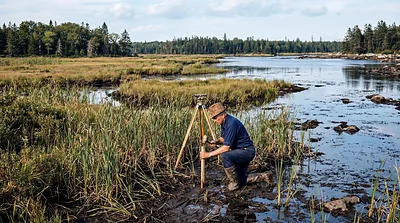
Work begins in the swamp's northeast corner near the paved area. Billy starts excavating and soon hits rock that appears to slope upward. Steve Guptill checks the elevation: the first spot sits about a foot to a foot and a half below sea level, matching the paved area, but the next spot is a couple of inches higher. Steve suggests the feature could be a ramp connecting the paved area to the road.