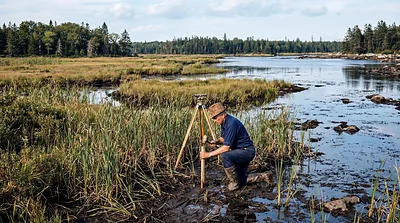
Craig Tester and Scott Barlow meet with Paul Cote at the Garden Shaft, where Dumas has cribbed the structure to a depth of 67 feet and is probing 12 feet outside the walls, with the corners probed to 20 feet. The shaft has been carbon dated to roughly 60 years before the discovery of the Money Pit, and wood and water samples from depths of 55 and 58 feet tested positive for gold. Scott confirms that Dumas is saving samples of clay and wood for further gold testing. Rick Lagina and Craig later return for another update from Paul: six holes have been completed on the eastern side of the shaft, but none have shown signs of valuables or man-made features. Drilling will now shift toward the Baby Blob area.
On Lot 13, Rick, Billy Gerhardt, Gary Drayton, and Tom Nolan begin excavating the Quadrilateral, a feature Fred Nolan found in the 1990s with a longest side of 32 feet and three layers of boulders. Gary notices a metal pipe in the feature, and Tom confirms his father drilled at this location. Billy uncovers a small cut and burnt stick, and Rick finds another piece of burnt wood that Gary compares to the charcoal found in the base layer of the stone road. Billy then exposes clay resembling the blue clay from the Money Pit, and Terry Deveau, arriving to inspect, confirms the similarity. Rick suspects a structure lies below, sealed with clay to prevent water from entering, with the boulders acting as a kind of key. The next day Dr. Ian Spooner examines the feature and states the clay is not geologic because it sits on a hill where it would not accumulate naturally. He identifies different clay types suggesting burning or heat and notes that burnt wood should not be present in the clay. As Ian is showing the layers to Craig, Alex Lagina, Gary, and Tom, he strikes a piece of metal and pulls out an iron staple. Metal staples have been used since the 6th century B.C. to connect stone or wooden structures.
In the War Room, Rick, members of the team, and Judi Rudebusch meet by video conference with Portuguese researcher Francisco Nogueira, who has been searching local archives for evidence that the Portuguese traveled to the Oak Island area during the 15th and 16th centuries. Francisco explains that the Order of Christ, a group of Knights Templar who fled to Portugal, maintained a presence on both the mainland and the Azores. He identifies the rock wall on Lot 26 as the most important evidence of a Portuguese connection, noting that during the 15th and 16th centuries the Portuguese built double walls of large stones with smaller rocks packed between them. Francisco then describes a missing treasure tied to the War of Portuguese Succession. When King Henrique died in 1580, a conflict erupted over the throne. Many believed it should pass to António, Prior of Crato, who had ties to the Order of Christ, but King Philip II of Spain waged war and eventually took control of both nations. After the war, a large fortune of gold possibly connected to the Order of Christ went missing. Francisco believes that gold could have been hidden on Oak Island.
At the Interpretive Center, Carmen Legge examines the iron staple from the Quadrilateral and determines it was not an anchoring staple but one used to change the direction of a rope or block and tackle, and that such staples were made as far back as medieval times. Emma Culligan's metallurgy report shows the piece is 98 percent iron, with traces of silicon, aluminum, manganese, calcium, sulfur, and phosphorous, all indicating very old technology.
The team reconvenes to hear results from the stone wall investigation. Laird Niven confirms the wall is a double-skin construction and that a good charcoal sample was recovered. Craig reports the carbon dating returned a single time period: 1474 to 1638.