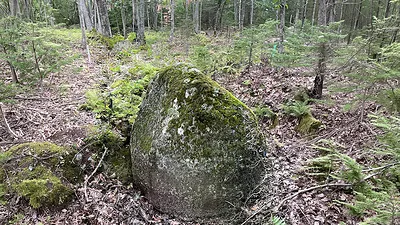
Marty Lagina arrives at the Garden Shaft where Dumas is installing the set at the 50-foot mark. Wood samples from the previous week tested positive for gold, and Marty requests additional samples including a piece of the tight lining. If gold is present at this depth, the source is either deeper in the shaft or coming from a possible offset chamber. In the War Room, Tom Nolan proposes a different search agenda based on his father Fred Nolan's work. Tom recalls that in the 1970s he and Fred found a well near the swamp that had been filled in and buried, approximately 10 feet deep with a large amount of broken pottery at the bottom. They filled it back in at the time, and Tom believes it is worth revisiting. He also describes the Quadrilateral, a feature Fred discovered in the 1990s using an offset sightline of Nolan's Cross, located about 200 feet from the top of the cross on the north side. Fred cleared the site and excavated a boulder field measuring 32 feet on its longest side, about 10 feet deep, and consisting of three layers of boulders. Rick Lagina suggests investigating the well first.
On Lot 11, Rick, Alex Lagina, Gary Drayton, and Billy Gerhardt begin searching for the hidden well. Gary finds an old rose-head spike in the spoils and then a hand-forged hook that reminds him of the bunk hook Carmen Legge dated to the 1600s. When the well and the stones Tom described do not appear, Rick calls Tom back to confirm the location. On the return visit Billy uncovers steel casings that Fred left behind years ago, but the stone well lies deeper. Gary scans the spoils and finds a piece of blue glazed pottery, and then part of a pick or digging tool. Tom and Rick locate what they believe is the edge of the well, and the group decides to hydro-vac the area before continuing. The next day Clean Earth Industrial Services begins clearing the mud and water. Rick, Marty, Tom, and Billy arrive to check progress and notice that nearly all the rocks have a flat side and are stacked. Rick points out these are not round boulders and that the well is constructed just like the well on Lot 26. Further excavation will require permits.
At the Research Center, forestry technician Peter Romkey shares the results of core samples taken from the tree growing out of the rock wall on Lot 26. The second bore showed an age of approximately 240 years based on ring count, with a possible margin of 20 to 30 rings. The wood was rotten beyond a certain distance, limiting the precision. Carmen Legge then examines the hook found during the well search and identifies the long shank as characteristic of a block and tackle, a device invented by the Greek scientist Archimedes in 250 B.C. to raise and lower heavy objects. Carmen dates the hook to 1650 to 1690.
On Lot 26, Alex, archaeologist Laird Niven, and Miriam Amirault continue excavating the stone wall. They reach what appears to be the bottom, where Laird identifies base rocks that differ from the stones above. The team also recovers charcoal in the form of a burnt twig that can be dated. When Rick and Craig Tester arrive, Craig suggests the wall was built to support something at a higher elevation. Alex, Laird, and Miriam will continue searching for additional artifacts.
At the Interpretive Center, Laird and Emma Culligan meet with Rick and Craig to discuss the wood taken from the Garden Shaft's tight lining at a depth of 58 feet on the crane side. Emma's XRF scan of the previous week's wood showed 0.13 percent gold, and the new sample from the crane side contains even more. The team plans to compare gold values from wells across the site to determine where to focus the search.