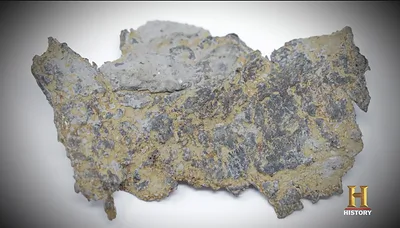
About This Artifact
The miner's whale-oil lamp was found during Gilbert Hedden's 1937 excavation of shaft No. 22, the largest shaft ever opened in the Money Pit area, recorded as twelve or fourteen feet wide by twenty-four feet long. Finn (1994) records that "remnants of much earlier work such as heavy drill casings and a miner's whale-oil lamp were uncovered" during the dig, and places these items at about the fifty-foot level. Graham Harris and Les MacPhie, the geotechnical engineers who wrote Oak Island and its Lost Treasure, give a more detailed sequence taken from the shaft record: old drill casings at fifty feet, the old miner's whale-oil lamp at sixty-five feet, an old oak stump at eighty feet, an old collapsed tunnel with a band of putty nearby at ninety-three feet, and at 104 feet a tunnel three feet ten inches wide by six feet four inches high, cribbed with oak and hemlock timbers. The difference between fifty and sixty-five feet appears to come from Finn grouping the lamp with the drill casings.
Whale-oil lamps of this type provided a reliable, relatively smoke-free light source and were standard equipment in underground excavations throughout the eighteenth and nineteenth centuries. Hedden, a successful American businessman from Chatham, New Jersey, conducted one of the most methodical searches in Oak Island history. He spent 1934 researching the island's history, interviewing previous explorers including William Chappell, and examining records of earlier digs before starting fieldwork. He hired the professional firm of Sprague and Henwood of Scranton, Pennsylvania, who brought a one-thousand-gallon-per-minute electric pump. After re-timbering the Chappell shaft in 1936, they opened the new Hedden shaft in May 1937 and reached about 125 feet, with borings to 167 feet, before Hedden turned his attention to a treasure map published in Harold T. Wilkins's book Captain Kidd and his Skeleton Island.
This lamp is a different object from the miner's lamp found beside the Cornish pick at 127 feet in the Chappell shaft in 1931. That lamp still contained oil when it was recovered, and the oil was identified as seal oil.
The Hedden lamp was found amid the debris of earlier expeditions that had accumulated in the Money Pit area over the preceding century. At sixty-five feet it sat above the flood tunnel level and within the zone where multiple searcher shafts had intersected and collapsed into one another. Its age has not been determined, and whether it belonged to the Onslow Company workers of the early 1800s, the Truro Company men of the 1850s, or another early expedition is unknown. Its presence alongside drill casings from later operations illustrates the layered ground of the Money Pit area, where tools and debris from more than two centuries of searching lie mixed at various depths.
Historical Context
Hedden expedition, 1937. Graham Harris and Les MacPhie, Oak Island and its Lost Treasure, third edition (Formac Publishing, Halifax, 2013), chapter 5, listing the Hedden shaft findings by depth. Finn (1994) for the 50 ft figure.
Where It Was Found
Found at Hedden shaft (No. 22), 65 ft depth (Finn gives about 50 ft). Location: the original 1795 excavation shaft on Oak Island, Nova Scotia.