About This Coin
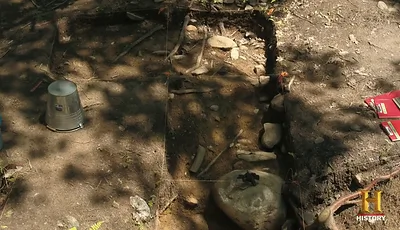
A copper coin with a square hole punched through its centre, recovered by Gary Drayton and Jack Begley on Lot 15 during the Season 8 premiere. Drayton found the coin approximately 100 feet west of the stone walls using his CTX 3030 detector, alongside a ship's rigging axe head. He called it a top-pocket find and tentatively dated it to the 17th or 18th century, noting it did not appear to be European in origin.
At the Oak Island Research Centre, artifact conservator Kelly Bourassa photographed the coin beside a ruler, recording a diameter of approximately 2.4 centimetres. She suspected Chinese origin based on the square hole, a characteristic feature of East Asian coinage. After cleaning the faces with a toothbrush to remove green copper tarnish, Bourassa found no visible characters or inscriptions but confirmed a coin-like edge on the piece.
Numismatist Sandy Campbell examined the coin later that season and identified it as a Chinese cash coin. Based on the narrow rim and level of deterioration, Campbell estimated the coin dated from 400 BC to 900 AD, which at the time of its identification made it potentially the oldest artifact discovered on the island. Campbell explained that Chinese currency, unlike European coins, did not travel widely with colonial expansion. He suggested the coin arrived on Oak Island as a pocket piece or good luck charm carried by someone who had visited the Far East, rather than through direct Chinese contact with the New World.
The coin was found in the same area as a pine tar kiln dated by Carmen Legge to 1550 to 1620, ox shoes from the same period, and a ship's rigging axe head. Lot 15 sits between the swamp and the Money Pit, along a route the team later identified as a possible wagon trail connecting the two areas. Gary Drayton presented the coin in the War Room alongside an axe head he and Laird Niven dated to the early 1700s, reinforcing the concentration of pre-1795 activity on the lot.
Where It Was Found
Found at Lot 15 (west of stone walls). Location: Oak Island, Nova Scotia, Canada.