About This Sample
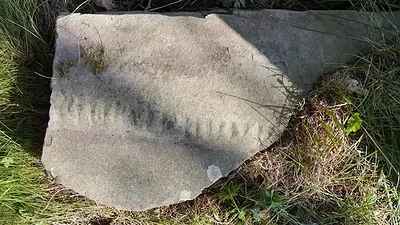
Peat samples from two beach pits along the south shore barrier beach of Oak Island, dated by the Woods Hole Oceanographic Institute (WHOI) using AMS (Accelerator Mass Spectrometry) in 1995-1996. These represent the oldest reliably dated organic deposits from the island.
• Beach Pit 2 (OI-BP-2, receipt 10169): Peat from approximately 8 feet below mean sea level (MSL), along the south shore barrier beach across from the swamp. Dated to 1940 ±40 years before present → approximately 10 AD (range 30 BC to 50 AD). This corresponds roughly to the time of Alexander the Great's childhood in Macedonia.
• Beach Pit 8 (OI-BP-8, receipt 10170): Peat from approximately 10 feet below MSL, same barrier beach area. Dated to 2340 ±35 years before present → approximately 390 BC (range 425-355 BC).
These peat layers were deposited at or above sea level in a marsh/sediment water interface environment. Their depths below current MSL provide critical data for calculating the rate of relative sea-level rise at Oak Island:
• Beach Pit 2 yields a minimum relative sea-level rise of 1.25 mm/year (approximately 0.4 feet per century)
• Beach Pit 8 yields a relative sea-level rise of 1.3 mm/year (approximately 0.43 feet per century)
Both samples indicate consistent rates of relatively sea-level rise, suggesting that at the time the coconut fibres were deposited (some 800-1100 years ago), Smith's Cove was at a sea level approximately 3.4 to 5 feet below present levels. This means evidence left by people working at the site during this period must be referenced to a substantially lower shoreline, and the area that searchers know as Smith's Cove would have been above water during the period 800-1100 AD.
The WHOI researchers concluded that flood tunnel outlets and inlets should be sought farther seaward than where the search has traditionally focused.
Historical Context
Sources: Les MacPhie, "Summary of Documents and Results for Carbon Dating at Oak Island" (compiled July 2006). WHOI draft report (8 April 1996), Table 6, receipts 10169 (OI-BP-2) and 10170 (OI-BP-8). WHOI report discussion of peat samples and sea-level implications, pp. 36-37 of draft (MacPhie compilation pp. 50-52).
Where It Was Found
Found at South shore barrier beach, opposite swamp. Location: Oak Island, Nova Scotia, Canada.