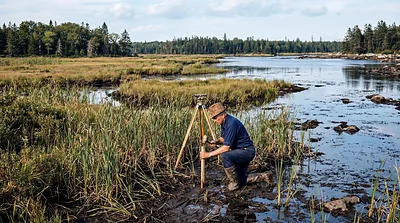
In the War Room, the fellowship reviews plans following the Lagina brothers' return to Oak Island. Doug Crowell reveals that the wall Dr. Ian Spooner detected via sonar in the southeastern corner of the swamp is actually the top of a 9 by 9 foot shaft, a feature Fred Nolan reportedly discovered years ago when he secretly drained part of the swamp. The team agrees to excavate the anomaly using a cofferdam to isolate the area, an operation they acknowledge may prove even more challenging than the Season 7 work at Smith's Cove. Rick Lagina suggests processing the spoils at the wash plant to catch any artifacts. Irving Equipment Ltd. representatives David Irving, Mathew Kingston, and Patrick Craig join via Skype to discuss logistics: the project will require a 1,600 square foot crane pad and 89 steel sheets, with construction expected to begin within a month.
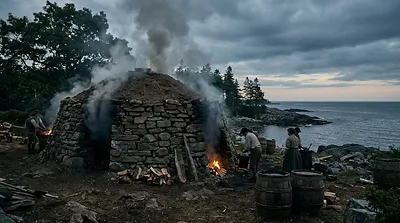
On Lot 15, David MacInnes and archaeologist Liz Michels show the Laginas a layer of rocks discovered beneath the tar kiln stones. MacInnes suggests the lower stones may have been placed to fill a well, while Marty offers an alternative theory that the feature could mark the backfilled entrance of an underground tunnel, consistent with what Fred Nolan's survey map indicates. Throughout the excavation, the archaeologists note the site is covered with fire-cracked rock, stone deliberately split by heat.
At the Oak Island Research Centre, Alex Lagina meets with artifact conservator Kelly Bourassa to examine the coin with a square hole that Gary Drayton and Jack Begley found on Lot 15 in the season premiere. Bourassa suspects it may be of Chinese origin and photographs both sides beside a ruler, showing a diameter of about 2.4 centimetres. After cleaning the faces with a toothbrush to remove green copper tarnish, the conservator finds no visible characters but does uncover what appears to be a coin-like edge.
On Lot 15, Gary Drayton and Jack Begley metal detect their way toward the swamp and recover a large broken ox shoe, followed by a smaller one nearby. Jack observes that a line drawn through both finds would intersect the Paved Area in the swamp and the Lot 15 stone structure, suggesting the two landmarks were once connected by a wagon trail. A third iron artifact follows, which Drayton identifies as a component of an ox cart.
Alex Lagina and Jack Begley bring the ox shoes to blacksmith Carmen Legge in Centreville, who identifies the first as a British winter shoe for the left front hoof of a draft ox, dating it to 1650 to 1750 and noting it could be military in origin. The second is a winter shoe by the same smith for a larger animal, and the third a summer shoe for a rear hoof, also from the same hand. Legge concludes the volume of shoes along a single route points to sustained industrial activity spanning several months across both winter and summer seasons. He also examines the third iron object and identifies it as a finial from a military ox cart, noting that only military vehicles carried such decorative scroll work.