With the American team members still completing their mandatory 14-day COVID-19 quarantine on the Nova Scotia mainland, work on Oak Island continues under the Canadian crew. On Lot 15, archaeologists Laird Niven, Aaron Taylor, and David MacInnes resume excavation of the mysterious stone walls and uncover a large flat stone with a beveled edge and a drilled hole in its surface. Surveyor Steve Guptill inspects the find and suggests it resembles an old survey marker, possibly connected to drilled stones found elsewhere on the island over the years. MacInnes believes the flat stone was placed before the walls beside which it was found.
At Smith's Cove, Doug Crowell and Steve Guptill stake out the positions of underground tunnels and non-ferrous metal deposits indicated by the 1988 Barringer Survey. The endpoint of one tunnel falls at the exact spot where Gary Drayton and Rick Lagina discovered the lead cross in Season 5, while one of the four non-ferrous deposits lies directly south of the Uplands Pit, where the team hit what they suspected was a tunnel at 50 feet in Season 7. At Isaac's Point, Jack Begley and Gary Drayton metal detect and recover a pewter spoon bowl that Drayton dates to the mid-1700s along with the head of a tunneling pick resembling a rock hammer found in Borehole RF1 the previous season.
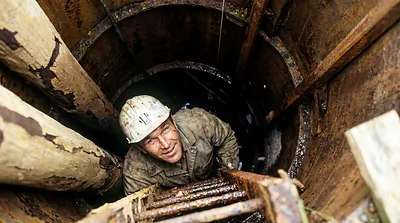
At the wash table, Steve Guptill supervises the processing of spoils from caisson 8A, a shaft sunk in Season 7 at the suspected junction of the Money Pit and the Shaft 6 tunnel. Josh Ballard discovers a brown button made of wood or horn, and Michael John finds a large piece of leather that Guptill suspects may date to the original depositors. Archaeologist Laird Niven examines the leather and notes it is not bonded, suggesting it could be from a piece of footwear similar to the antique leather shoes Dan Blankenship found at Smith's Cove in the 1970s.
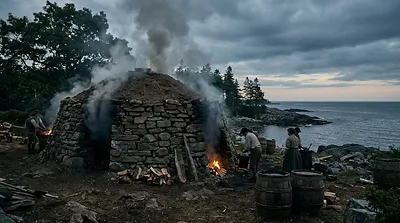
Rick and Marty Lagina, Alex Lagina, and Peter Fornetti complete their quarantine and arrive at the Oak Island Research Centre, where Charles Barkhouse and Doug Crowell bring them up to speed. At the Lot 15 dig site, David MacInnes explains the structure is not a tunnel entrance as first hoped. Aaron Taylor voices the team's conclusion that it constitutes the remains of a pine tar kiln, and Laird Niven adds that the kiln may have been used in the construction of the Money Pit.
Alex Lagina and Jack Begley visit blacksmith Carmen Legge in Centreville with the pickaxe head from Isaac's Point. Legge dates it to the late 1700s or early 1800s and points out a stress fracture indicating extremely heavy use. That evening in the War Room, Gary Drayton reveals his recent finds from Lot 15: an axe head that both he and Niven date to the early 1700s, and the copper coin with a square hole, his prized top-pocket find. Drayton believes the coin is not European, possibly from somewhere far more exotic, and tentatively dates it to the 1600s or early 1700s. The episode closes with a memorial to producer Kevin Burns, who passed away on September 27, 2020.