In a War Room video conference, GIS expert Erin Helton presents a new theory built on the La Formule cipher, the coded document Zena Halpern shared with the team in Season 4. Helton interprets the cipher's instructions as describing a 522-foot corridor at a 45-degree alignment from the Money Pit, followed by a second passage of 1,065 feet. When she draws a circle of that radius from the suspected corridor elbow, it intersects cone E of Nolan's Cross, leading her to conclude that the treasure vault lies not beneath the Money Pit itself but at the end of a tunnel extending over 1,000 feet to the west. Helton proposes the team drill to intercept the corridor rather than risk triggering the flood tunnel from above.
At the Money Pit area, Choice Drilling begins borehole EJZ-1 at coordinates provided by Helton, with Rick Lagina and Steve Guptill overseeing the operation. The drill reaches 119 feet through hard, undisturbed material, encountering a layer of sand that Terry Matheson and Charles Barkhouse determine is likely natural. No evidence of Helton's tunnel is found. Guptill suggests the discrepancy may stem from the assumption that borehole RF-1 marks the Money Pit's centre, noting that borehole OC-1, where wood was dated to 1706, could represent the pit's eastern extremity. The team decides to share all drilling data with Helton so she can recalculate.
At the Oak Island Research Centre, numismatist Sandy Campbell examines the coin with a square hole found on Lot 15 earlier in the season and identifies it as a Chinese cash coin. Based on the narrow rim and level of deterioration, Campbell estimates it dates from 400 BC to 900 AD, potentially making it the oldest artifact ever discovered on the island. He explains that unlike European coins, Chinese currency did not travel widely with colonial expansion, suggesting the coin arrived as a pocket piece or good luck charm carried by someone who had visited the Far East.
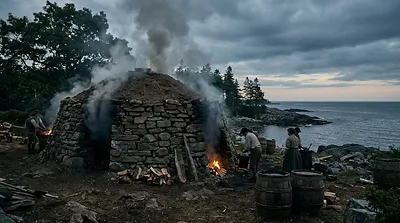
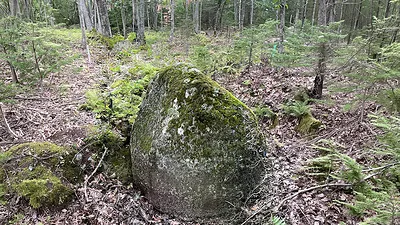
On Lot 15, archaeologists Aaron Taylor and Miriam Amirault investigate a serpent-shaped mound that Doug Crowell identified near the pine tar kiln. Taylor notes its resemblance to the ancient serpent mounds in Keene, Ontario, which date back as much as 2,000 years. The team recovers charcoal from within the feature, which Taylor plans to carbon date. If the results match the charcoal from the nearby tar kiln, it could establish that both features were part of the same activity.
Near the southeastern corner of the swamp, Gary Drayton and Peter Fornetti recover an old iron pin that Drayton identifies as a ship or wharf fastener, likely from the 1700s or earlier. Continuing their search, they uncover notched wooden timbers joined at right angles with iron fasteners just below the surface. Archaeologist Laird Niven arrives and identifies the feature as a slipway for docking ships, similar to the one found at Smith's Cove. Rick Lagina connects the discovery to the stone formation he and Dr. Ian Spooner identified in the swamp two episodes earlier, and the team discusses whether the find should alter their cofferdam plans to avoid damaging undiscovered structures.