About This Material
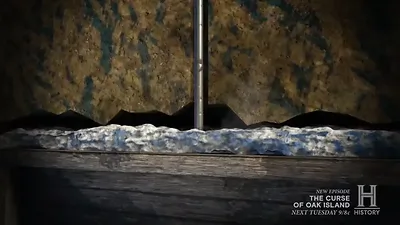
Below the cement vault at one hundred and fifty-three feet, the Oak Island Treasure Company's 1897 drilling passed through eleven feet of blue clay before striking the iron barrier at 171 feet. Finn (1994) described the material as "blue puddled clay," the term "puddled" indicating that the clay had been manually worked and mixed with water to create a dense, plastic, watertight mass. This technique has been used for centuries to line tunnels, reservoirs, and underground chambers, and puddled clay differs visibly from naturally occurring clay deposits in its uniformity and compaction.
The presence of puddled clay at this depth, directly below the suspected vault and above the iron barrier, suggests the original builders created a layered seal around the chamber contents. The sequence from top to bottom (cement encasing wood and metal, then worked clay, then iron) represents a progression of barrier materials designed to protect whatever the vault contained from both water infiltration and physical intrusion. Blue clay has appeared consistently across multiple boreholes in the Money Pit area during the Lagina-era drilling programs, indicating it forms a continuous horizontal feature at that depth rather than a localised pocket. In Season 7, blue clay packed onto a large stone at the Eye of the Swamp was noted as similar in character to the material found in the Money Pit, providing a possible surface-level connection to the deep underground deposits.
Historical Context
Oak Island Treasure Company
Where It Was Found
Found at Money Pit, below 153 ft. Location: the original 1795 excavation shaft on Oak Island, Nova Scotia.