About This Artifact
A small metal plate recovered by Gary Drayton on Lot 24, one of nine four-acre properties once owned by Samuel Ball, during Season 4. The plate came from the stock of a musket or pistol and bore what appeared to be an engraved name or signature. The engraving led to speculation that the plate carried Ball's own name, which would connect the weapon directly to the former soldier who owned the property.
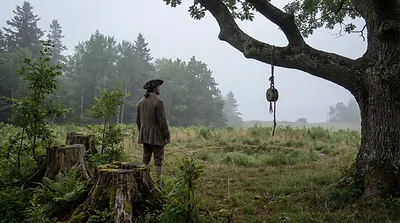
Samuel Ball was born in South Carolina around 1764 and escaped slavery during the American Revolution after Lord Dunmore's 1775 Proclamation offered freedom to enslaved men who joined the British forces. Ball served as a woodcutter with the army under General Henry Clinton at Bergen Point, New Jersey, before fleeing to Nova Scotia with other loyalist freemen after Cornwallis surrendered at Yorktown. He arrived in Shelburne in 1783 and moved to Chester three years later, purchasing his first lot on Oak Island on September 22, 1787 for eight pounds, a considerable sum at the time. By his death on December 14, 1845, Ball owned nine four-acre lots on Oak Island and an additional hundred acres on the mainland, making him the largest private landowner on the island.
The name tag was found alongside a concentration of military artifacts: an 18th-century dandy button, a copper coin bearing the image of King George II (dated 1727 to 1760), a lead musket ball ingot, and six additional George II copper coins clustered in a small radius. Gary concluded the density and type of artifacts pointed to a British military encampment. Author Randall Sullivan, who documented the find in his book on the Oak Island mystery, observed that the artifacts could equally have belonged to Ball himself, given his service with the British army during the Revolutionary War. Charles Barkhouse noted during the search that the 1870 first edition of Mather Myles DesBrisay's History of the County of Lunenburg lists Ball as one of the original Money Pit discoverers rather than Anthony Vaughn, a detail removed without explanation in the 1896 second edition. How Ball afforded nine lots, mainland property, and a servant on a farmer's income remains unexplained.
Historical Context
Lagina team
Where It Was Found
Found Near Samuel Ball's home. Location: Oak Island, Nova Scotia, Canada.