Near the eastern border of the swamp, archaeologists Aaron Taylor and Miriam Amirault continue excavating the stone pathway, which now appears to be branching in two directions, one heading toward the uplands and the other angling toward the Eye of the Swamp. Rick Lagina assists the effort, and the team discovers what Taylor describes as a possible cellar feature: courses of intentionally placed, stacked stones forming straight angular lines consistent with a foundation or building cellar. The excavation also reveals a void beneath the stones, raising the possibility that something may be concealed within. Rick speculates on a connection to Anthony Graves, who built his home nearby and was known to spend Spanish gold and silver coins on the mainland.
In the Money Pit area, Terry Matheson and Charles Barkhouse oversee borehole CD-2.5, the sixth consecutive hole to intersect wood-cribbed tunnel material at roughly 83 to 88 feet below the surface. The tunnel has been carbon-dated to as early as 1648, nearly 150 years before the Money Pit's discovery. Rick arrives and learns the wood lies just five feet from the exterior wall of borehole C-1, where the team previously discovered a massive cavern and compelling video evidence of gold-coloured objects embedded in the anhydrite.
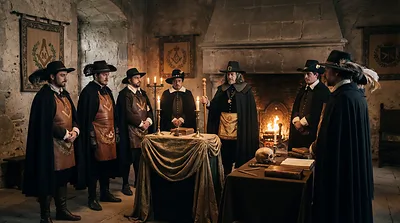
In the War Room, author and theorist James McQuiston presents research connecting the Oak Island mystery to three overlapping groups: the Freemasons, the Knights Baronet, and settlers from the Plymouth Colony of Massachusetts. McQuiston traces all three to Sir William Alexander, the Scottish nobleman who founded Nova Scotia in the early 1600s, and whose son was among the first to be initiated as a Freemason. He argues that when French forces expelled the Scots from Nova Scotia in 1632, the retreating settlers took shelter in Mahone Bay and buried valuables on Oak Island. McQuiston further demonstrates that several prominent Oak Island searchers, including Franklin Roosevelt and his grandfather Warren Delano Jr., descended from Plymouth Colony families.
Gary Drayton and David Fornetti search the ground near the stone pathway and discover a heavy caster wheel, which Drayton identifies as a component from a tunneling cart. He connects the find to the swages, or tunneling tools, discovered on Lot 21 the previous season, which may date to the 15th century. At the wash table, Steve Guptill and Michael John sift through stored spoils from borehole E-5.25 and recover possible coconut fiber along with a dense stone projectile. Drayton examines the stone and identifies it as a gunstone, a pre-cannonball projectile fired from a blunderbuss, a type of weapon dating to before the 17th century and closely associated with the Plymouth Colony pilgrims.
Rick Lagina and Steve Guptill return to the stone cellar feature at the end of the day, where Michael John discovers a cavity beneath the stones large enough to reach into. Archaeologist Miriam Amirault also recovers a piece of printed white earthenware from within the structure. The team finds burned wood and charcoal staining in the soil near the cellar, which the team reads as further evidence that significant activity predating the 1795 discovery of the Money Pit took place along this pathway.