Rick Lagina gathers the team to report on a stone foundation unearthed near the swamp's northeastern border, adjacent to the stone pathway now estimated by Steve Guptill at 460 feet. The feature stands roughly two feet high with two clear right angles, buried beneath three feet of soil. Steve notes its resemblance to 1700s and 1800s foundations across Nova Scotia and its proximity to the property of Anthony Graves, who purchased most of Oak Island in 1857 and was known to spend Spanish silver and gold coins on the mainland. Voids between the stacked stones raise the possibility that valuables were concealed within the structure.
Archaeologist Miriam Amirault and David Fornetti continue excavating the foundation and discover a large charcoal deposit with reddened soil beneath it. Dr. Aaron Taylor identifies the find as evidence of intense, repeated burning, consistent with a hearth feature or a structure that burned down. Geoscientist Dr. Ian Spooner later confirms the oxidation from sustained heat and suggests it points to industrial activity, similar to the pine tar kiln on Lot 15. Despite the scale of the burn feature, no artifacts have surfaced in or around the foundation, a puzzling absence that Aaron calls almost eerie and possibly indicative of deliberate concealment.
In the Money Pit area, Steve Guptill directs Charles Barkhouse and geologist Terry Matheson to drill borehole CD-7, positioned 13 feet east of previous holes to locate the eastern edge of the tunnel or the center of the original Money Pit. Six boreholes drilled in recent weeks had consistently hit a wooden tunnel between 86 and 90 feet, but CD-7 returns undisturbed till through 91 feet with no wood. The setback prompts Marty Lagina, Craig Tester, and Jack Begley to regroup, and Craig suggests investigating four nonferrous targets identified on a 30-year-old Barringer VLF survey found in Dan Blankenship's files by historian Doug Crowell. The targets sit roughly 100 feet deep near Smith's Cove and could indicate silver or gold, and the team agrees to redirect the drill rig.
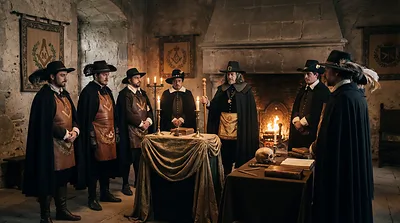
On Lot 26, metal detection expert Gary Drayton and treasure hunter Michael John deploy a GPX 5000 with a 32-inch coil on property once belonging to Samuel Ball. They recover a small hind ox shoe, which Jack Begley and Charles Barkhouse take to blacksmithing expert Carmen Legge in Centerville, Nova Scotia. Carmen identifies it as Scottish in origin, dating between 1610 and the 1740s, well before Ball's arrival. The find connects to author James McQuiston's theory linking the treasure to the Knights Baronets, a 17th-century Scottish order with ties to the Freemasons and the Knights Templar whose followers settled in Nova Scotia before being ousted by the French in 1632.
Along the pathway, project manager Scott Barlow works with Gary and Billy Gerhardt to recover cut wood from beneath the stones, pieces intentionally placed as cribbing during construction. Near the swamp's upland border, Miriam discovers hand-painted pottery bearing blue, pink, and green coloring while tracing the pathway's direction. Billy opens test pits at Aaron's direction, and the team uncovers cobblestones extending into the uplands, suggesting the pathway turns away from the swamp. In the War Room, Craig presents carbon-14 results on wood recovered from beneath the pathway: it dates to between 1489 and 1654, placing the road's construction well before the 1700s. Marty, who long believed nothing of significance happened on Oak Island before 1795, says the evidence has changed his mind.