The Order That Never Died
When Pope Clement V dissolved the Knights Templar in 1312, the order was dismantled across Europe. Knights were arrested, assets seized, leaders burned. But in Portugal, King Denis I refused. Rather than destroy the Templars, he simply renamed them. In 1319, a papal bull officially established the Ordem Militar de Cristo, the Military Order of Christ, granting it all former Templar properties, personnel, and wealth. The headquarters remained at Tomar, in the same Convento de Cristo the Templars had built. The knowledge, the traditions, and the mission survived intact.
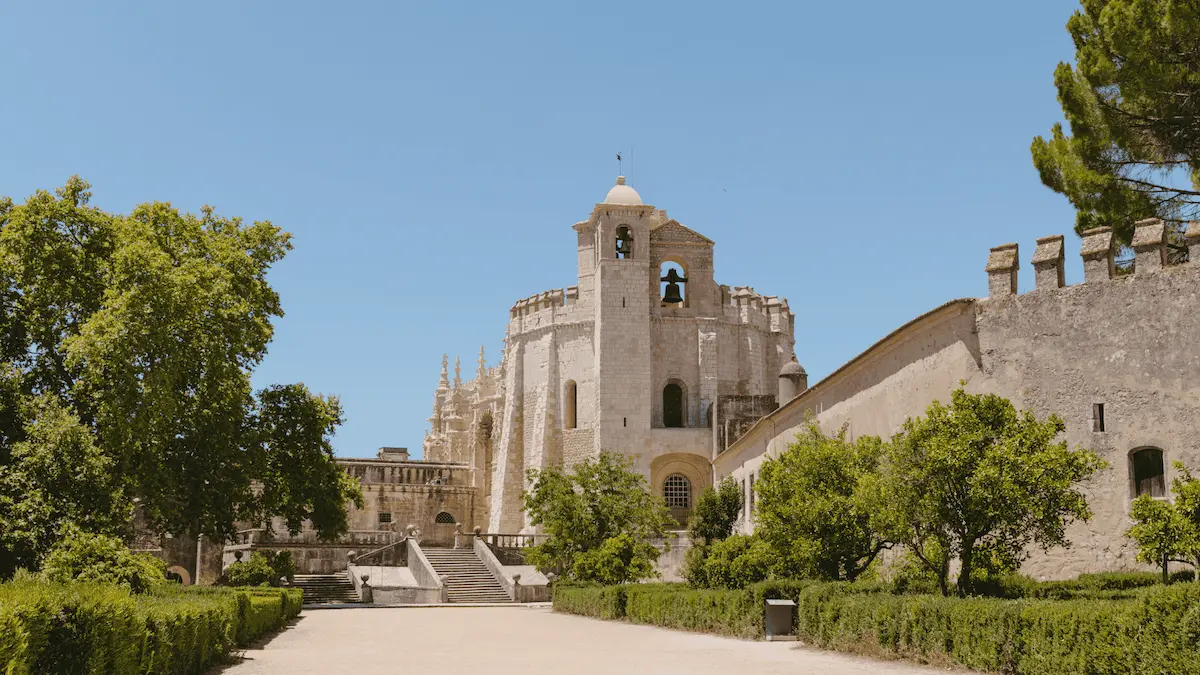 Convento de Cristo→
What happened next changed the world.
The Cross on Every Sail
In 1417, Prince Henry of Portugal, known to history as Henry the Navigator, became administrator of the Order of Christ. Under his leadership, the Order channeled its vast Templar-inherited wealth into something unprecedented: a systematic program of maritime exploration. Henry established a navigation school at Sagres and funded voyage after voyage down the African coast.
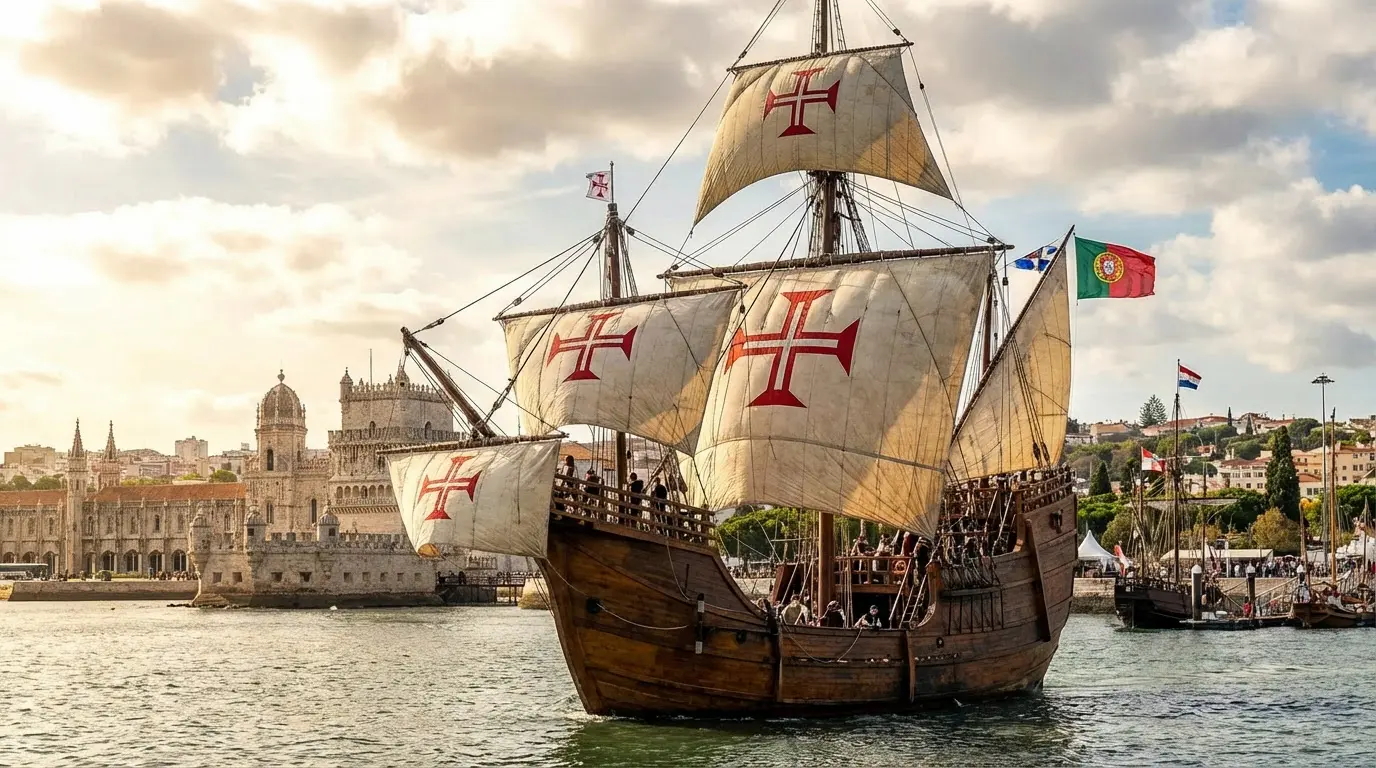
The distinctive red Cross of Christ appeared on the sails of every Portuguese ship during the Age of Discovery. This was not decoration. It was identification. The voyages were Order of Christ operations.
The roster of navigators who sailed under that cross reads like a roll call of exploration itself. Bartolomeu Dias, who rounded the Cape of Good Hope in 1488. Vasco da Gama, who reached India in 1498. Pedro Álvares Cabral, who claimed Brazil in 1500. Ferdinand Magellan, whose expedition completed the first circumnavigation of the globe. Every one of them sailed under the Cross of Christ. Every one of them was connected to the Order.
These were not rogue adventurers. They were agents of an institution with two centuries of Templar heritage, operating under royal charter with access to resources, knowledge, and navigational expertise that no other European power could match.
Portuguese Footprints in Nova Scotia
The Portuguese did not confine themselves to southern waters. João Álvares Fagundes, a ship owner from Viana do Castelo, explored the Nova Scotia coast around 1520 and attempted to establish a permanent settlement. With his captain Pero de Barcelos and colonists mostly from the Azores, Fagundes charted Sable Island, Cape Breton, and the Gulf of St. Lawrence. King Manuel I granted him exclusive rights to the lands he discovered. By 1521, approximately 200 settlers had established a fishing colony on Cape Breton Island, possibly at Ingonish.
The colony ultimately failed. Fagundes died in Portugal around 1522, leaving the settlement without leadership. Harsh climate and conflict with indigenous populations forced its abandonment. But the Portuguese had been there, and they left traces.
When Samuel de Champlain explored Nova Scotia in 1607, he reported finding an old, moss-covered cross near what is now Advocate, Nova Scotia. Some researchers believe it was erected by Fagundes eighty years earlier. The Lopo Homem map of 1554 includes Mi'kmaw place names along the Cape Breton coast, evidence of sustained Portuguese-Mi'kmaq contact over decades.
The Overton Stone
In 2015, local historian Terry Deveau presented the Oak Island team with his analysis of the Overton Stone, a large carved boulder found near the town of Overton, not far from Oak Island. Deveau identified the cross carved into the stone as stylistically consistent with padrão crosses, the stone markers Portuguese explorers planted to claim territory during the Age of Discovery.
The padrão tradition was directly tied to the Order of Christ. Diogo Cão carved one at Yellala Rock on the Congo River in 1485. Bartolomeu Dias erected one at the Cape of Good Hope. Vasco da Gama planted them along the East African coast. These crosses were not simply Christian symbols. They were the Order's mark of possession.
Deveau proposed that the Overton Stone commemorates a friendship treaty between Portuguese explorers and the local Mi'kmaq people. The carving includes tobacco leaves and an eagle feather, both of deep spiritual significance in Mi'kmaw culture, alongside the crescent moon that corresponds to their tradition of observing the lunar cycle. If Deveau is correct, the stone represents documented contact between Order of Christ navigators and indigenous Nova Scotians, within reach of Oak Island.
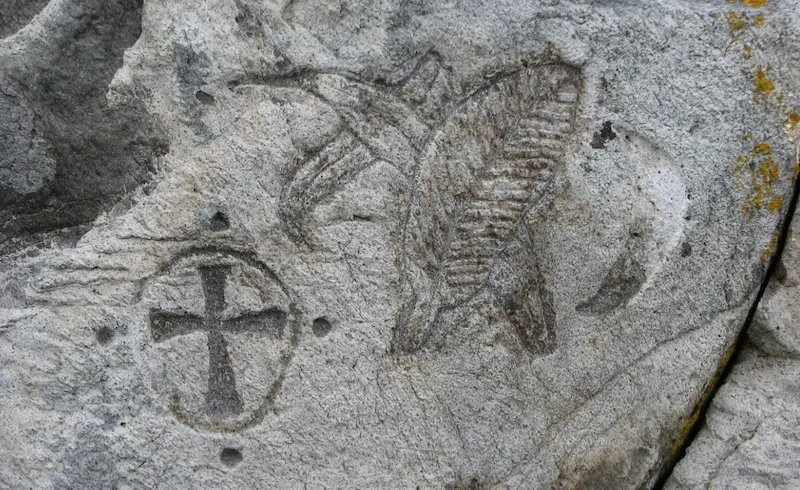 Overton Stone→
Artifacts on the Island
Physical evidence of a Portuguese presence on Oak Island has been steadily accumulating. Two stone cannonballs, or gun stones, were found in separate seasons: one excavated from more than 100 feet deep in the Money Pit area, another discovered by Gary Drayton near the swamp. Chemical analysis revealed both were made from volcanic rock sourced from the Azores, a Portuguese territory. Museum experts in Portugal confirmed they matched 14th and 15th century ship-mounted cannons of Portuguese origin.
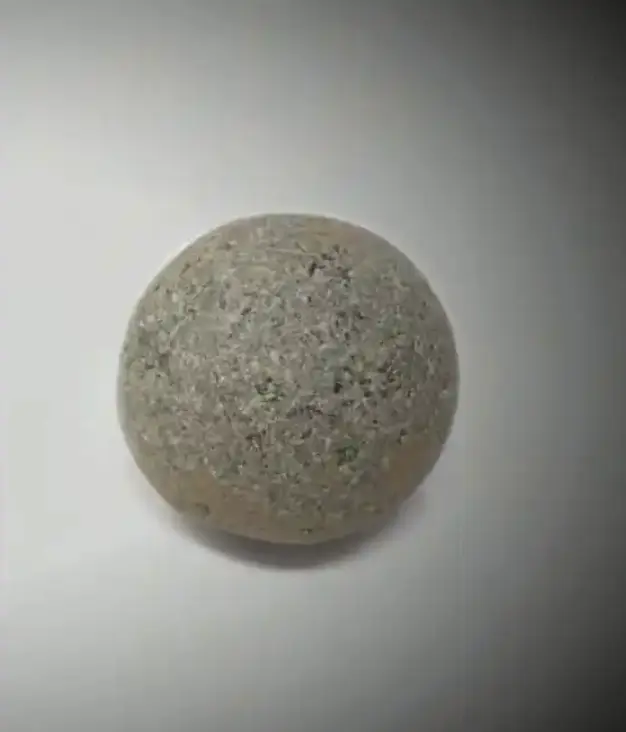 Stone Shot (Lot 16)→
A fragment of what was identified as a Portuguese breech swivel gun was found on Lot 4, in an area marked on Zena Halpern's map as "The Hole under the Hatch." Analysis by Dr. Christa Brosseau confirmed the metal was consistent with cannon material, possibly of Portuguese manufacture.
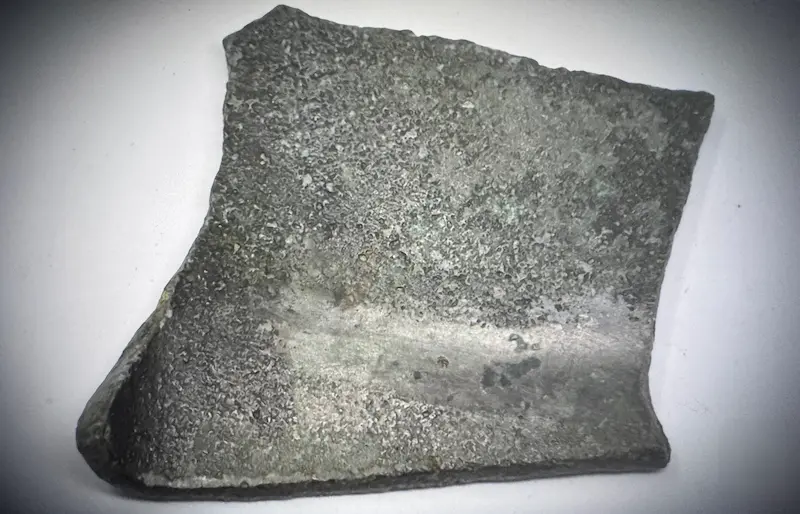 Swivel Gun Metal→
In Season 13, a hand cannon fragment was identified through CT scanning, revealing a touch hole that confirmed its function. Maltese military historian Matthew Balzan dated it to between the 1200s and early 1500s, and raised the possibility it had been repurposed as a tool for directing gunpowder to fracture rock, a technique that would predate conventional blasting and could connect to the construction of the island's stone road feature.
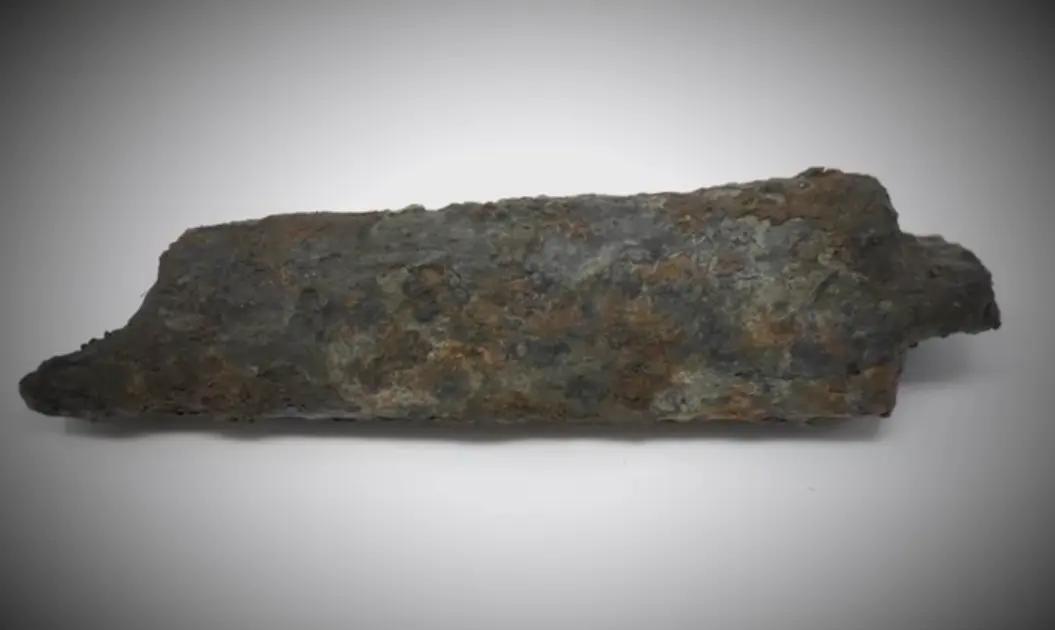 Barrel of a hand cannon→
Perhaps most striking is the Portuguese coin: a billon Tornês from the reign of King Ferdinand I, minted at Miranda do Douro between 1369 and 1370. Its reverse carries a cross design that researcher Judi Rudebusch identified as resembling a Templar cross, alongside a six-pointed star similar to symbols found at Fonte Arcada Church in northern Portugal.
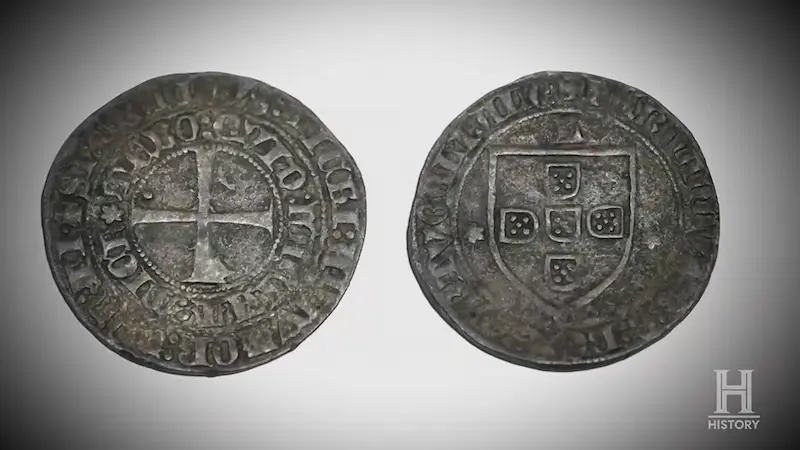 Coin - Portuguese Tornês (Pitblado coin)→
The Stone Road
When the triangular swamp on Oak Island was drained and excavated, the team discovered a stone road and cobblestone pathway leading toward the Money Pit. Historian Terry Deveau immediately noted its resemblance to road construction techniques used by the Portuguese in the 1500s. The comparison was not casual. During the team's trip to Portugal, guided by researcher Corjan Mol and Templar historian João Fiandeiro, they visited Alqueidão Da Serra, where a medieval Portuguese stone road bears a striking similarity to the one found in the Oak Island swamp.
Tomar, Fontarcada, and the Archives
In Season 9, the Oak Island team traveled to Portugal to investigate the connection directly. At the Convento de Cristo in Tomar, the 12th century Templar stronghold that became the Order of Christ's headquarters, Corjan Mol drew attention to the aqueduct drainage system. He believed it could have served as an engineering precedent for whoever constructed the finger drains at Smith's Cove, the elaborate system designed to flood the Money Pit when disturbed.
At the Church of Fontarcada in Póvoa de Lanhoso, the team found cryptic symbols and carvings that appeared to match those found on Oak Island. A well at Quinta da Regaleira in Sintra, built to match older designs, was found to share the exact dimensions of the original Money Pit treasure shaft. While the Sintra structure dates to the 19th century, it preserves construction traditions linked to the Order of Christ and Masonic initiation rituals with deep roots.
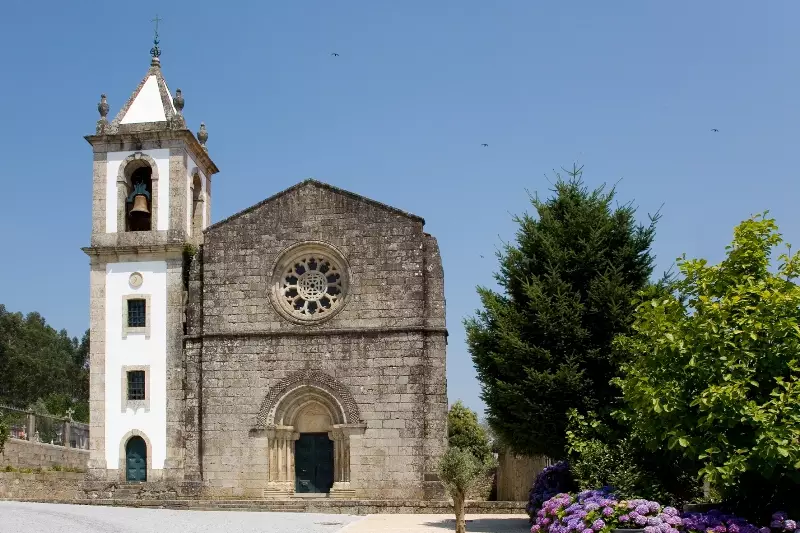 Church of Fonte Arcada→
A Theory Built on Evidence
The Portuguese theory does not rest on a single artifact or a speculative leap. It is built on a convergence of physical evidence, documented history, and geographical logic. The Order of Christ had the motive: it inherited the Templar mission and its secrets. It had the means: the most advanced naval fleet in the world, funded by centuries of accumulated wealth. And it had the opportunity: documented Portuguese expeditions to Nova Scotia spanning decades, including attempts at permanent settlement within sailing distance of Oak Island.
Stone shots from the Azores. A coin from the reign of Ferdinand I. Cannon fragments matching Portuguese manufacture. A stone road built using Portuguese techniques. Padrão-style crosses carved within miles of the island. And behind all of it, an Order that carried the Templar cross on its sails to every corner of the known world.
The question is not whether the Portuguese reached Oak Island. The question is what they did when they got there.