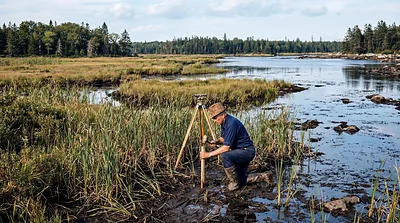
In the swamp, Rick Lagina, his nephew David Fornetti, archaeologist Miriam Amirault, and heavy equipment operator Billy Gerhardt investigate whether the stone pathway is beginning to fork in two directions near the eastern border. As they clear overburden from the uphill section, Rick discovers puddled blue clay lodged among the cobblestones, a finding that immediately draws attention. The same man-worked substance was used as a sealant deep in the Money Pit when it was first excavated to the 90-foot level in 1804, and large quantities were also found in the Eye of the Swamp, a feature geoscientist Dr. Ian Spooner dated to as early as 1680. Miriam suggests the clay may have served as a binder to hold the pathway together, while in the Money Pit it functioned as caulking to prevent soil migration. Rick acknowledges the connection is not definitive but notes that the presence of the same material in both locations raises the possibility of a link between the stone road, the Eye of the Swamp, and the original Money Pit.
At the Money Pit, Charles Barkhouse and geologist Terry Matheson drill borehole C-3, and once again the core produces wood at the now-familiar 87-foot horizon. Six consecutive boreholes have now struck wood at 86 to 87 feet, forming a consistent line that Rick regards as a preponderance of evidence for a tunnel or constructed structure at that depth. The critical questions remain unanswered: whether the tunnel leads to the Money Pit, to a previously unknown shaft, or somewhere else entirely. The team resolves to continue drilling along the line to trace its origin and destination.
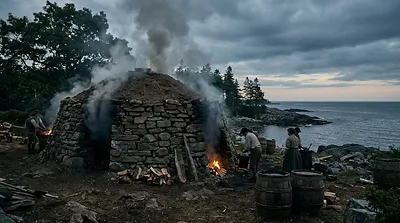
On Lot 15, David Fornetti joins metal detection expert Gary Drayton and excavator operator Michael John to investigate a mysterious mound located near the pine tar kiln discovered earlier in the season, a feature that could date as far back as the 16th century. As Michael John breaks up the hard, compacted soil, Gary recovers three heavy, hand-forged iron pieces from deep within the mound, each crude in shape and unlike anything previously found on the island. Michael John suggests they may be ship'\''s ballast, given their weight and the proximity of wharves along the island'\''s south shore. Charles Barkhouse, David Fornetti, and veteran treasure hunter Dan Henskee travel roughly 50 miles north to Centreville, Nova Scotia, to present the pieces to blacksmith expert Carmen Legge at Historic Northville Farm. Carmen determines the three objects belong to the same piece of equipment: legs from a small cannon or large signal cannon, dating to the early 1700s and English in origin. One piece retains a rounded foot designed for dragging, while another shows a bend caused not by design but by tremendous destructive force, consistent with an explosion. Charles suggests the cannon may have served an observation post monitoring ships entering the bay.
In the War Room, Craig Tester presents carbon-14 results on two wooden survey stakes Marty Lagina and Dr. Aaron Taylor recovered along the stone pathway. Sample 112 dates to 1719-1826, while Sample 113 dates to 1636-1684, nearly 150 years before the Money Pit'\''s discovery. The stakes were found within ten feet of each other, yet their dates span roughly a century, prompting the team to consider multiple occupation periods on the island. Marty proposes the road may have been built very early, then partially buried as the swamp expanded, with the upland section reused in a later era. Later that afternoon, Rick, Gary, and Dr. Ian Spooner search Lot 13 for evidence of the pathway'\''s direction and Gary detects iron embedded in a large boulder near an old apple tree. Tom Nolan, son of the late Fred Nolan, confirms it as one of the original ring bolt rocks his father located in the 1960s, noting that Fred removed the upper portion for photographs. Dr. Spooner observes the pathway appears to be angling uphill toward the Money Pit, and Tom suggests that if someone wanted to move cargo unobserved, the center of the island would be the ideal concealed location.
'