Following completion of a 6,000-square-foot extension to the massive steel cofferdam at Smith's Cove, Rick Lagina and members of the team begin excavating a mysterious square-shaped log structure that has no record among previous searchers. Billy Gerhardt operates the excavator while geologist Terry Matheson, archaeologist Laird Niven, Doug Crowell, and Jack Begley examine the emerging feature. A dense concentration of cobblestone appears on the seaward side of the structure, forming what looks like a rock wall. Terry notes the south end of the feature sits close to the north end of the wooden slipway discovered the previous year, which dendrochronology dated to as early as 1769. Laird observes the structure does not appear on any existing maps and suspects it could be Restall-era or earlier, though the fact that it lies in an area that would have been underwater makes Restall construction unlikely. When Gary Drayton and Jack search the area with a metal detector, they recover hand-hammered wrought iron cribbing spikes similar to those found along the slipway, which blacksmithing expert Carmen Legge previously suggested could be as much as 400 years old.
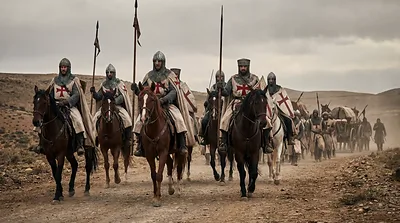
In the War Room, Rick, Marty, Craig Tester, and members of the team welcome author and researcher Corjan Mol, who has traveled to the island to present a theory connecting three paintings by 17th-century French master Nicolas Poussin to a hidden message about Oak Island. Corjan explains that Poussin's 1627 painting Shepherds of Arcadia depicts shepherds gathered around a stone tomb inscribed with the Latin phrase "et in Arcadia ego," which he argues is an anagram for the Italian "Gite neo Arcadia," meaning excursion to new Arcadia. In 1523, Italian explorer Giovanni da Verrazzano had named the Atlantic coast of North America Arcadia, a name later adapted by French cartographer Samuel de Champlain to Acadia, encompassing Nova Scotia. A companion painting, Midas Washing His Feet in the River Pactolus, references a gold-bearing river that Corjan connects to the Gold River located just north of Oak Island. The third work, a later version of the Shepherds, contains an embedded pentagram that, when superimposed on Nolan's Cross using the fifth boulder as an anchor point, places the shepherd's pointed finger directly at the swamp. Corjan tells the team he believes the Ark of the Covenant was recovered by the Templars after 1099 and ultimately brought to Oak Island.
The following day, Jack Begley and Gary Drayton continue digging inside the box-like wooden structure at Smith's Cove while Rick Lagina, surveyor Steve Guptill, and local diver Tony Sampson welcome ground-penetrating radar experts to the triangle-shaped swamp for a new survey. At the Money Pit area, the team drills exploratory boreholes in search of the historic Shaft Two, the oldest known searcher excavation on the island and the one closest to the original Money Pit. At a depth of 19 to 29 feet, the drill brings up substantial timbers with cut ends and what appears to be a box joint, indicating a corner of a structure. A second and then a third drill point produce more wood, giving the team evidence of two distinct walls. If the structure is confirmed as Shaft Two, the connecting tunnel at 110 feet could point directly to the Money Pit, just 14 feet away.
One week later, Rick, Marty, and the team gather in the War Room to hear dendrochronology results from Dr. Colin Laroque. Wood recovered from the Money Pit area at a depth of 98.5 to 103.5 feet returns a date of 1796, fitting squarely with the known construction of Shaft Two in 1805. The result effectively confirms the team has located Shaft Two. Craig notes that nothing else on the island dates anywhere near that old except the Money Pit itself, and the team calculates that the original treasure shaft must lie within a 20-foot radius. Marty sums up the significance: "The Money Pit may no longer be lost."