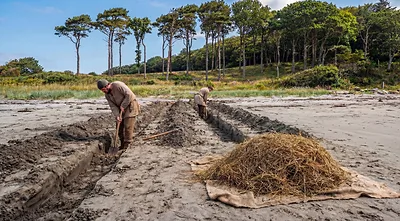
With the 525-foot steel cofferdam now complete, Rick and Marty Lagina begin the massive excavation of Smith's Cove, a nearly 12,000-square-foot area that has never been fully explored. A large wash plant has been installed to process the enormous volume of spoils, funneling excavated earth through industrial grizzly bars and shaker decks that separate material by size while spray nozzles wash away soil. Among the early finds, Gary Drayton spots pottery fragments on the shaker deck, and the team prepares to dig toward the location where old photographs indicate the U-shaped structure should lie. At the research center, archaeologist Laird Niven examines the suspected 90 Foot Stone found the previous week in the basement of the former Creighton and Marshall bookbindery in Halifax. He suggests lidar scanning to reveal surface details invisible to the naked eye.
Doug Crowell, Jack Begley, and Paul Troutman host Rob Hyslop and Ryan Levangie of Azimuth Consulting Limited at the research center to conduct a three-dimensional laser scan of the suspected 90 Foot Stone. Using a Trimble CX scanner capable of collecting 40.5 million data points, they create a detailed 3-D model of the artifact for later digital enhancement. Meanwhile, at the Money Pit, Rick, Dave Blankenship, Charles Barkhouse, Doug, and the Choice Drilling crew continue their search for Shaft Six, the 1861 searcher tunnel. A core sample from the K-series borehole initially shows no wood at 118 feet, disappointing the team. However, geologist Terry Matheson then identifies a piece of wood at the edge of the sample, which he interprets as having clipped the western boundary of the tunnel. Combined with two earlier data points, this provides the third confirmation that Shaft Six has been located.
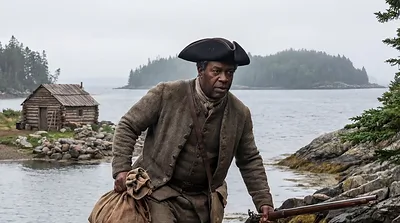
On Lot 24, Marty and Laird Niven set up an archaeological grid to investigate a stone formation discovered the previous week by Alex Lagina, Peter Fornetti, and Gary Drayton. Laird recovers the base of a pot dating to approximately 1750 to 1840 and suspects the site may be connected to Samuel Ball, the former slave who fought for the British during the American Revolution, settled on Oak Island in 1786, and became one of Nova Scotia's wealthiest men by the time of his death in 1846. The larger stones suggest the formation could be a previously unknown cellar.
Back at Smith's Cove, Gary Drayton recovers a hand-forged spike from the spoils that he dates to the 1700s based on its unique beveled design. Shortly after, his metal detector registers a non-ferrous signal in a spoil pile. Rick, Marty, and Gary extract a heavily encrusted object with visible gold coloring around its edges. At the Oak Island Research Center, Paul Troutman examines it under a Grobet digital microscope at up to 2,000 times magnification, revealing what appears to be gold beneath the encrustation. Gary notes the absence of a milled edge, a feature introduced by Sir Isaac Newton at the Royal Mint to combat coin clipping, which suggests the object may predate the discovery of the Money Pit in 1795.
The episode culminates with the team uncovering the U-shaped structure at Smith's Cove for the first time since Dan Blankenship found it in 1971. Billy Gerhardt carefully exposes massive beams while Rick, Craig Tester, Jack, and Charles clean them by hand. They discover the Roman numeral VII carved into an upright, a marking never previously recorded. Further excavation reveals the numerals III and IV on additional posts, matching Blankenship's original findings. The beams are joined with wooden pegs rather than metal fasteners, and Marty marvels at the preservation of pen-knife-style engravings that could be several hundred years old. The team agrees to dig inside the structure, where they expect to find evidence of the legendary stone box drains.