With only two weeks remaining before winter forces the team off the island, the Money Pit excavation at the Site Three borehole has ground to a halt after the provincial union of crane operators goes on strike. The walkout could last anywhere from one to 21 days, leaving Rick Lagina, Craig Tester, and Marty Lagina, who joins by video from the War Room, to decide how to use whatever time remains. Craig suggests finishing Smith's Cove and calling it a season, but Rick pushes back, unwilling to leave without exhausting every option. The three ultimately agree to complete the Smith's Cove work and, in a move Rick has long championed, launch a seismic survey of the triangle-shaped swamp. Rick confirms permits are already in place and Eagle Canada out of Calgary, who earlier this season conducted a successful geophysical survey of the Money Pit area using more than 1,500 explosive charges, are ready to begin.
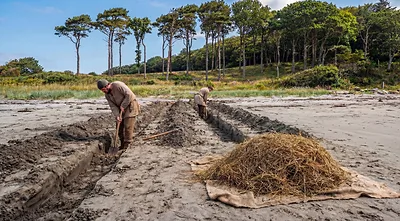
At Smith's Cove, the team continues digging beneath the beach area in search of the point where the five stone box drains, first discovered in 1850, converge into a single flood tunnel leading to the Money Pit. Another wooden structure emerges with placed stones above it. Rick, Terry Matheson, archaeologist Laird Niven, Gary Drayton, Billy Gerhardt, and Jack Begley work to expose the feature, eventually revealing four sides, slat-like pickets around the perimeter, and a well-entrenched construction that Gary calls another shaft. The structure has no known historical record, and Laird notes it does not appear on any existing maps. The discovery of a picket-fence arrangement around a buried shaft at Smith's Cove is unlike anything the team has encountered.
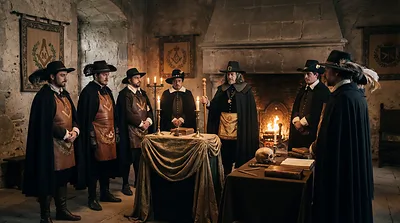
In the War Room, Oak Island theorist Chris Donah presents a celestial mapping theory connecting constellations to landmarks on the island. Drawing on the Royal Arch of Freemasonry and its association with Leo, Libra, and Aries, Donah argues that the constellation Virgo overlays the triangle-shaped swamp, with the star Spica aligning precisely with the southeast corner. He suggests this corner marks a back door leading to the original Money Pit treasure vault. Paul Troutman and Doug Crowell engage with the theory, and Rick recalls that five years earlier he, Charles Barkhouse, and metal detection expert Steve Zazulyk identified a strong nonferrous signal at that same southeast location, indicating possible gold or silver. When professional diver Tony Sampson investigated, the signal vanished, but a mysterious line of flat rocks was found on the mucky bottom, possibly evidence of a buried passageway.
Representatives from Eagle Canada return to begin preparations for the swamp seismic survey, meeting with Rick, Dave Blankenship, and Charles Barkhouse to assess conditions and plan plywood walkways across the terrain. The episode culminates in the War Room with Dr. Colin Laroque of the University of Saskatchewan presenting dendrochronology results via Skype. Sample seven, taken from the north arm of the slipway at Smith's Cove, is identified as red spruce and dated to 1771. Samples eight and nine, both from the U-shaped structure, are also red spruce and return a date of 1769. Laroque calibrates his findings against a 550-year-old reference tree still growing in the region and reports 99.999 percent confidence in the results. Both structures predate the discovery of the Money Pit in 1795 by more than two decades, prompting Marty to call the findings "conclusive proof that not everything we're finding is searcher" and "the biggest thing that's happened since we started this quest."