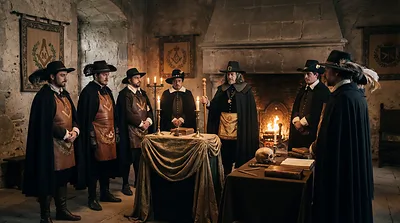
In Season 2, Rick, Marty, and Alex Lagina visited Rosslyn Chapel with Dave Blankenship, Charles Barkhouse, and researchers Kathleen McGowan and Alan Butler. The chapel's carved botanical motifs, particularly the corn or maize, supported the theory that Prince Henry Sinclair reached Nova Scotia in 1398 and that the Sinclair family possessed…
Built by William Sinclair between 1446-1484. Extraordinarily dense with carved symbolism, including what many identify as pre-Columbian corn or maize, suggesting the Sinclair family had knowledge of North America nearly a century before Columbus.
About This Site
Rosslyn Chapel is a 15th-century chapel in the village of Roslin, Midlothian, Scotland, designed by William Sinclair and built by Freemasons between approximately 1446 and 1484. The chapel is renowned for the extraordinary density and complexity of its carved stone decoration, which includes Biblical scenes, Green Men, geometric patterns, and botanical motifs that have fascinated researchers for centuries. Among the most debated carvings are what many scholars identify as depictions of corn or maize, a grain native to North America that would not have been known in Scotland before the European discovery of the New World. If the identification is correct, it suggests the Sinclair family had knowledge of North American plants decades before Columbus crossed the Atlantic.
William Sinclair's grandfather, Prince Henry Sinclair, is a central figure in theories connecting Scotland to pre-Columbian Atlantic voyages. Historical accounts suggest that Henry Sinclair sailed to Nova Scotia in 1398, accompanied by Venetian navigators Antonio and Nicolo Zeno, nearly a century before Columbus. The Mi'kmaq people of Nova Scotia are said to have encountered Henry Sinclair and regarded him as a figure named Glooscap who taught them new methods of fishing and navigation. The ceremonial flag of the Mi'kmaq bears a striking resemblance to the Templar battle flag of Henry Sinclair.
Connection to Oak Island
In Season 2, Rick, Marty, and Alex Lagina visited Rosslyn Chapel with Dave Blankenship, Charles Barkhouse, and researchers Kathleen McGowan and Alan Butler. The chapel's carved botanical motifs, particularly the corn or maize, supported the theory that Prince Henry Sinclair reached Nova Scotia in 1398 and that the Sinclair family possessed knowledge of the New World passed down through generations.
Alan Butler presented a theory connecting Rosslyn Chapel directly to Oak Island through measurement. The distance between Rosslyn Chapel and Rosslyn Castle is 366 megalithic yards, equivalent to 996 feet. Butler argued that the Templars used this same measurement system on Oak Island, constructing a new Jerusalem based on the Enochian model, with a hidden chamber located 366 megalithic yards from the Money Pit at a fixed compass point due west, a location that falls squarely in the swamp. The measurement theory provided a mathematical link between the Scottish Templar tradition and the physical layout of Oak Island, and pointed once again to the swamp as a location of central importance.
Fieldwork Notes
Visited during Season 2 by Rick Lagina, Marty Lagina, Alex Lagina, Dave Blankenship, and Charles Barkhouse with Kathleen McGowan and Alan Butler. The team examined the pre-Columbian botanical carvings and discussed Alan Butler's 366-megalithic-yard measurement theory linking the chapel to a location in the Oak Island swamp due west of the Money Pit.