Rick Lagina, Dan and Dave Blankenship, and Divemaster Tony Sampson scout the island's coastline for potential flood tunnel exit points in preparation for a major dye test. Dan recalls that in the winter of 1980, while overseeing a pumping operation in the Money Pit, he noticed four large circular holes in the frozen bay off the island's south shore where air bubbles were rising through 12 to 13 feet of water. The holes reappeared in 1987. A dye test Dan conducted in 1988, recreating Frederick Blair's 1898 experiment, showed dye emerging at Smith's Cove, the south shore, and a third location north of Fred Nolan's property. The team positions spotters in boats, stations observers on the shore, and charters a helicopter from Halifax for aerial surveillance.
Rick pumps over 300 gallons of water per minute into Borehole 10-X mixed with a non-toxic bright green dye capable of coloring 120,000 gallons per pound. The goal is to force the dye through the flood tunnel system and identify the exact points where seawater penetrates the island, so the team can seal them and excavate the Money Pit down to the Chappell vault. After hours of monitoring from the air, boats, and shore, the team sees nothing. The dye test produces no visible results at any of the expected exit points. Rick compares the outcome to Edison's famous remark about finding hundreds of things that don't work, and the team shifts its focus to sending a diver down Borehole 10-X.
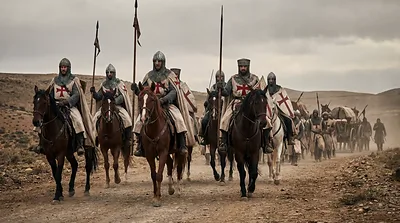
While the dye test takes place on Oak Island, Marty and Alex Lagina travel to southern France with author and researcher Kathleen McGowan. Their first stop is Montsegur, the mountaintop fortress where the Cathars, a sect of early Christians who claimed origins dating to the time of Jesus, made their last stand. In 1244, Pope Innocent IV authorized a massacre that left roughly 500 Cathars trapped inside the fortress. Nearly 200 of the most devout monks negotiated a two-week truce, during which four men escaped by lowering the Cathar treasure down the mountain on a pulley system into the hands of waiting Knights Templar. McGowan believes the sacred objects, which she identifies as the Ark of the Covenant and the Holy Grail, were then moved through Templar territory and eventually transported to Oak Island.
The group visits Rennes-le-Chateau, a village McGowan describes as the most enigmatic and mysterious place in France, and meets Tobi, a modern-day Knight Templar and Templar historian, at a house bearing an iron Templar cross above the door. Tobi confirms that treasure existed, that it was never found, and that the Templars were persecuted by King Philip IV of France, who on Friday, October 13, 1307, ordered their arrest and burned many at the stake. When asked about Oak Island, Tobi points to the carved stone found at the center of Nolan's Cross, describing what has been identified as a sword on its surface as a possible Templar tomb marker. At the old baths of Alet-les-Bains, Tobi shows the group a carving depicting a Templar cross with a flash descending through angel wings into a handshake, a symbol he explains represents the transfer of Templar knowledge into Freemasonry.
In an early-morning War Room conference call connecting Oak Island to France, Rick reports the dye test failure. Marty, energized by what he has seen in France, pushes to extend the research trip to Scotland, where McGowan claims the treasure trail continues after the Templars fled French persecution and took refuge. The connections between the Knights Templar, the Rosicrucians, and Scottish Rite Freemasonry are noted as potentially critical to understanding Oak Island. Rick agrees to join Marty and Alex in Scotland, and the team commits to pursuing both the European research trail and a diver descent into 10-X as their next steps.