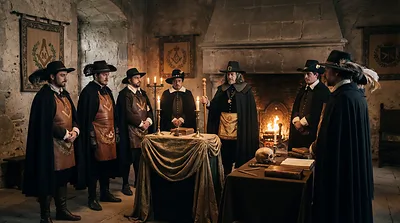
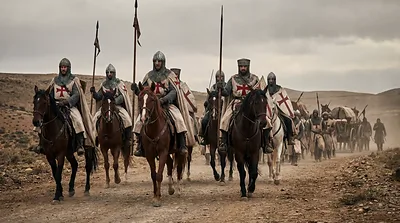
Saltwater is flooding the Garden Shaft tunnel at a rate of 479 gallons per minute. Roger Fortin tells Rick and Scott they need to consult everyone involved before deciding on next steps. Rick, Craig, and Doug connect by video conference with Corjan Mol and Emiliano Sacchetti to begin planning a European research trip aimed at answering the "who" and "when" behind the Oak Island mystery. Professor Gaspani's dating work has provided a starting point around 1200 A.D. Emiliano will search for religious sites with stellar and solar alignments comparable to Nolan's Cross, while Corjan reports finding two promising locations in the Netherlands: a stone quarry system with 40-foot-high tunnels and hundreds of 14th-century charcoal drawings, and a castle catacomb with a 30-meter wall of Templar inscriptions featuring symbols he recognizes from his Oak Island research. Emiliano has identified Morimondo Abbey near Milan, a Cistercian foundation established in 1134 that produced over 100 manuscripts, including astronomical texts, by the end of the 12th century. Marty notes that the Cistercians, founded in 1098 as an order of Catholic monks and nuns who built megalithic abbeys and made advances in science, astronomy, agriculture, and hydraulic engineering, are considered the link between the Templars and modern Freemasonry, with Bernard of Clairvaux among their leaders having helped establish the Knights Templar. Emiliano adds that Professor Gaspani has new information about additional alignments, and the team agrees they need to travel to Italy and the Netherlands.
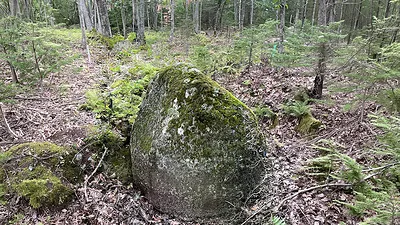
In the northern swamp, Marty and Dr. Spooner examine a boulder found at the location John Edwards identified as Tiferet, where Jack, Gary, and Billy had earlier discovered a large stone sitting atop a formation. When Billy rolls the boulder, Spooner finds a stick trapped between it and the sediment, evidence that the stone was moved, along with a piece of cut wood he will send for carbon dating. Deeper excavation by Craig, Jack, Gary, and Billy reveals chopped timbers, tree stumps, and a rock-lined depression that Jack believes was shaped by human hands. Rick, Craig, and Laird arrive to inspect and Rick points out deliberate one-over-two and two-over-one stone construction. He also notices a stake similar to those Fred Nolan found and dated to the 1500s, which Nolan believed were survey markers used in creating the swamp. Steve's elevation readings place the base of the feature at the same level as the paved area: one foot below sea level. Dr. Spooner confirms the feature is manmade.
Cameron Carter and the Dumas team join a video conference to discuss Garden Shaft options. The 60-horsepower pump can keep water levels manageable, but continuous pumping of water mixed with sand and silt could destabilize the shaft at the 106-foot level. Jec proposes an alternative: holding the water back at the 40-to-50-foot mark and drilling from that elevation, which could still allow the team to reach the offset chamber.
In Halifax, Rick and Doug meet Eric Wroclawski, son of the late Oak Island researcher Paul Wroclawski, who passed away in 2014. In the 1990s Paul had established a relationship with Dan Blankenship and began researching the island's earliest inhabitants. Eric shows them an artifact given to his father by Robert Dunfield Jr., though its exact provenance on the island remains unknown. Doug identifies it as a crossbow bolt, one of three found on the island, with the other two now lost. The crossbow was documented as early as 500 B.C. but revolutionized warfare 1,500 years later in Europe and the Holy Land during the Crusades. The group agrees the artifact should be tested.