Rick and Scott meet with Paul Cote to outline priorities for the probe-drilling program at the bottom of the Garden Shaft: drill the tunnel, report anything unusual, and collect samples every ten feet with distances and elevations for carbon dating. Later that week, water suddenly floods the shaft while Scott is on site. The Dumas crew evacuates safely at the 97-foot mark. Roger tells Rick the water is still flowing, and a sample is collected for salinity testing. Rick tastes the water and confirms to Marty over the phone that it is salty, a sign the legendary flood tunnel system may have been breached. Pumping and further testing are scheduled for the following day.
In the swamp, Jack, Gary, and Billy continue exploring the wooden structure found near the southeast corner. The artifacts recovered so far suggest this area was in use before the discovery of the Money Pit. As Billy excavates, he exposes a layer of rocks that appears to be a stone road running over the swamp. Jack wonders if it was buried deliberately and whether it could be the path visible in a 1930s aerial photograph of the Money Pit area that was later destroyed by searcher activity in the 1960s. In the lab, Carmen Legge examines artifacts from the same area. He immediately identifies the metal tool as a backing bolt, the piece that locks into the yoke apparatus connecting a pair of oxen to their load, and dates it French from the early 1600s to 1760. Emma's analysis of the iron spike reveals manganese levels too high to be modern but distributed inconsistently through the metal, a pattern she attributes to Swedish iron, which carried natural manganese content. Carmen identifies the spike as a wharf pin.
On Lot 5, the archaeology team reaches floor level in the stone foundation. Moya discovers blue clay, which Helen calls unusual for an area that normally yields sandy silt subsoil. Jack notes that the Onslow Company found blue clay at a depth of 40 feet in the Money Pit, where it was thought to serve as a sealant against water intrusion. Samples are bagged for comparison. In the War Room, John Edwards returns with measurements he and Steve took of Nolan's Cross to extend the formation into a larger pattern known as the Tree of Life. He explains the importance of the number 72: the Latin Rule of 72, written by Bernard de Clairvaux and Hugues de Payens, contained 72 clauses governing the behavior of the Knights Templar. Using this rule, John calculates the positions of five anchor stones and tells the team that if the Ark of the Covenant is buried on Oak Island, it would be at one of three points on the Tree of Life: the Yesod, the Da'ath, or the Tiferet. Tom suggests they dig those locations.
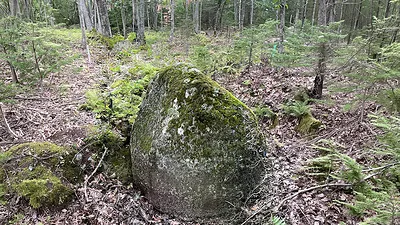
At the Tiferet site near the northern swamp, Jack, Gary, and Billy begin excavating and find the area extremely rocky. A boulder resting above C horizon rather than on it suggests deliberate placement as a marker. The team calls in Rick, Marty, and Dr. Spooner for evaluation. Separately, the War Room examines a copper artifact from Lot 8 that Dr. Edwin Barnhart previously suggested could be Viking. A conservator in Canada has unfolded the piece, which Laird identifies as a decorative element made by pressblech, a metalworking technique dating to the 5th century and used by the Norse, Anglo-Saxons, and western European cultures. Doug spots a ribbon-and-circle motif on the piece that matches symbols in an Icelandic manuscript and a Viking rune. He then presents a quadrant from an astrolabe found in southern France and dated 1291 to 1310 that contains both symbols together, connecting navigation, Norse culture, and the Templar era. Doug has sent images of the piece to Professor Gaspani for evaluation.