About This Artifact
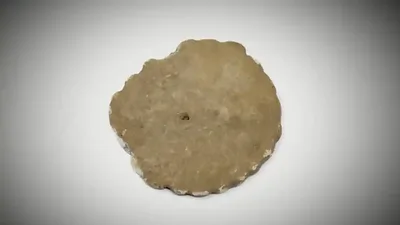
A long, narrow piece of lead with a slight curve, discovered alongside a smaller fragment that fits together as part of a larger object. Both ends feature square-shaped terminals reminiscent of the square hole on the Smith's Cove lead cross. The surface bears a raised floral pattern identified by geochemist Tobias Skowronek of the German Mining Museum as evidence of cloisonné - a medieval metalwork technique in which artists soldered strips of metal onto an object's surface, then filled the compartments with colored glass or gemstones. Skowronek's chemical analysis revealed that the lead isotope data from this artifact is identical to that of the lead cross found at Smith's Cove, meaning both objects originated from the same ore deposit in France and date to before the 15th century. The two pieces were found on opposite sides of the island - this fragment on Lot 21 in the west and the cross at Smith's Cove in the east - yet share the same pre-1400s provenance.
Significance is High - the second piece of lead confirmed to match the Smith's Cove lead cross isotopically, establishing that pre-15th-century European material was distributed across multiple locations on Oak Island, not concentrated in a single deposit site.
Historical Context
The Curse of Oak Island, Season 6, Episode 18, "Heavy Metal" (History Channel). Analysis by Tobias Skowronek, German Mining Museum.
Where It Was Found
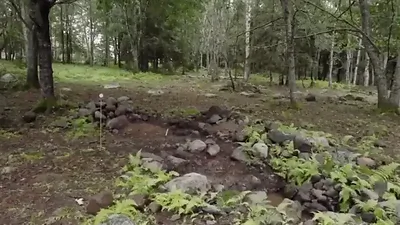
Found in a clearing, opposite the McGinnis family foundation. Location: Oak Island, Nova Scotia, Canada.